
Flywheel Weight by Part Number: 11 kg to 71 kg
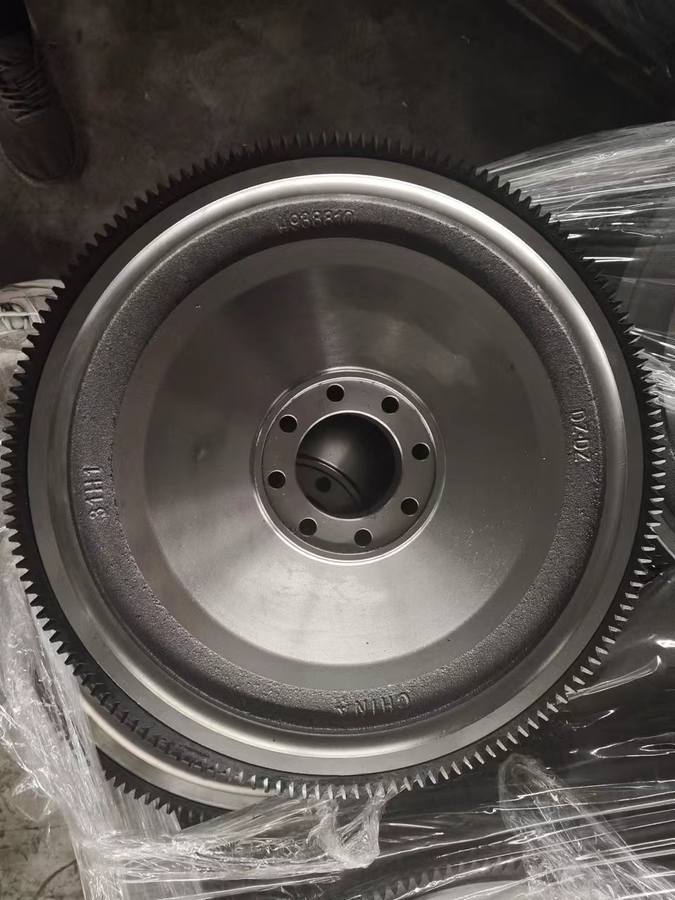
A flywheel quote carries two numbers. One is the price per piece. The other is the net weight. Buyers check the first and skim the second. Then the freight quote arrives and the two numbers stop agreeing.
This page opens our own production weight record. It holds 226 flywheel rows, from an 11 kg industrial unit to a 70.9 kg truck flywheel. We also photographed two parts on the workshop scale, so you can see how close the file sits to the real casting.
Every number below comes from that file or from the scale display. Where the file disagrees with itself, we print both figures instead of picking one.
Table of Contents
- Two Scale Photos That Match the Record
- The Weight Bands in Our Record
- Bare Flywheel and Complete Assembly
- When One Number Comes in Two Weights
- What One Kilogram Means in Iron
- Checking Weight at Incoming Inspection
- Frequently Asked Questions
- Send the Number and the Reading
Two Scale Photos That Match the Record
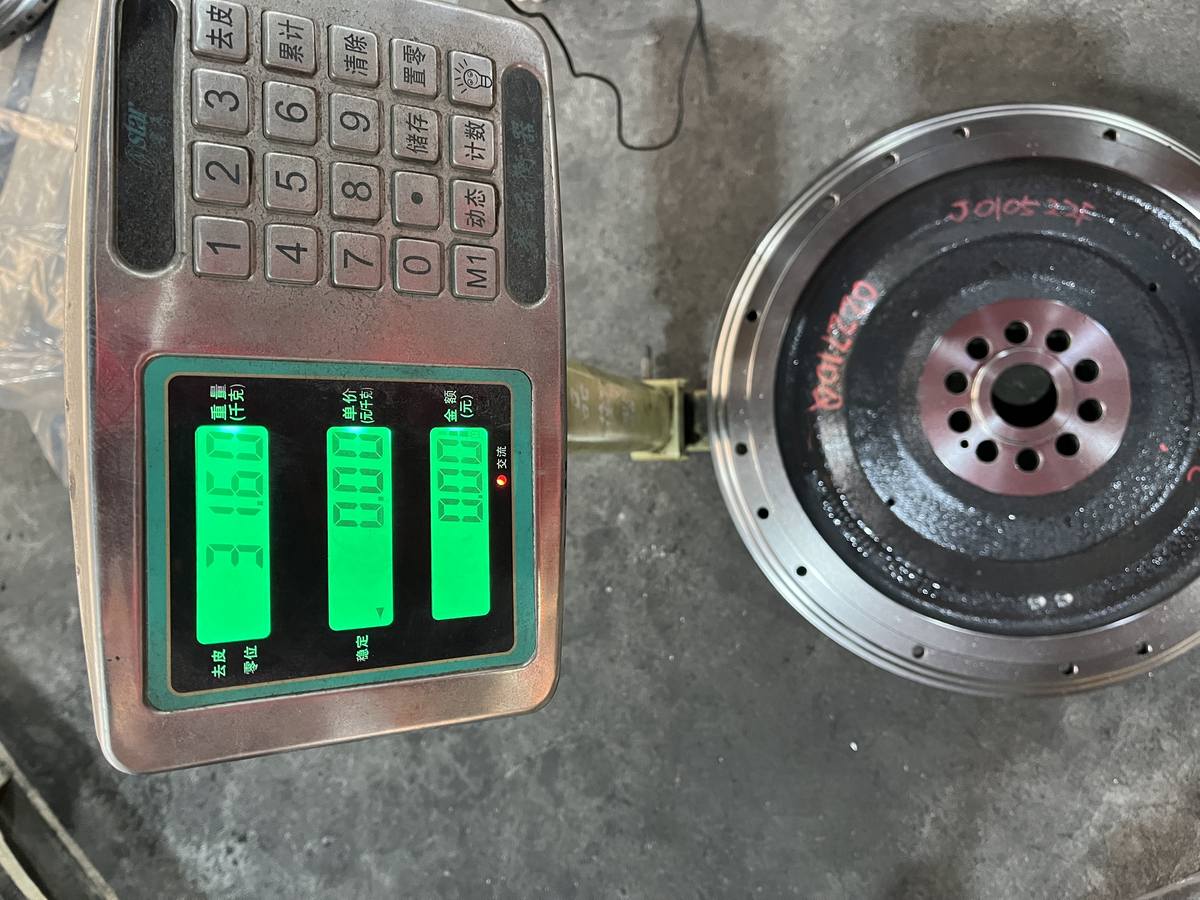
The first photo is a six-cylinder flywheel on the packing bench scale. The display reads 31.608 kg. Our record for the same part, 1001320868, says 31.6 kg.
That is a difference of eight grams on a 31 kg casting, or 0.03 percent. The scale is an ordinary bench unit, not a laboratory balance. It is the one we use when a customer asks what a part weighs, and it agrees with the file.
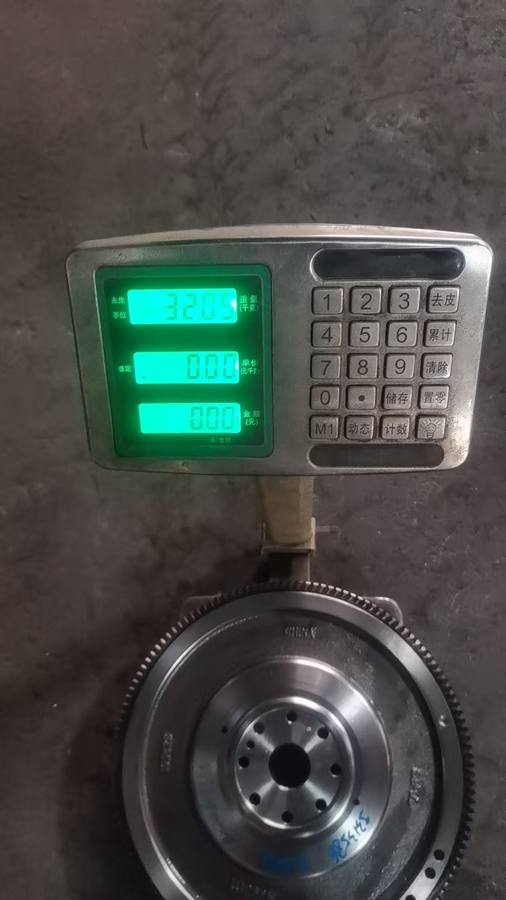
The 32.05 kg Reading
The second photo is a different flywheel. The display reads 32.05 kg. The record for 5313586 says 32.05 kg. Here the two agree exactly, to the last digit the scale shows.
Look at the part itself. The friction face is turned flat, the ring gear is fitted to the rim, and the hub carries eight bolt holes. Nothing about it looks heavy or light. That is the whole problem with weight. It cannot be judged from a photo. It has to be measured, or looked up in a file that was measured.
Why This Matters to a Buyer
Two things follow from those two photos.
The first is that a net weight on our quotation is not an estimate typed by a salesperson. It comes from a record that a scale check can reproduce.
The second is that weight becomes a usable inspection point. If a crate arrives and the parts are 3 kg lighter than the figure on the packing list, something in the scope changed. That is worth finding before the parts go on an engine.
The Weight Bands in Our Record
The sheet is not sorted by brand or by engine family. It is sorted by whatever the workshop weighed that week. Sorted by mass instead, the rows fall into four groups.
| Band | What sits there | Examples from the record | Net weight |
|---|---|---|---|
| Under 23 kg | Four-cylinder and small industrial flywheels | NPR/F28 16 kg, 0J1-8H 19 kg, 4HK1/WF-C 22 kg | 11 to 22 kg |
| 23 to 33 kg | Mid-size six-cylinder and light truck | 6HK1/WF-A 25 kg, 6D16T/WF-52 26 kg, 6BG1/F10 31.5 kg | 23 to 33 kg |
| 34 to 45 kg | Heavy truck six-cylinder | GE13 39 kg, 6D22 39.25 kg, E13C 40 kg, 4933490 45 kg | 33 to 45 kg |
| Over 45 kg | Large displacement and export truck | 12311-96179 48.7 kg, DAF1314029 52 kg | 45 to 70.9 kg |
The counts are 40 rows under 23 kg, 83 rows between 23 and 33 kg, 92 rows between 34 and 45 kg, and 11 rows over 45 kg. The median row is 33.15 kg.
Three rows in four sit between 23 and 45 kg. If you are quoting a truck flywheel and your supplier says 18 kg, one of you is talking about a different part.
Under 23 kg
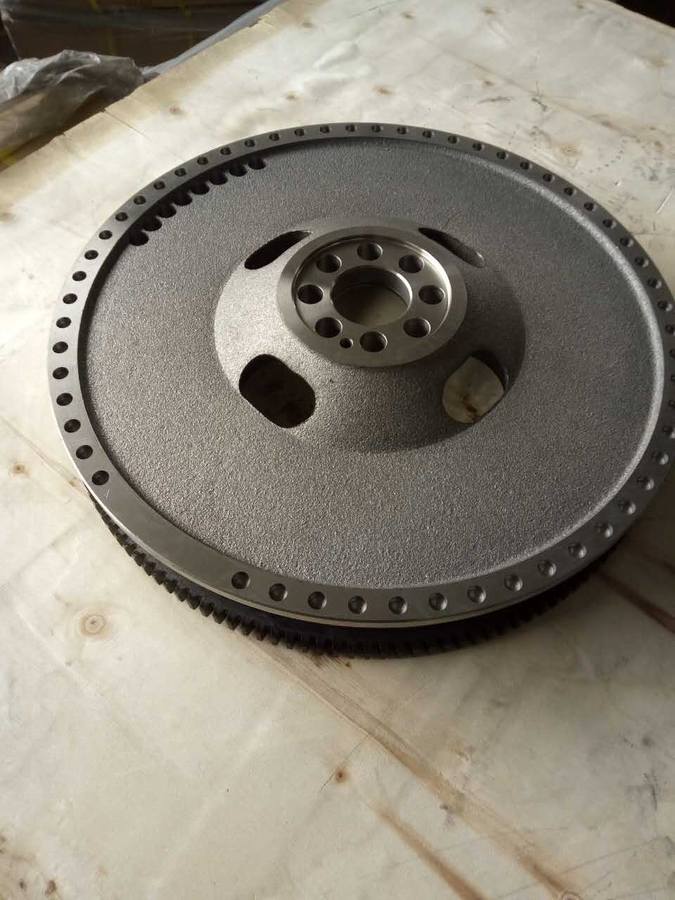
Small flywheels are not scaled-down truck flywheels. The Isuzu 4HK1 unit below has two large windows cast straight through the disc. Those windows remove mass near the hub, where it contributes almost nothing to inertia, and leave the rim alone.
The result is a light part that still carries a full ring gear. On a four-cylinder industrial engine that trade is worth making, because the engine has less torque to recover from and the starter has an easier job.
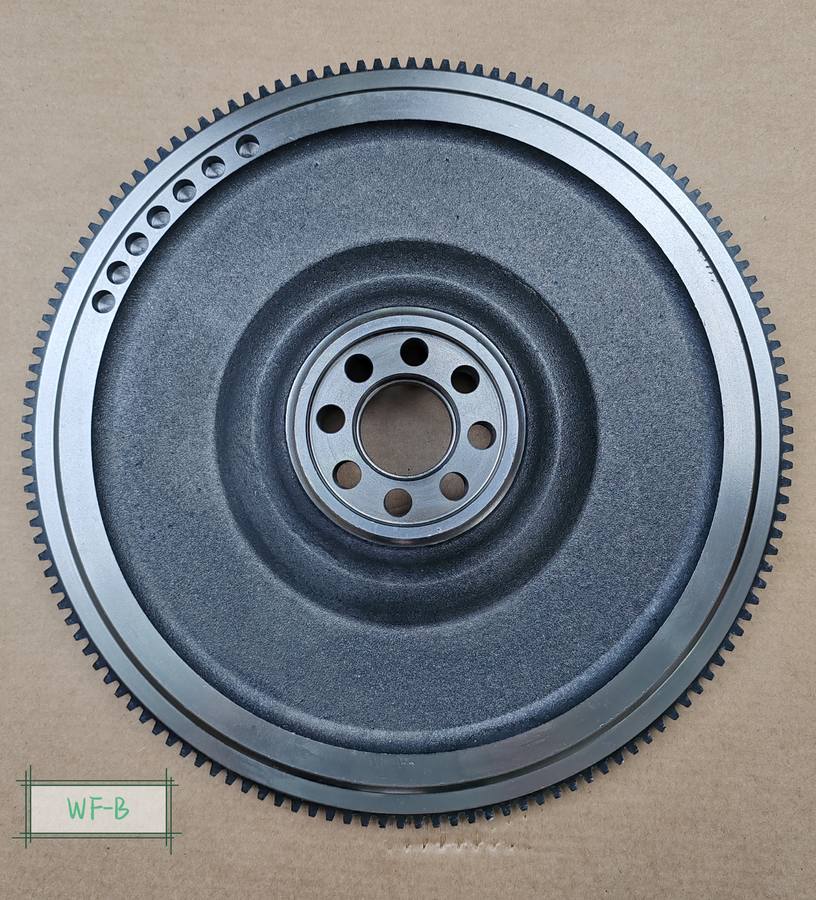
The second photo is the same idea in cast iron. This flywheel has no windows, but it does carry a short row of balance holes drilled near the rim, and a fully cast face apart from the friction ring. It is logged at 19 kg.
The Middle Band
Most of the record sits here. This is the working range for six-cylinder truck and bus engines, and it is where the weight differences that matter to a buyer live.
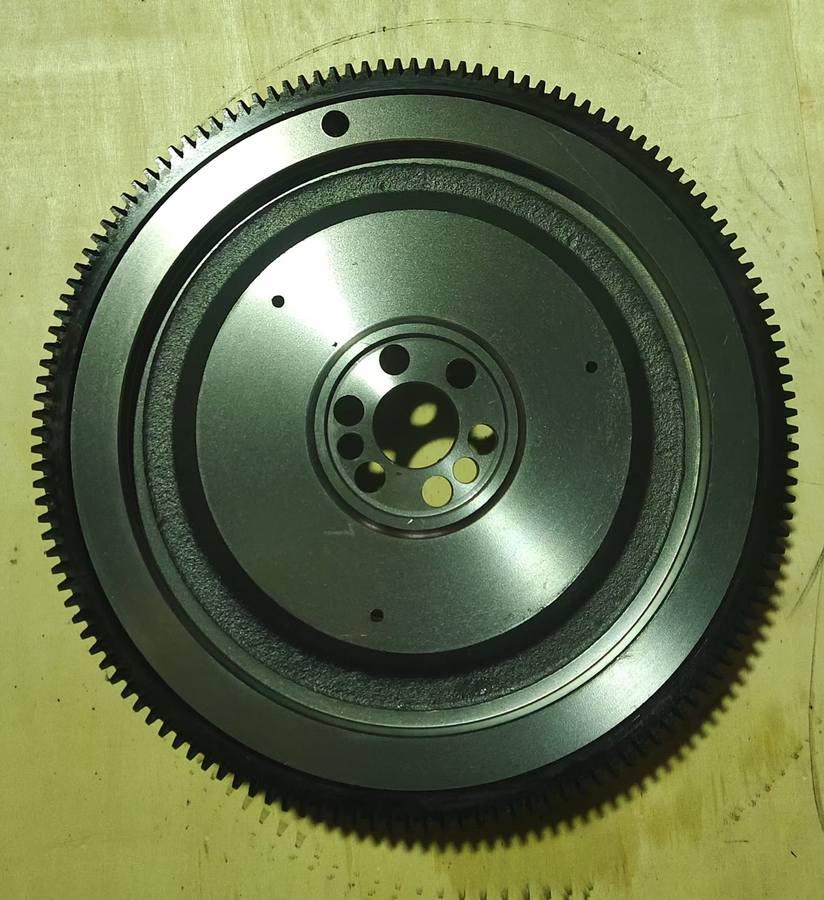
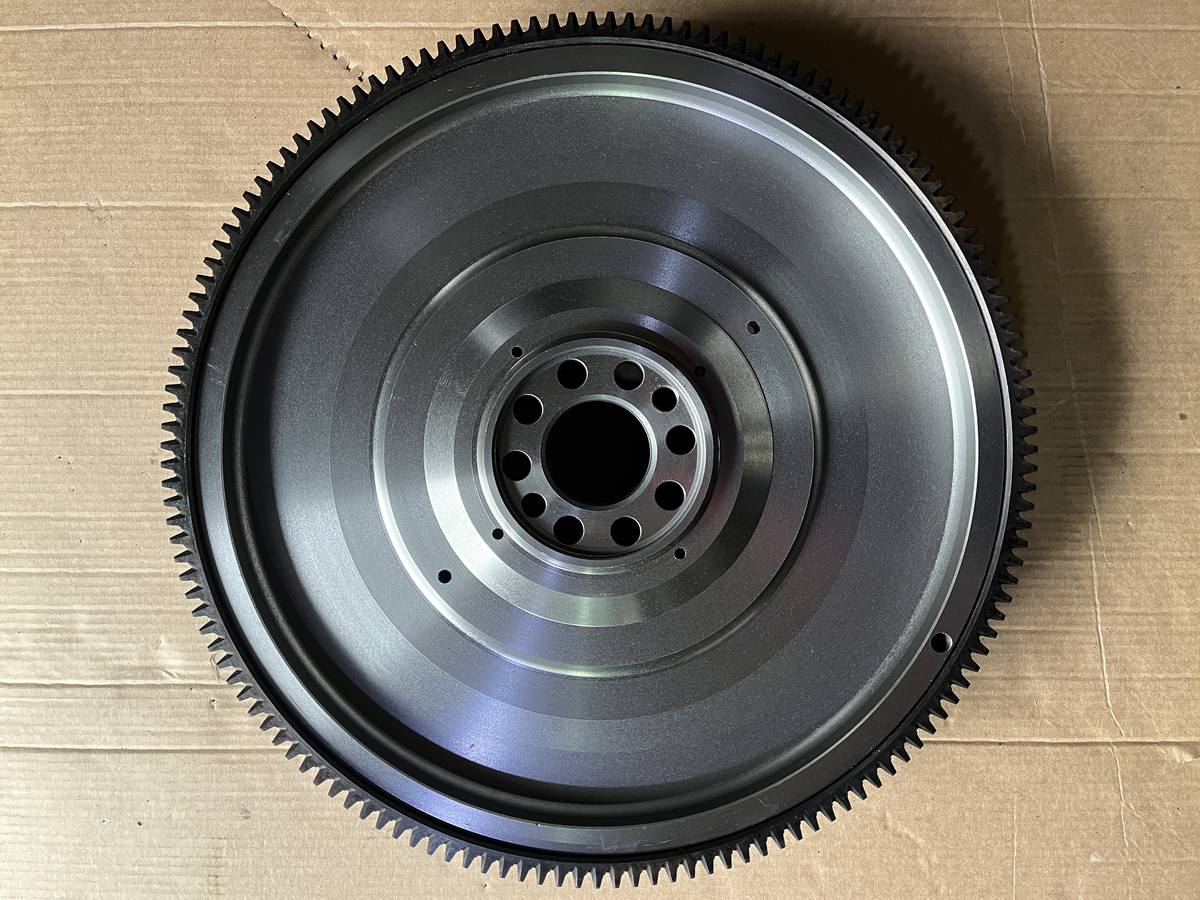
Start with the light end of the band. The 6D16 part has a flat turned disc and a shallow dish. The 6D22 part beside it has a deeper dish and a heavier web behind the friction face. Both take the same kind of clutch. One is logged at 26 kg and the other at 39.25 kg.
Where the Difference Comes From
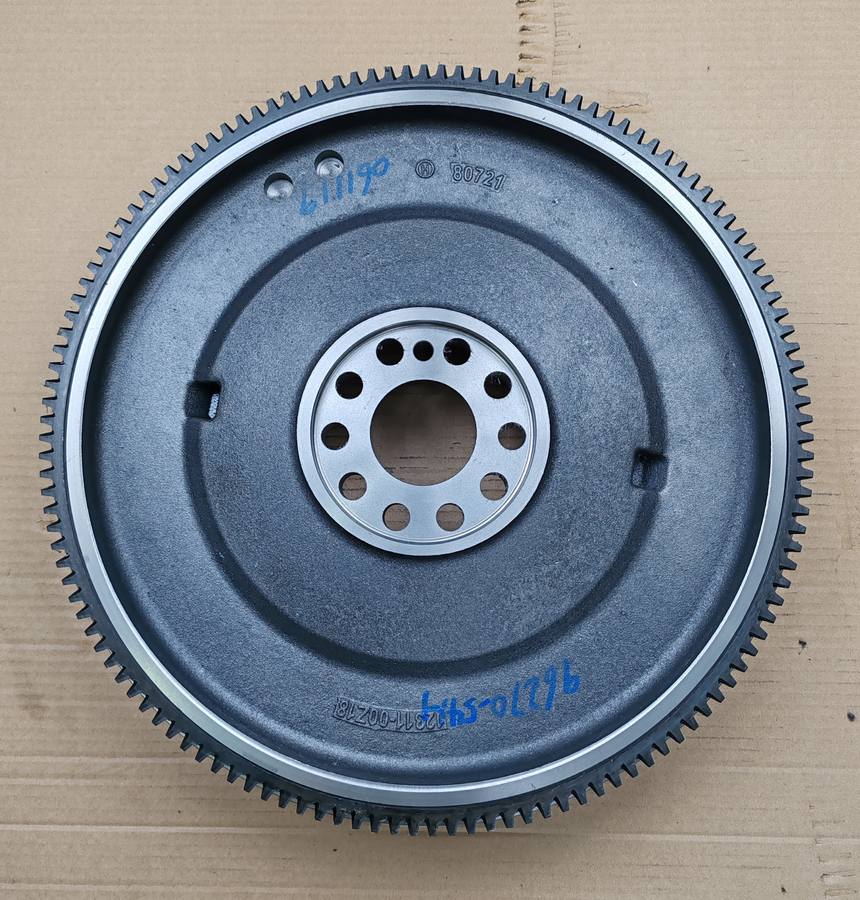
The two Japanese parts below sit one kilogram apart on the scale, 39 kg against 40 kg, yet they are built for different engines.
The GE13 flywheel has a narrow hub boss and a thin web, and its cast number 12311-00Z18 sits on the lower edge of the disc. The E13C flywheel has a wider friction ring and a thicker section behind it. Neither difference is visible until you put them side by side.
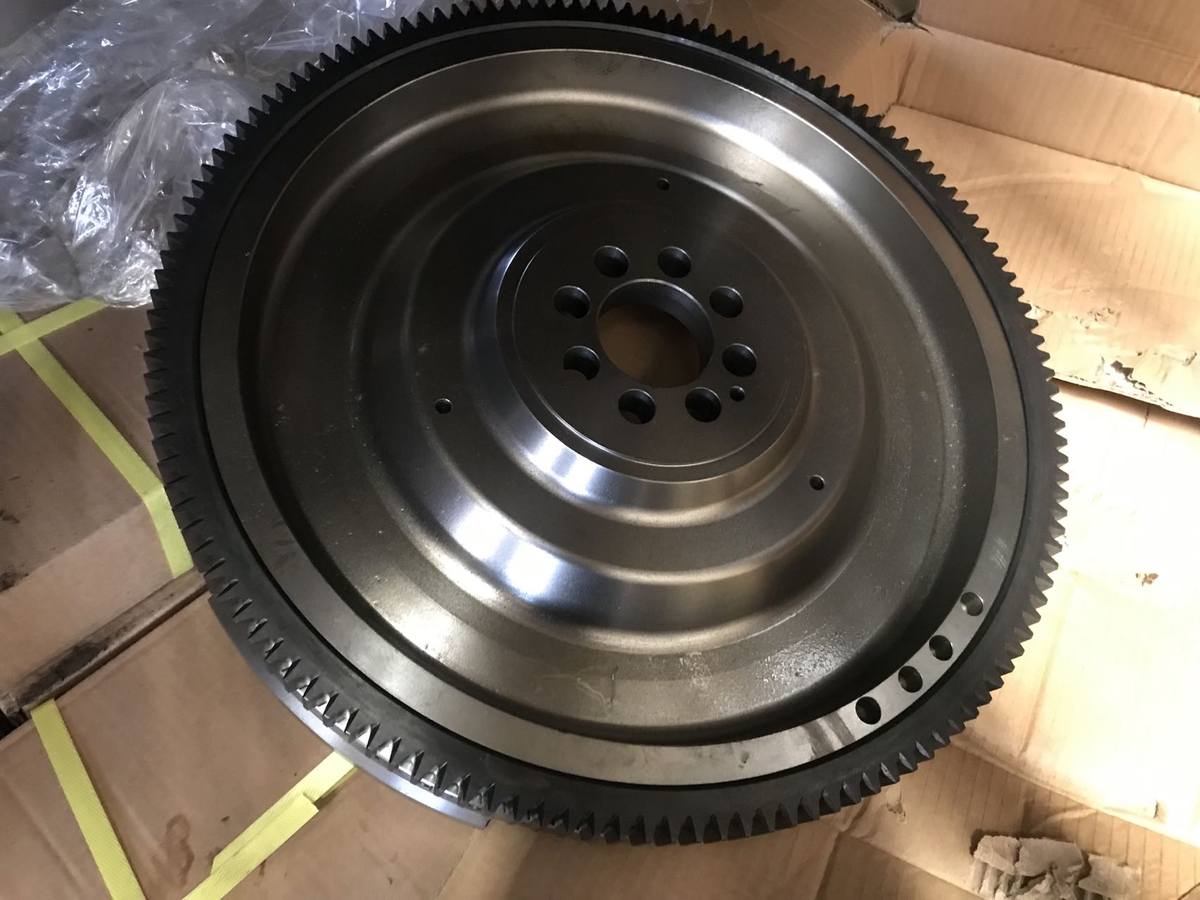
The heaviest part in this band is a Cummins unit at 45 kg, with a 158-tooth ring gear and a fully cast back face. It is the point where a flywheel stops being a single-person lift in a workshop.
Above 45 kg
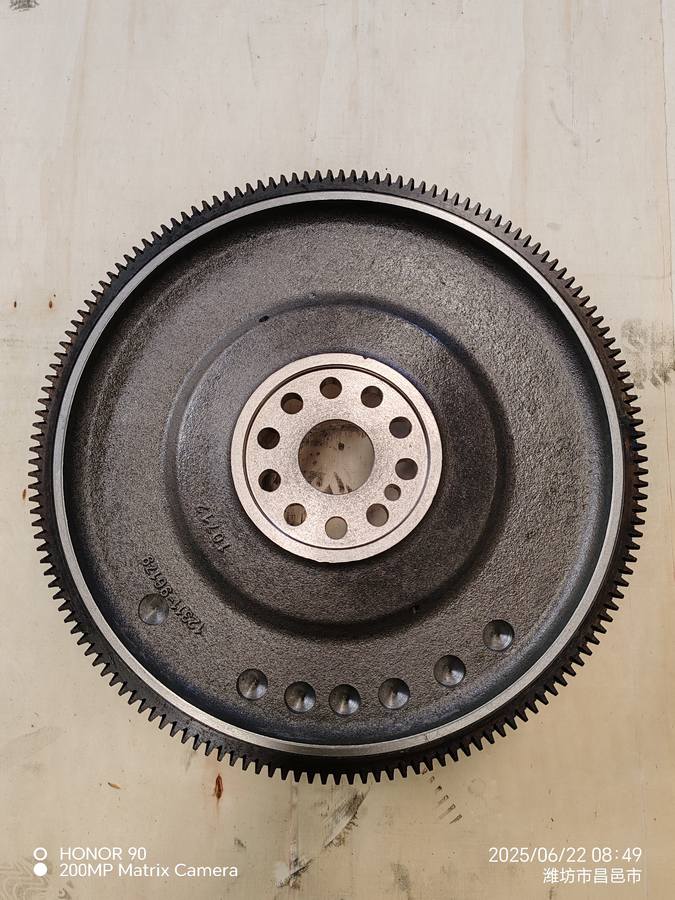
The heavy end is not a different design philosophy. It is more iron in the same envelope. The 12311-96179 casting below has a thick rim section and a row of lightening holes drilled only partway through, which is a compromise: enough mass for a heavy truck, not so much that the starter struggles.
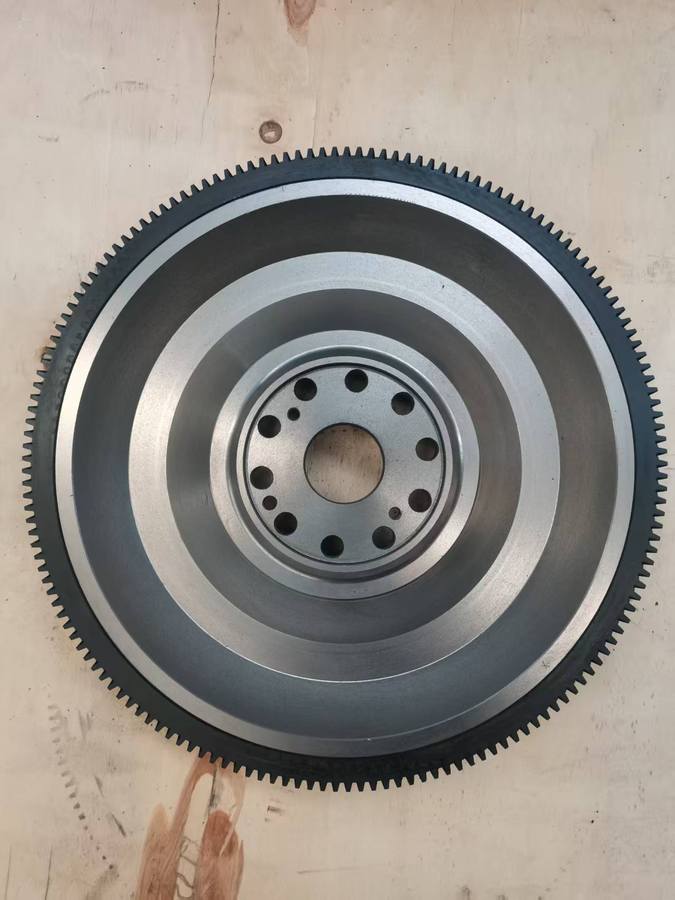
The DAF part beside it is a deep dished flywheel with a wide friction ring. Flat on the bench it looks like any other flywheel. On the scale it reads 52 kg, and that number decides how it is packed and how two people lift it.
Bare Flywheel and Complete Assembly
The most common weight argument is not about a wrong part. It is about a different scope. A flywheel can be quoted bare, or complete with the ring gear already fitted.
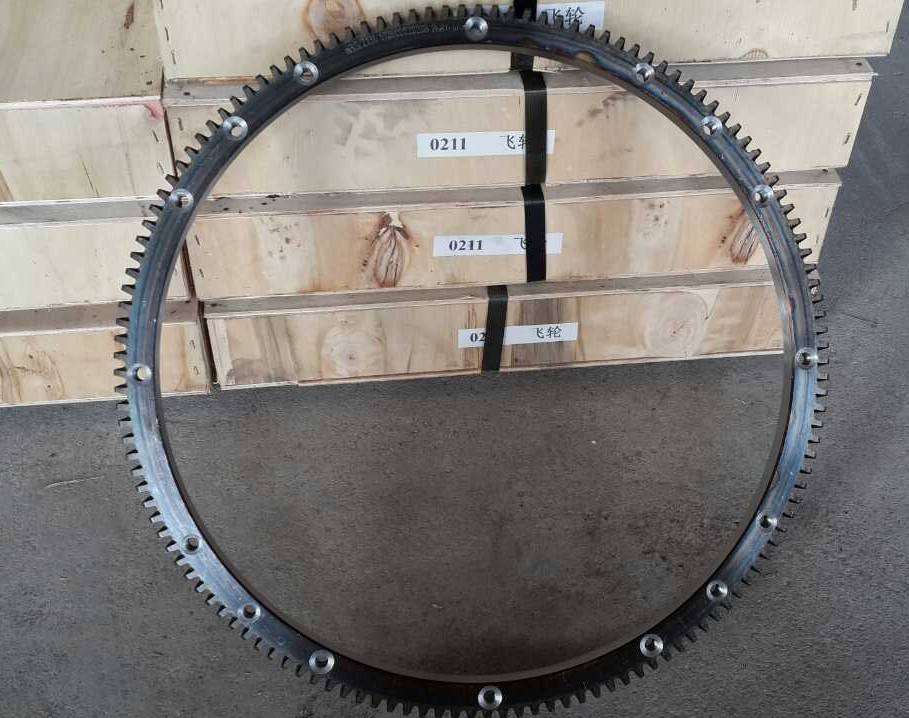
Our record keeps both figures for the same part number. For the M50 unit, the bare flywheel is logged at 43.2 kg and the finished assembly at 47 kg. The gap is 3.8 kg.
A 158-tooth ring gear row in the same sheet reads 4 kg. Add that to 43.2 and you get 47.2, which is within 0.2 kg of the finished figure. The gap is the ring gear, and nothing else.
Two Smaller Examples
The pattern repeats lower down the range. One small industrial flywheel is logged at 14.5 kg bare and 16.7 kg complete, a 2.2 kg gap. Another is 11 kg bare and 12.45 kg complete, a 1.45 kg gap.
In both cases the gap tracks the ring gear for that size. A 129-tooth ring gear in the sheet weighs 2.9 kg. A 114-tooth one weighs 2.5 kg. A 110-tooth one weighs 1.55 kg.
Why the Gap Matters
The ring gear is 8 to 13 percent of the unit weight on these examples. On 500 pieces, a 3.8 kg scope difference is 1.9 tonnes of freight.
That is the size of mistake that gets noticed at the port rather than at the quotation stage. If your inquiry says flywheel and your drawing shows a ring gear, say so in the first email.
When One Number Comes in Two Weights
Some part numbers appear twice in the file with two different weights. We did not average them and we did not delete one.
| Part number | First entry | Second entry | Gap |
|---|---|---|---|
| 20354 | 31.5 kg | 29.7 kg | 1.8 kg, 5.7 percent |
| 5205 | 31 kg | 32.3 kg | 1.3 kg, 4.2 percent |
| 612600020010 | 30.45 kg | 31.5 kg | 1.05 kg, 3.4 percent |
The file does not record which entry is which, so we cannot tell you. What we can tell you is what a gap of that size means physically, and that is the subject of the next section.
The Heavy Version Is Named
Not every difference is unexplained. The record carries explicit variants for some numbers. One row reads 30354/051 at 40.4 kg, and another row is labelled as the heavier variant of the same number at 41 kg.
The M5B assembly appears twice and both entries say 43.5 kg, which is what a consistent record looks like.
What to Do With a Conflict
If your supplier quotes one figure and the part arrives at another, ask which casting version was shipped. Do not assume the scale is wrong.
A 1.8 kg gap on a 31 kg part is not scale drift. It is a different amount of iron in the casting, and it usually traces back to a drawing revision or a heavy-duty variant.
What One Kilogram Means in Iron
Grey cast iron runs about 7.1 to 7.3 grams per cubic centimetre. Take 7.2 as a working figure. One kilogram of iron is then roughly 139 cubic centimetres.
That converts a weight argument into a geometry argument.
Turning Kilograms into Millimetres
The 1.8 kg gap on 20354 is about 250 cubic centimetres of iron. Spread across a 400 mm disc, that is close to 2 mm of section thickness over the whole web.
Two millimetres does not change the outline of a casting. It does not change the bolt pattern or the ring gear. It changes the part number, and it changes the inertia, and neither of those shows up in a photo.
Where the Mass Sits
Inertia depends on how far the mass is from the centre. Iron at the rim does most of the work. Iron at the hub does almost none. That is why a light flywheel can carry windows near the hub while a heavy one grows a thicker rim instead.
We do not recommend changing the weight of a flywheel to tune an engine. The engine maker set that figure for starting, idle quality and gearbox life. Our job is to deliver the figure on the drawing.
Checking Weight at Incoming Inspection
Weight is one of the few specifications a receiving department can check without opening the engine. It needs a platform scale and a packing list.
Weigh Three Pieces, Not One
One casting can sit a few hundred grams off and still be correct. Machining allowance varies, and so does the amount of iron left in a corner.
Weigh three pieces from the same pallet. If all three read low by the same amount, the batch is light. If one reads low and two read normal, you have a single part problem, not a batch problem.
What a Low Reading Usually Means
Before you reject a delivery, check two things.
The first is the ring gear. A missing 4 kg ring gear explains 10 percent on a 40 kg flywheel, and it is the most common scope error we see.
The second is the declared basis. A net weight and a gross weight differ by the crate. Ask which one is on the document before comparing.
The Check We Run
We weigh the first article of every batch and log it against the part number. When a customer sends back a weight complaint, the log tells us within a minute whether the part changed or the scope did.
If you want that log line on your packing list, ask for it. It costs nothing and it ends most arguments before they start.
Frequently Asked Questions
Is a heavier flywheel better
Not in itself. A heavier flywheel stores more energy and smooths idle, but it also takes more energy to accelerate and loads the starter. The correct weight is the one the engine was designed around, not the heaviest one available.
Why does the same part number come in two weights
Usually a different casting version, a heavy-duty variant, or a scope difference such as bare versus complete with ring gear. Our record shows all three cases, and it does not always say which applies.
Do you quote net or gross weight
Net. Our figures are the part alone, with no crate and no pallet. Gross weight depends on packing and is quoted separately per shipment.
Can you confirm the weight before shipment
Yes. We weigh the first article of a batch and report the reading with the part number. The two photos in this article are exactly that practice, not a special request.
Does the weight in your table include the ring gear
It depends on the row, and the row says which. Where the record separates a bare flywheel from a complete assembly, we printed both figures side by side.
Send the Number and the Reading
If you have a flywheel on the bench, send three things: the part number, a photo of the friction face, and the weight from your own scale. Those three answer most fitment questions before a quotation is written.
If you only have the number, send that. We will check it against our record and tell you what we have weighed, and what we have not.
Browse the full range on the product overview, or send the details straight to our quotation desk. We answer with the part number, the net weight and the drawing revision we are working to.
Related reading: starter pinion clearance and ring gear mesh, how signal hole position traps a part number, packing and container loading for cast iron parts, and the UD GE13 flywheel reference page.