
Flywheel Part Number Trap: Why Signal Hole Position Changes Everything
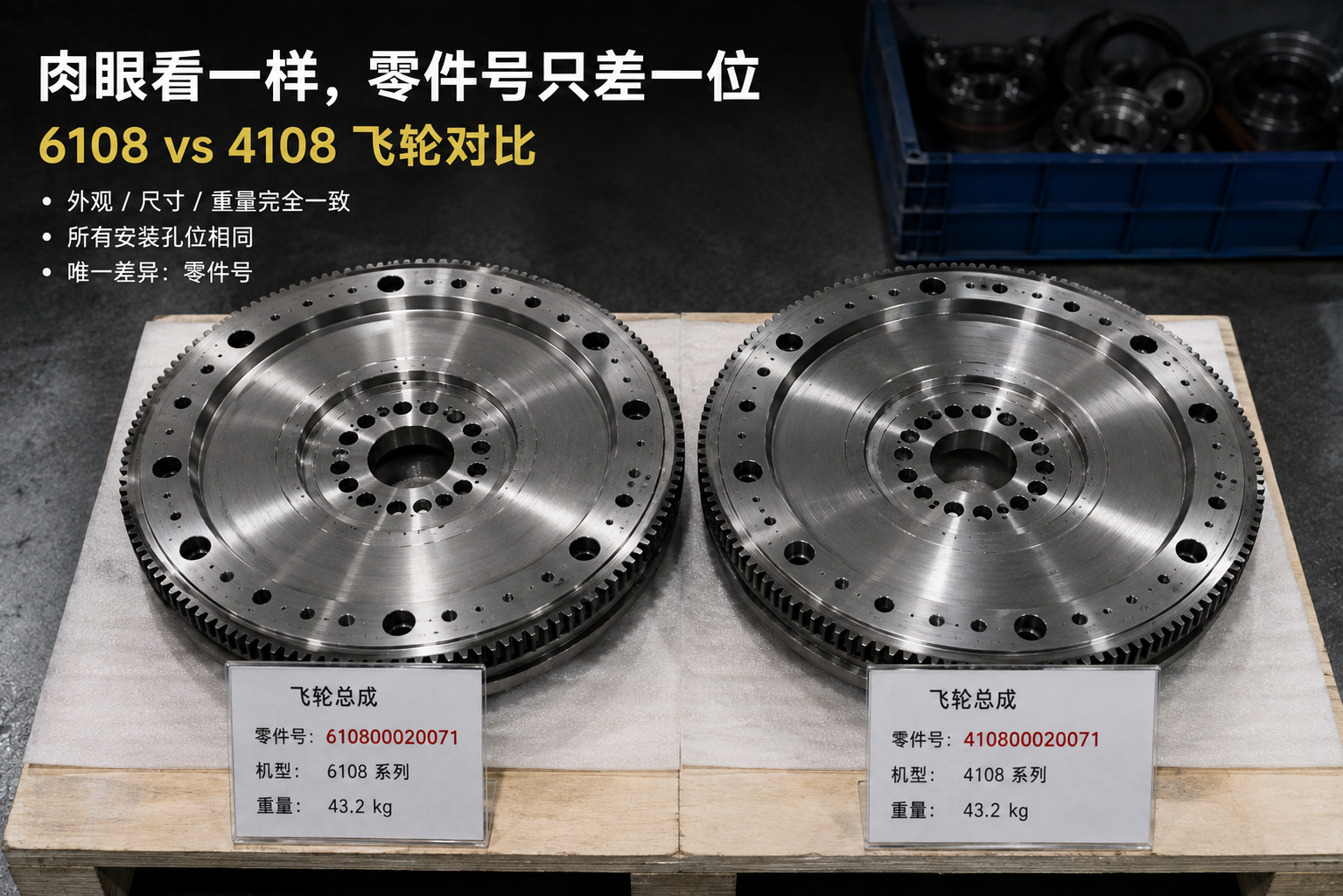
If you work in commercial vehicle parts procurement, you already know engine flywheel identification is one of the most error-prone tasks in the ordering process. A single flywheel model can have dozens of variants, and the visual differences between them are often so subtle that even experienced buyers get tripped up. The result: wrong parts ordered, return shipping costs, delayed repairs, and frustrated customers.
At Changwei, our engineering team has spent over 20 years manufacturing and identifying engine flywheels across Chinese, Japanese, and European platforms. One trap catches buyers more often than any other: the signal hole position difference.
This article breaks down a real example we see regularly: two flywheels that look identical in every visible dimension, yet carry completely different OE part numbers because of one detail.
Key takeaways:
- Two flywheels can match in every measurable external dimension and still be different parts — the signal hole position is a functional specification, not a cosmetic one.
- Part numbers 610800020071 and 410800020071 differ by only the first digit (6 vs 4), but that digit encodes a different signal hole orientation and a different engine application.
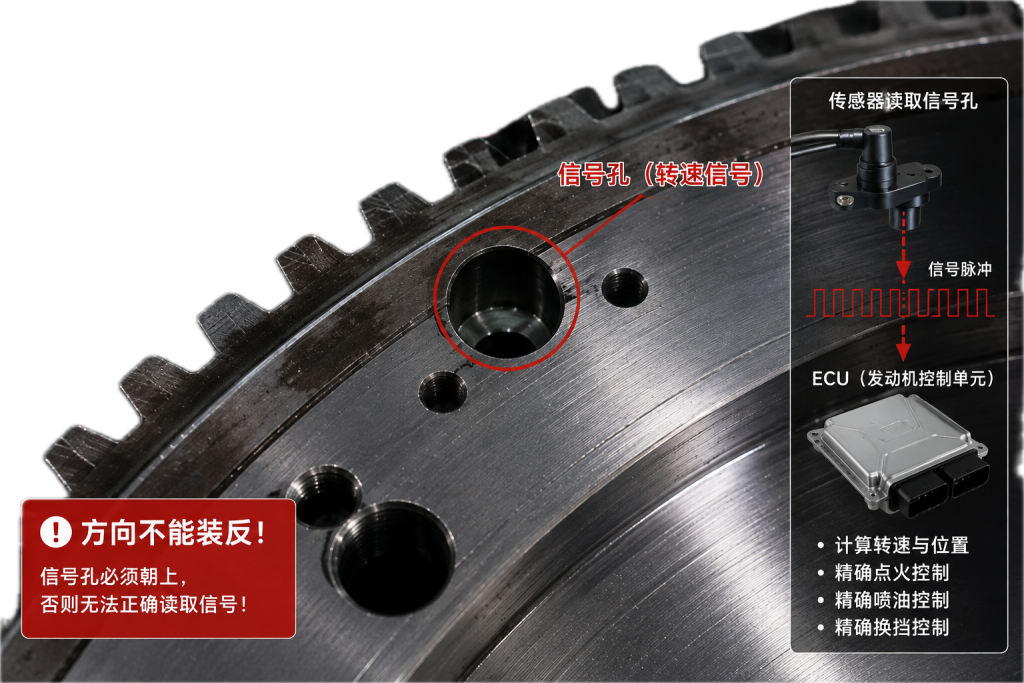
- The crankshaft position signal hole is what the ECU reads for engine timing. Wrong position means wrong timing data — no start, rough running, or check-engine codes.
- Always capture the full part number (including the prefix), photograph the signal hole position, and verify against the engine application before ordering.
Why Flywheel Identification Is Harder Than It Looks
A flywheel is not a simple disc. It carries the clutch friction surface, the ring gear, the pilot bearing seat, the crank mounting pattern, and — on modern engines — a signal feature the crankshaft position sensor reads. Each of those can vary independently between otherwise similar models.
That is why professional identification requires more than a caliper and a catalog. It requires knowing which detail actually decides fit and function. And on many platforms, that detail is the one most buyers never check.
The Core Problem: Visually Identical, Different Part Numbers
Here is the scenario. A customer sends in a flywheel sample to identify and quote. You measure it carefully:
- Pressure plate mounting pattern: same
- Guide bearing (pilot bearing) size: same
- Gear ring tooth count and diameter: same
- Crankshaft end dimensions: same
- Overall thickness: same
- Outer diameter: same
By every conventional measurement, the two flywheels are identical. But they are not. The part numbers are completely different: 610800020071 and 410800020071.
What Is Different? The Signal Hole Position
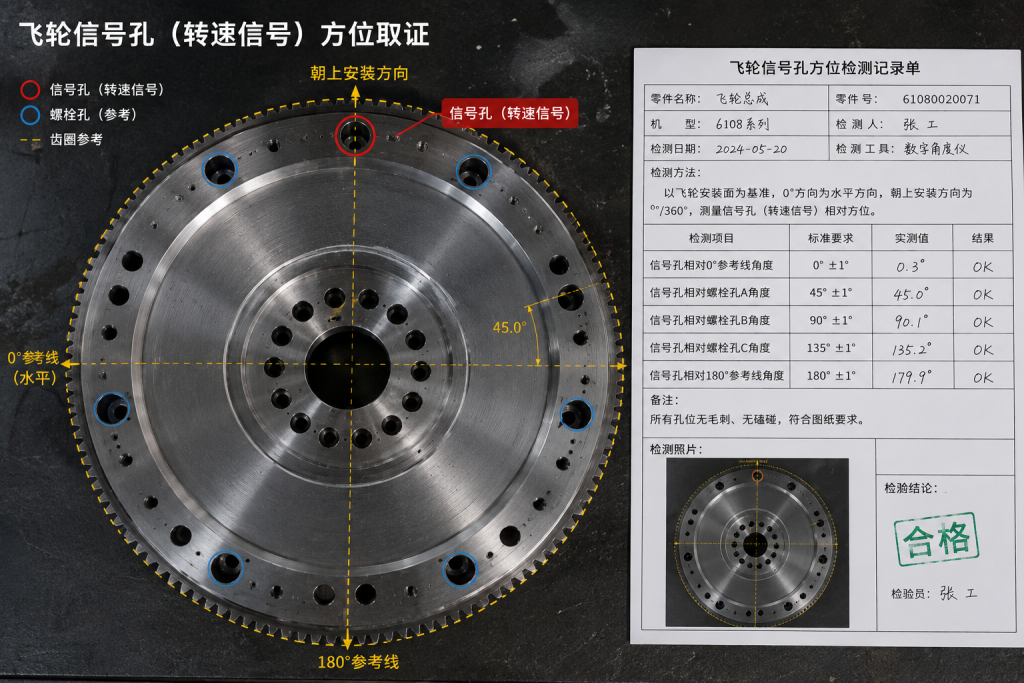
The crankshaft position signal hole — sometimes called the timing signal hole or CKP signal hole — is oriented differently on each flywheel. On one, it faces one direction relative to the gear ring and mounting bolt pattern. On the other, it faces a different direction.
This is not cosmetic. The signal hole is what the crankshaft position sensor reads to determine engine timing. If the signal hole is in the wrong position, the engine management system receives incorrect timing data. The engine will not run correctly — or may not run at all.
Part Number Breakdown: 610800020071 vs 410800020071
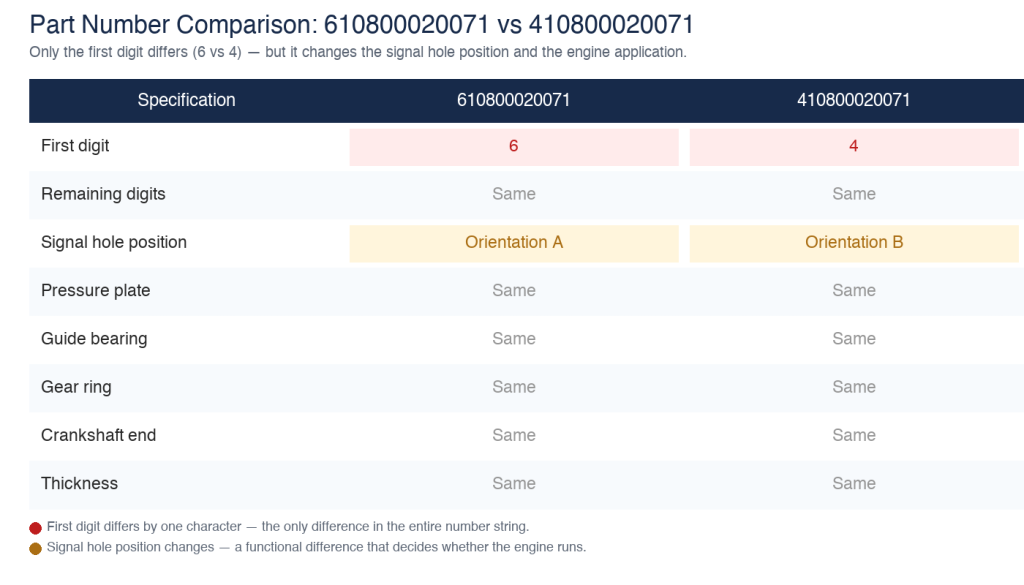
The only difference in the part number string is the first digit: 6 versus 4. Everything else — all 11 remaining digits — is identical. But that single leading digit encodes a different signal hole orientation, which means a different engine application.
Why the First Digit Matters So Much
In many OE part numbering systems, the leading digit (or prefix) designates a critical variant: engine series, application code, or — as in this case — the signal hole orientation. Buyers who are not deeply familiar with the specific convention often focus on the middle or end of the number, assuming the long string of digits matters most. But here, the most important distinguishing information sits in the very first digit.
This is why professional flywheel identification requires knowing not just the part number, but understanding what each digit represents.
The Real Cost of Ordering the Wrong Flywheel
You might think: “It is just one digit. How bad can it be?” Bad enough to cause problems throughout the supply chain.
For parts distributors
- Return shipping: flywheels are heavy, precision-machined components. International return freight is substantial.
- Restocking and inspection: every returned flywheel must be inspected before restock, tying up quality-control resources.
- Customer trust: a distributor who ships the wrong part twice can lose the account entirely.
For repair shops and fleet operators
- Downtime: a wrong flywheel means the vehicle or equipment sits idle while the correct part is sourced.
- Labor loss: the technician may have removed the old flywheel and begun installation before the mismatch surfaces.
- Cascading delays: if a wrong flywheel is installed and the engine will not start, extra diagnostic time is spent before the root cause is found.
For procurement teams
- Budget overruns: expedited freight for the correct replacement usually costs far more than the original order.
- Inventory distortion: wrong parts land in stock as non-returnable or slow-moving inventory, tying up working capital.
How to Avoid the Trap: A 4-Step Verification Process
At Changwei, our technical team handles flywheel identification daily. Here is the process we recommend for any buyer or procurement specialist:
- Record the complete OE part number. Never rely on a shortened or abbreviated number. Write down every digit, including the leading prefix. In the 6108 vs 4108 example, dropping the leading “6” or “4” makes the two parts indistinguishable.
- Verify the signal hole position. If you have a physical sample, locate the signal hole and note its orientation relative to a fixed reference — typically a gear ring tooth or a specific mounting bolt hole. Take a clear overhead photograph for documentation.
- Cross-check against engine application. Confirm which engine the flywheel is intended for. Even with a correct part number, verifying the engine application adds a second layer of protection.
- Consult the supplier’s technical team. When in doubt, send photographs and measurements to your supplier’s engineering team. A flywheel specialist will have cross-reference databases and technical drawings to confirm the model — far cheaper than ordering the wrong part.
Common Misconceptions About Flywheel Identification
“If the dimensions match, the flywheel is the same.” This is the most dangerous assumption in flywheel procurement. As the 6108 vs 4108 example shows, two flywheels can match in every external dimension and still be completely different parts. The signal hole position is functional, not cosmetic.
“The prefix is just a category code; the suffix is what matters.” In some numbering systems this is true. In flywheel numbers, the prefix often encodes the most critical variant. Never assume it is irrelevant.
“If the gear ring and pressure plate match, the flywheel will work.” Those are important, but not the only factors. Signal hole position, crank end bolt pattern, and pilot bearing configuration all decide whether a flywheel functions correctly.
“A general parts catalog is enough.” General catalogs are useful starting points but rarely include the detail needed to separate variants like 610800020071 and 410800020071. For critical orders, cross-reference the engine manufacturer’s documentation or a specialized flywheel manufacturer.
How Changwei Supports Accurate Flywheel Identification
As an IATF 16949 certified flywheel manufacturer, Changwei does more than produce flywheels — we help customers identify them correctly. Our engineering team maintains detailed cross-reference records for flywheel models across Chinese, Japanese, and European engine platforms.
When a customer sends a sample or a part number, we verify it against our production database and technical drawings before manufacturing. If there is any ambiguity — such as a number that could refer to multiple variants — we request additional information (photographs, engine model, measurements) to confirm the correct specification.
Our production facility in Weifang, China includes 40,000 sqm of manufacturing space with vertical CNC lathes, machining centers, and CMM inspection equipment. That means every flywheel we produce is verified to precise dimensional and positional tolerances — including signal hole orientation.
FAQ
Why does signal hole position change the part number?
The signal hole is what the crankshaft position sensor reads to determine engine timing. Different engine applications place that hole in a different orientation, so the same-looking flywheel gets a different part number — even when every other dimension is identical.
Are two flywheels with the same dimensions always interchangeable?
No. The 610800020071 vs 410800020071 case proves it: identical external dimensions, different signal hole orientation, different engine application. Dimensions alone do not confirm a flywheel will run correctly.
How do I identify the correct flywheel part number?
Record the full OE number including the prefix, photograph the signal hole position relative to a fixed reference, confirm the target engine application, and send the details to your supplier’s engineering team for verification before ordering.
Can Changwei verify a flywheel from a sample or part number?
Yes. Send us the part number and, if possible, overhead photographs plus basic measurements. We cross-check against our flywheel database and technical drawings and confirm the exact specification before any production or shipment.
Conclusion
The story of 610800020071 and 410800020071 is not isolated. Across the flywheel industry there are countless cases of visually identical flywheels with different part numbers, different signal hole positions, and different engine applications. The difference between a correct order and a costly mistake often comes down to a single digit.
By understanding the significance of the signal hole position, recording complete part numbers, and working with a manufacturer that provides technical verification, you can eliminate the most common source of flywheel ordering errors.
Need help identifying a flywheel or sourcing a specific model? Contact Changwei’s engineering team — we verify every specification before production so you get it right the first time.
About Changwei: Weifang Changwei Intelligent Equipment Co., Ltd. is an IATF 16949 certified engine flywheel manufacturer based in Weifang, China. With a 40,000 sqm production facility and 20+ years of engineering expertise, Changwei supplies flywheels, gear rings, and housing parts to customers in 20+ countries. Contact us for OEM/ODM flywheel solutions.