
ISUZU 4HF1 Flywheel Manufacturer | 138T, 325 mm, NPR/NKR Fitment
ISUZU 4HF1 Flywheel: 138 Teeth, 325 mm, and Why Three Versions Exist
The 4HF1 is one of the most common diesel engines still working in Asia, Africa, the Middle East and Latin America. Isuzu built it into the ELF, NPR, NKR and NQR trucks from the early 1990s through the mid-2000s, and a large share of those trucks are still on the road. A truck that runs keeps needing parts, and the flywheel is one of the parts that gets replaced.
That is the easy part. The hard part starts when a buyer orders “a 4HF1 flywheel” and the part does not fit, because the 4HF1 was built with more than one flywheel design. We keep three of them in our own stock, and they are not interchangeable.
This page covers the common specification, the visible differences between versions, how to identify the flywheel you have, and what to send us so the quote is right the first time.
Table of Contents
- 4HF1 Flywheel Core Specification
- Why the Same 4HF1 Takes Different Flywheels
- The Three Versions in Our Stock
- How to Identify Your 4HF1 Flywheel Before Ordering
- Reading ISUZU Flywheel Part Numbers
- Fitment: Which Trucks Use It
- Material, Casting and Machining
- What to Send for an Accurate Quote
- Frequently Asked Questions
- Get a Quote
4HF1 Flywheel Core Specification
The figures below are the trade specification that circulates in the aftermarket for the 4HF1 flywheel, cross-checked between two independent supplier listings. Treat them as the starting point for a conversation, not as a drawing.
| Item | Specification |
|---|---|
| Engine model | ISUZU 4HF1 |
| Engine type | Inline 4-cylinder, four-stroke, water-cooled, direct injection diesel |
| Displacement | 4,334 cc (4.3 L) |
| Bore × stroke | 112 mm × 110 mm |
| Flywheel outer diameter | 325 mm (13 inch class) |
| Ring gear teeth | 138 T |
| Crank mounting holes | 8 H |
| Flywheel thickness | 16.5 mm (reference) |
| Approximate weight | 21 kg |
| Typical clutch size | 325 mm (13 inch) |
| Material | Grey cast iron, machined friction face |
| Ring gear fitment | Shrink fit, heated assembly |
Two numbers in that table cause most of the wrong orders: the tooth count and the crank bolt pattern. A 325 mm flywheel is not enough information on its own. Isuzu also built a 325 mm flywheel with 128 teeth and a 6-hole crank pattern for the NPR, and the two look similar in a photo taken from arm’s length. If a buyer quotes only the diameter, the odds of getting the right part are roughly fifty-fifty.
Why the Same 4HF1 Takes Different Flywheels
An engine family does not stay frozen for a decade. The 4HF1 went into light trucks, medium trucks, industrial generator sets and stationary pump drives. Each of those applications puts a different clutch or coupling behind the flywheel, and the mounting interface had to change with it.
Three things changed between versions:
The pressure plate mounting holes. A flywheel has to carry the clutch cover, and different clutch covers bolt on at different radii with different hole counts. Change the clutch, and the flywheel casting changes with it.
The centre hub height. The hub sets how far the friction face sits from the crank flange. Get this wrong and the clutch either drags or never fully engages.
The ring gear. Starter motors differ by market and by production year, and the starter pinion has to match the ring gear tooth count and module. A flywheel with the wrong tooth count will bolt up perfectly and then destroy a starter.
None of these differences are visible from the parts catalogue line that just says “4HF1”.
The Three Versions in Our Stock
These three flywheels are all for the 4HF1, and they are all in our warehouse right now. The photos are our own castings and machined parts, not catalogue images.
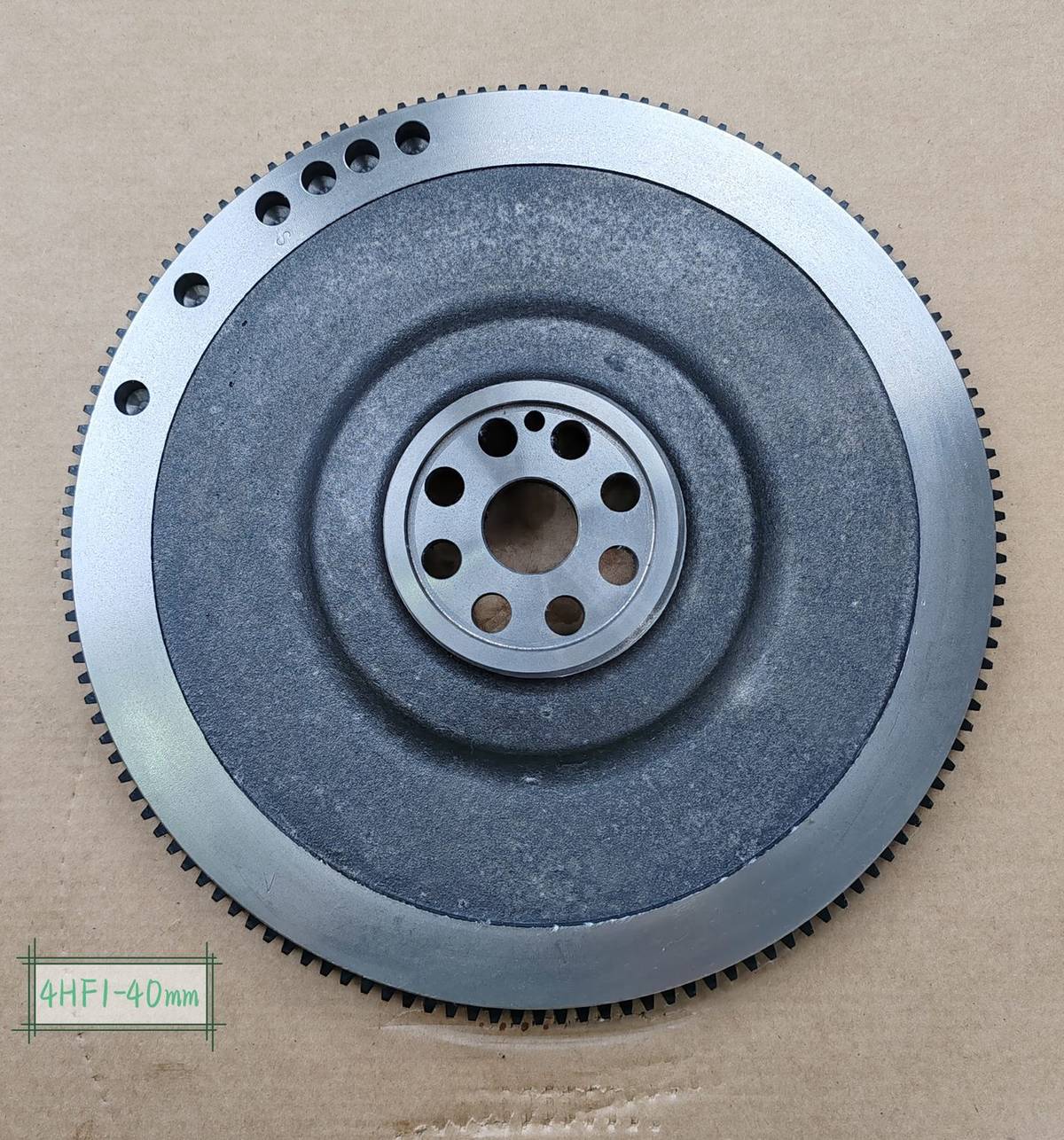
The 40 mm version. Eight holes are spaced around the outer band between the friction face and the ring gear, and the centre hub sits low against the disc. The friction face is machined bright and the toothed rim is cut square.
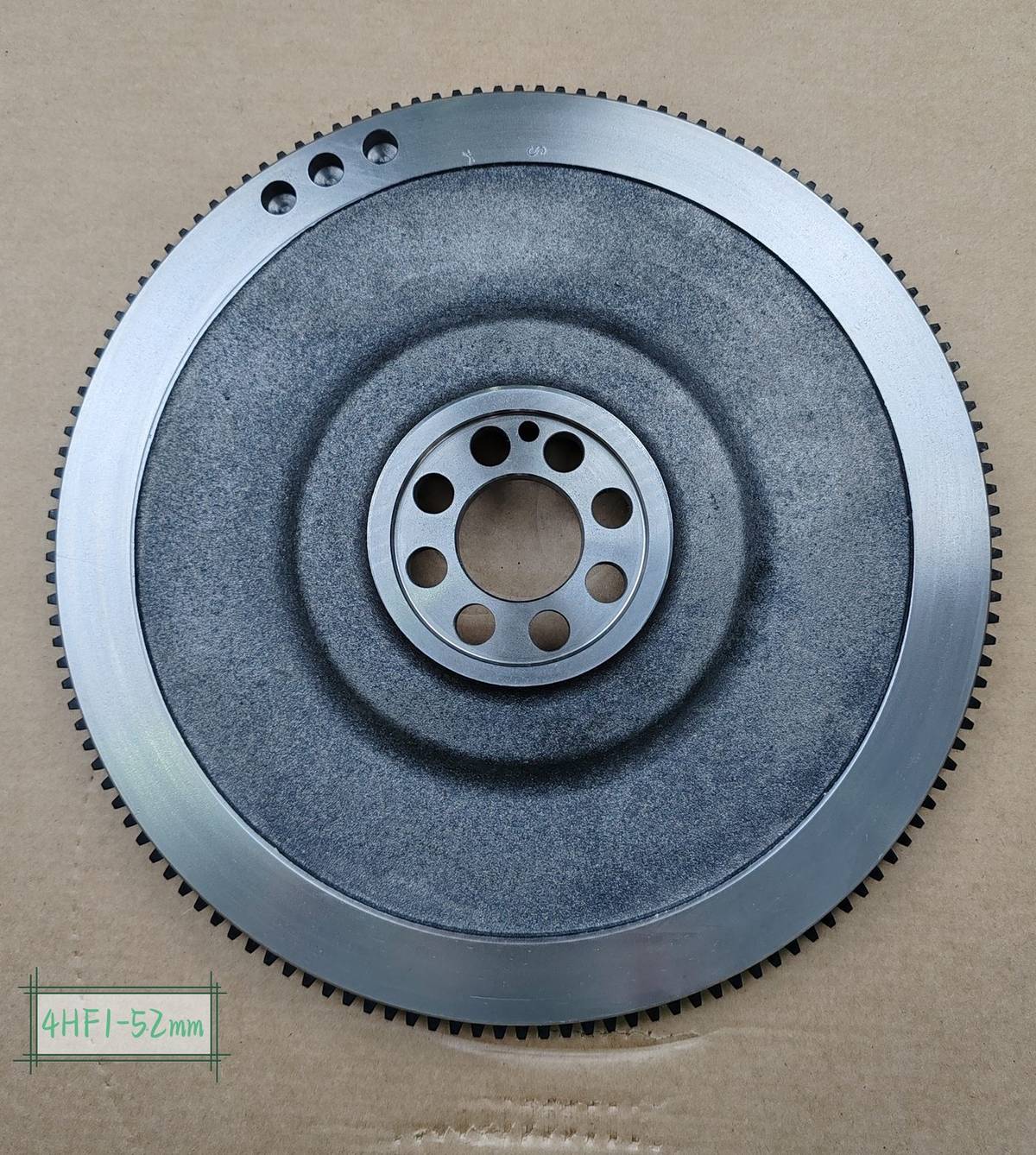
The 52 mm version. The hole pattern is different — four holes clustered in one sector rather than eight spread around the band — and the centre hub stands taller off the disc. Diameter and tooth count read the same as the 40 mm part at a glance.
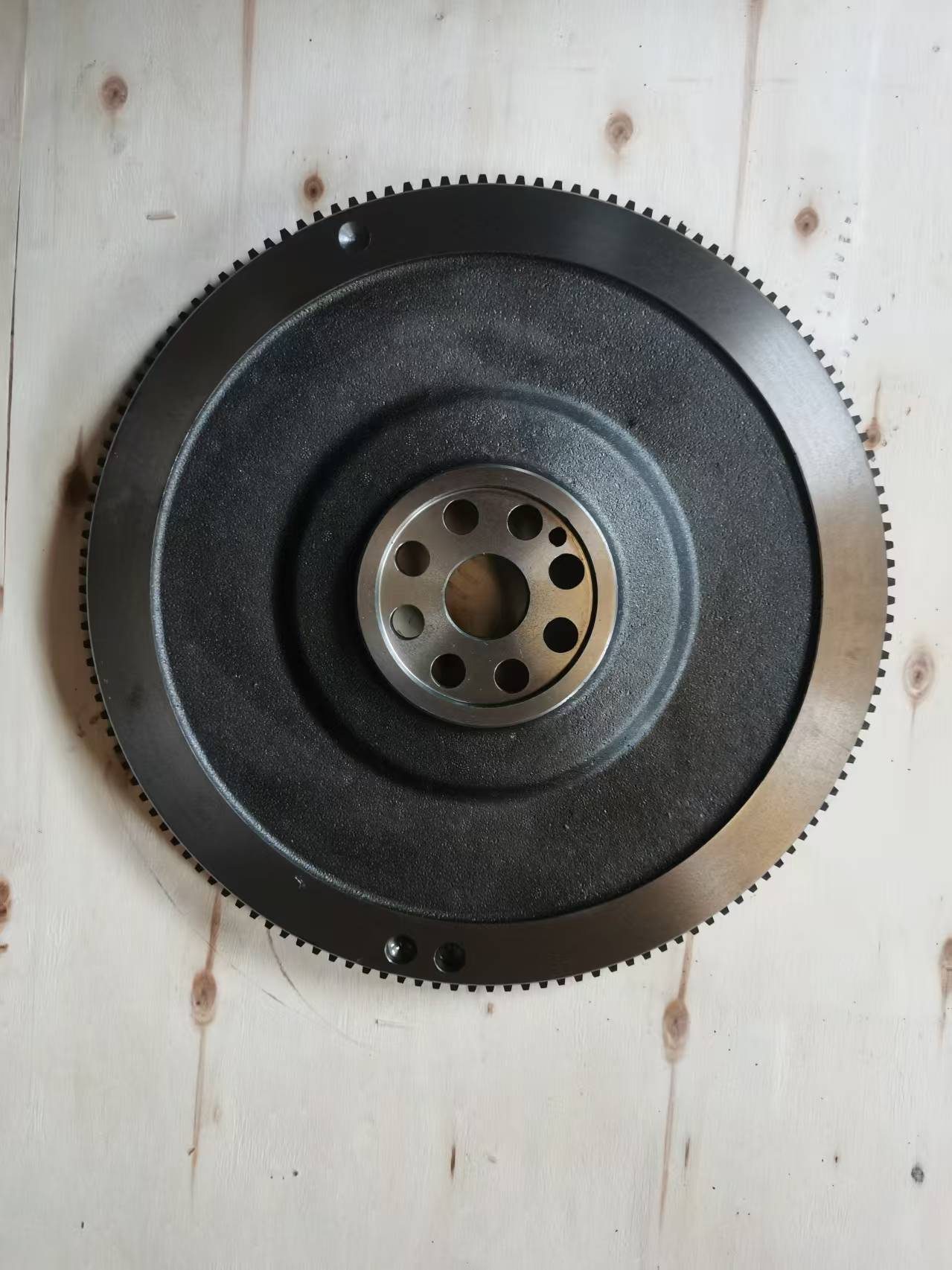
The S4 version. The centre hub is a raised stepped boss rather than a flat pad, and the ring gear teeth are noticeably finer and more numerous. Six hub holes plus a dowel location. This one is not a cosmetic variation of the other two — it is a different interface.
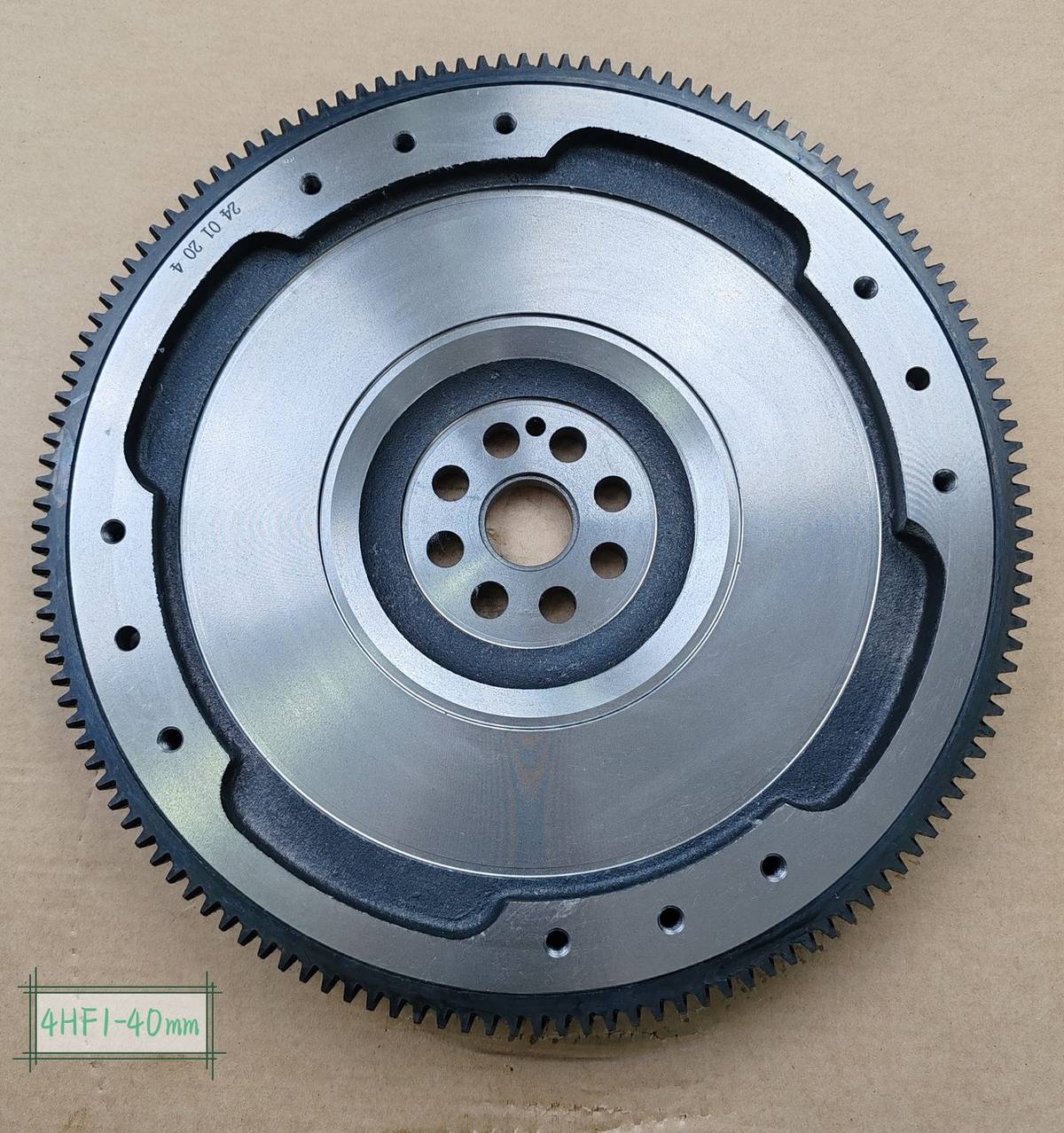
The crank side of the 40 mm part. The eight mounting holes are on a circular pitch around the centre bore, and the flange face is machined flat for full contact with the crankshaft end.
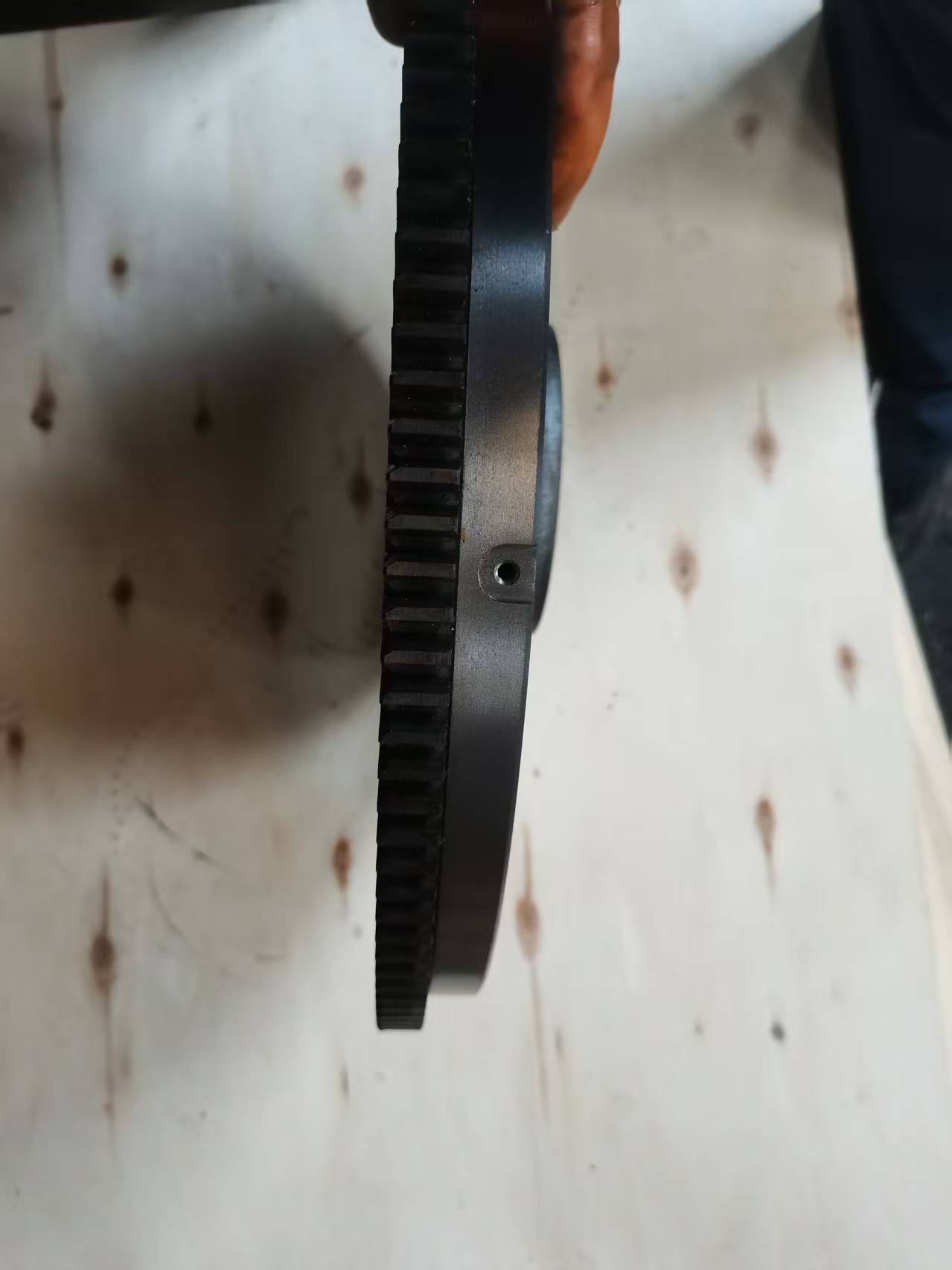
The same S4 part from the side. The hub height and rim section are the fastest way to tell a 40 mm casting from a 52 mm one without measuring gear teeth — stack them on a bench and the difference is obvious.
The internal labels 40 mm and 52 mm come from our own production records. They identify the versions by a critical height dimension that differs between them. If you are ordering, do not rely on the label alone; the identification steps below are what we use.
How to Identify Your 4HF1 Flywheel Before Ordering
Ten minutes with the old part in your hand saves a wrong shipment and a month of transit. Work through these in order.
Count the ring gear teeth. Mark one tooth with a paint pen and count all the way around. 138 is the common figure for the 4HF1, but do not assume it. This number must be exact.
Count the crank mounting holes. Eight is the common pattern. Count them rather than glancing at the part, because six and eight are easy to confuse in a photograph.
Measure the outer diameter across the ring gear, not across the friction face. The friction face wears and the rim is what the starter engages.
Measure the hub height from the crank mounting flange to the top of the hub. This is the dimension that separates the 40 mm and 52 mm versions, and it is the one buyers most often forget to write down.
Photograph the front face straight on and the crank side straight on, with a rule laid across the diameter in the frame. Send both photos with the inquiry. We can usually confirm the version from good photos alone.
Write down the vehicle details: model, chassis number, engine number, model year, and transmission type if it is known.
One practical note. If the truck was imported used from Japan, the parts book for that model year in your market may not match what is actually fitted. Japanese-market trucks are often retired while mechanically sound and then re-registered elsewhere, sometimes with a replacement clutch fitted at some point in their life. Trust the part in your hand over the catalogue when the two disagree.
Reading ISUZU Flywheel Part Numbers
Isuzu part numbers in this family follow a ten-digit pattern written with dashes, for example 8-97326227-0. In aftermarket listings the dashes are frequently dropped, giving 8973262270, and buyers searching for the part often shorten it further. This is how the same flywheel ends up with several number strings attached to it online, and it is why a search that returns no exact match does not mean the part does not exist.
Numbers we have handled or verified for the 4HF1 and its close relatives in the NPR family include:
| Number | Note |
|---|---|
| 8-97330892-0 | Flywheel for NPR trucks with 4HF1 / 4HG1 |
| 8-97326227-0 | Flywheel, NPR, often listed as plywood-boxed export packing |
| 8-97046366-0 | Replacement ring gear, Isuzu 700P with 4HK1 / 4HF1 |
| 897326270 | Short form used in search; confirm the full number against the drawing |
Notice the last row. When a number arrives in a shortened form, we treat it as a lead, not as an identification. The full OEM number, or a photo and measurement set, is what confirms the part. A dropped digit and a wrong digit look identical in a search box.
If you have a number you cannot resolve, send it over. We will tell you what we can confirm and what we cannot, rather than guessing to win the order.
Fitment: Which Trucks Use It
The 4HF1 is a 4.3 litre naturally aspirated engine, and it sits in the light and light-medium end of the Isuzu range. Truck models we commonly see it in:
| Series | Models | Class |
|---|---|---|
| ELF | Japanese domestic market, 1993–2004 | Light truck |
| NPR | NPR66, NPR70, NPR71, NPR75 | Light / medium truck |
| NKR | NKR55, NKR66, NKR77 | Light truck |
| NQR | NQR70, NQR75, NQR90 | Light / medium truck |
Outside truck applications, the 4HF1 also turns up in small industrial generator sets in the 60–100 kVA range, stationary pump drives and compressors, and in small city buses. Those applications do not use a clutch, so the flywheel interface differs from the truck version. If your 4HF1 drives a generator or a pump rather than a gearbox, tell us at the inquiry stage — ask for a flywheel built for a rigid coupling instead of a clutch.
Material, Casting and Machining
We cast these flywheels in grey cast iron, in our own foundry, on an IATF 16949 certified line. Cast iron remains the right material for this application for three reasons that have not changed: it damps vibration better than steel, it machines to a stable friction face, and it costs less per kilogram than a forged or billet alternative.
The production route is casting, stress relief, rough machining, finish turning of the friction face and the crank mounting flange, ring gear shrink fit, then dynamic balance. Balance is checked on every flywheel rather than sampled. An unbalanced flywheel in a light truck shows up as a driveline vibration that no amount of clutch adjustment will fix, and it wears the rear main seal and the transmission input bearing on the way to failing.
Surface finish on the friction face matters more than most buyers expect. A face that is too rough eats clutch discs; a face that is too smooth glazes and slips. We hold the finish to the drawing and check it with a surface comparator.
What to Send for an Accurate Quote
A complete inquiry gets a same-day answer. An incomplete one gets a question, and questions cost days.
Send us:
Engine model and vehicle model. “4HF1, NPR71” or “4HF1, NKR66” is enough to start.
Ring gear tooth count. Count it. This is the single most important number.
Crank hole count and outer diameter across the ring gear.
Hub height, if you can measure it, or a clear photo with a rule in frame.
Quantity. We work from a low minimum order for a trial shipment and scale from there. First orders from new overseas customers are commonly one pallet or one crate.
Destination port. We quote FOB Qingdao by default, and we pack for sea freight in export crates.
Anything you already know about the original part number, even if it is incomplete.
We do not require a drawing to quote. If you have no number and no catalogue reference, photos and measurements are enough to get started, and we will confirm the version before anything is cast.
Frequently Asked Questions
How many teeth does a 4HF1 flywheel have?
The common trade specification is 138 teeth on a 325 mm flywheel. Do not order from that number alone. Isuzu also produced a 325 mm flywheel with 128 teeth for the NPR, and the two are not interchangeable. Count the teeth on your old flywheel and send us the figure.
What does 897326270 refer to?
It matches the short form of an Isuzu part number in the NPR flywheel family. Digit strings in this family are commonly shortened when the dashes are dropped, so a nine-digit string is usually a ten-digit number with a digit lost. Send us the number off the part or the packaging, plus a photo, and we will confirm it rather than assume.
Will one 4HF1 flywheel fit any 4HF1 engine?
No. There are at least three interface designs in circulation. The crank mounting pattern is the same across them, which is exactly why a wrong flywheel bolts up and then fails at the clutch or the starter. The differences sit in the pressure plate hole pattern, the hub height and the ring gear.
Is the ring gear replaceable on its own?
Yes. On most of these flywheels the ring gear is a separate ring, shrink fitted to the rim. If the friction face and hub are still within tolerance, replacing only the ring is possible. In practice, a truck old enough to have worn teeth usually has a friction face that needs machining as well, and machining the face changes the height relationship to the clutch. Send photos and we will tell you which route makes sense.
Can you supply the flywheel with the ring gear already fitted?
Yes. We supply complete flywheels with the ring gear shrink fitted and balanced, and we also supply ring gears on their own for workshops that do their own assembly. See the ring gear range for separate supply, or ask us to quote both ways.
What is the minimum order quantity?
A trial order of one crate or one pallet is normal for a first shipment. Tell us your target quantity and we will confirm.
How is it packed for export?
Cast iron flywheels go into export crates with each part separated and restrained so nothing moves in transit. Shipping weight runs well above the 21 kg part weight once crate and packing are included. Our packing and loading process is described in this guide.
Can you make it from a sample instead of a drawing?
Yes, with the sample in hand. We measure, produce a drawing for your approval, then cast and machine. This is the normal route for older engines where the drawings are no longer available — which describes most of the 4HF1 fleet still working today.
Get a Quote
Send us the engine model, the ring gear tooth count, the crank hole count, and a photo of both faces of your old flywheel. If you only have the vehicle details, send those and we will work from there.
Irene
[email protected]
+86 19953662121
Weifang Changwei Intelligent Equipment Co., Ltd.
Wangke Industrial Zone, Changyi, Weifang, Shandong, China
IATF 16949 certified foundry
FOB Qingdao
Request a quote or see the full ISUZU flywheel range.