
Agricultural Flywheel Selection Guide: How to Choose the Right Tractor Clutch-Flywheel Combination
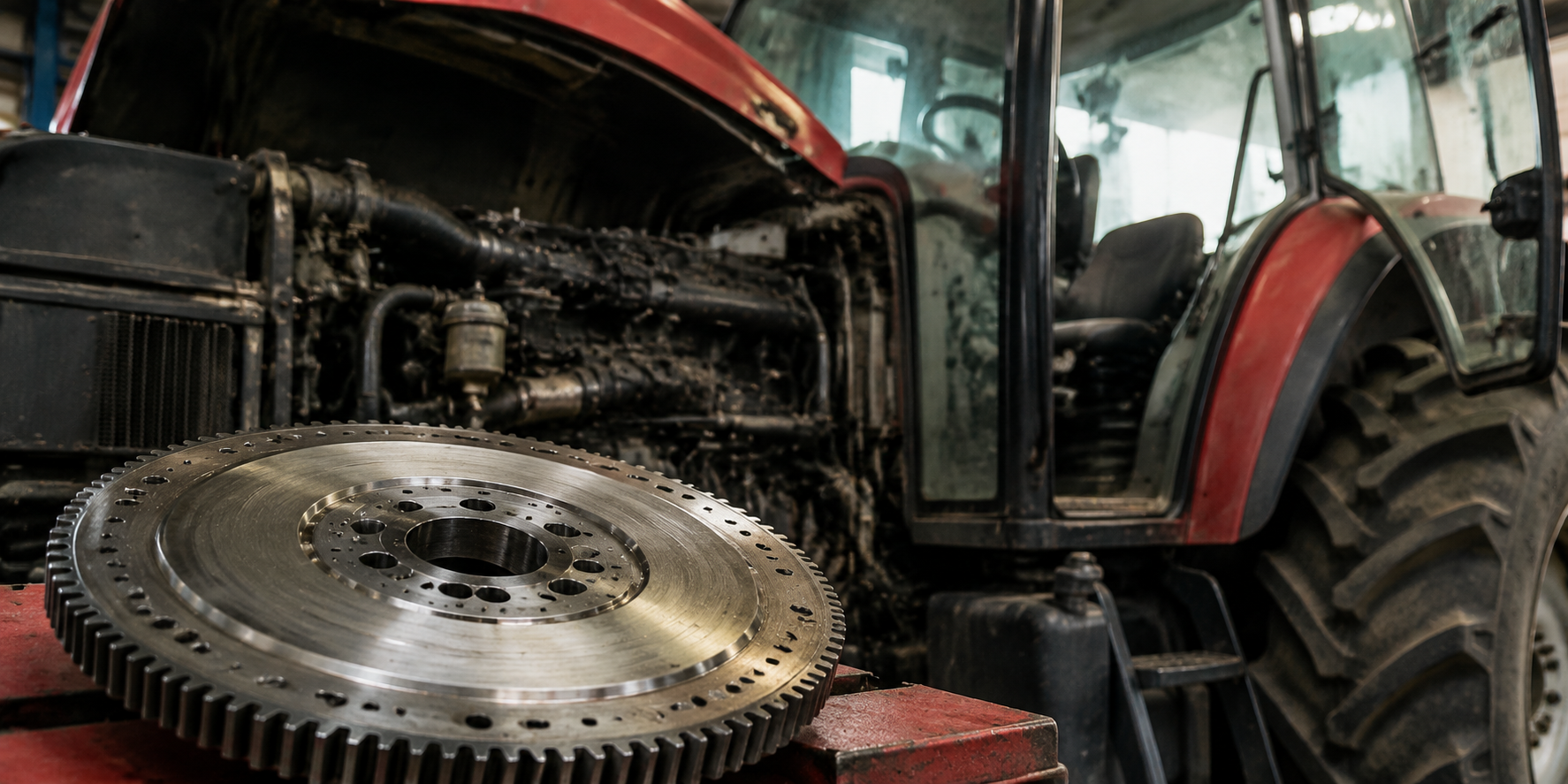
Selecting the right agricultural flywheel and clutch system for a tractor is not a matter of finding any component that fits. The clutch-flywheel combination directly affects equipment reliability, operational efficiency, and total cost of ownership over the machine’s service life. In agriculture — where downtime during planting or harvest can mean lost income — component selection has real economic consequences.
This guide provides a practical framework for evaluating and selecting tractor flywheel and clutch components across the major equipment brands. It compares imported (international) and domestic (Chinese) brands, explains what to look for in flywheel and clutch components, and gives selection criteria based on real operational requirements.
As a manufacturer supplying flywheel products across multiple engine platforms, Changwei brings production-level understanding to the selection process — helping buyers, dealers, and repair shops make informed decisions rather than guessing at compatibility and quality.
Why Flywheel Selection Matters in Agricultural Equipment
A wrong clutch-flywheel combo rarely costs only the price of a part. The real cost shows up as a lost day in the field, a crankshaft bearing damaged by vibration, or a clutch disc worn out early because the friction surface was out of flat. When the system fails during a planting or harvest window, the downtime itself — not the component — is what hurts.
The agricultural design philosophy is deliberately different from a passenger car: simplicity over refinement, robustness over smooth modulation, and field-serviceability over sealed complexity. Every major brand follows this idea. The differences are in execution, not in the fundamentals.
Understanding the Agricultural Clutch-Flywheel System
The Three-Component System
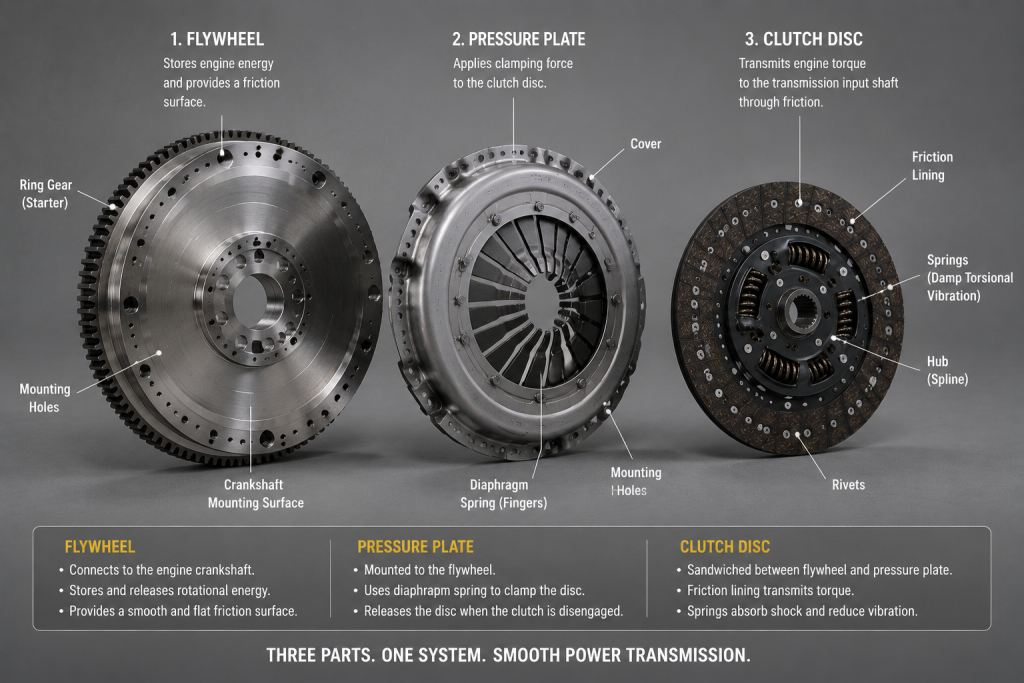
Before comparing brands, it helps to be clear on what the system comprises:
- Flywheel — bolted to the engine crankshaft, providing energy storage, a friction surface for the clutch disc, and mounting for the starter ring gear. On many tractors it also interfaces with the power take-off (PTO) system.
- Pressure plate (clutch cover) — bolted to the flywheel, providing the clamping force that holds the clutch disc against the flywheel friction surface. Agricultural pressure plates are built simple and overbuilt: straightforward spring mechanisms with robust construction.
- Clutch disc (friction disc) — sandwiched between the flywheel and pressure plate, transmitting power from the engine to the transmission. Agricultural clutch discs feature robust spline teeth designed for high-torque, shock-loaded operation.
These three must be matched as a set. Get any one wrong and the system underperforms or fails early.
Design Philosophy: Reliability Over Complexity
The agricultural clutch-flywheel system follows a different design philosophy than passenger vehicles:
- Simplicity — fewer complex mechanisms mean fewer failure points.
- Robustness — components are overbuilt for their nominal torque capacity.
- Serviceability — systems are designed for field-serviceable maintenance and repair.
- Consistency — the priority is that the system works reliably every time, not that it provides refined engagement.
This philosophy is consistent across virtually all major brands. The differences lie in execution, not in the approach.
Major Agricultural Equipment Brands Compared
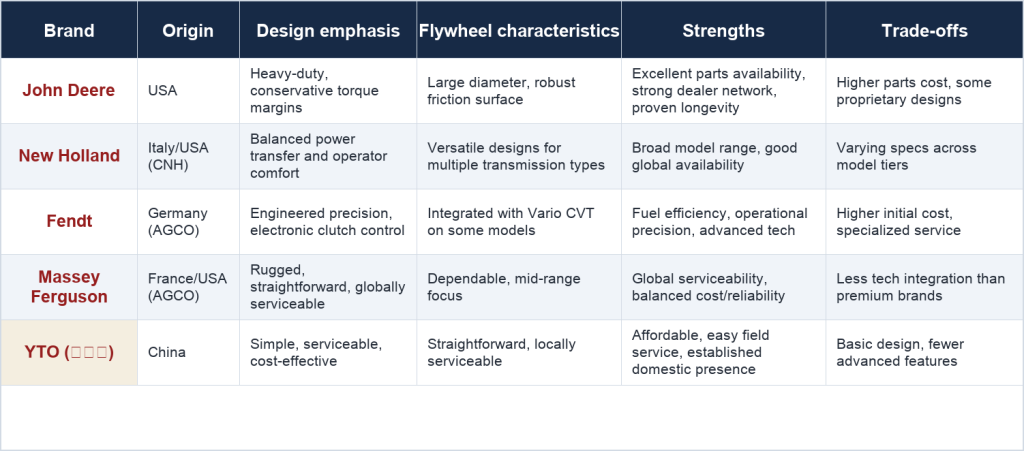
John Deere
John Deere flywheel and clutch systems are engineered with significant torque capacity margins. The brand’s approach is conservative — components are typically specified to handle more than the engine’s rated output, providing a reliability buffer for demanding operations.
Key characteristics:
- Flywheel assemblies designed for heavy-duty, sustained operation.
- Clutch systems that prioritize positive engagement over modulation refinement.
- Extensive service documentation and parts availability.
- Some models use dual-disc clutch configurations for high-horsepower applications.
When sourcing replacement flywheels for John Deere tractors, verify that the component matches the specific model and engine variant — John Deere uses multiple flywheel specifications across its product range.
New Holland
New Holland flywheel systems are designed for versatility across crop farming, livestock, and utility applications. The clutch-flywheel combinations accommodate both manual and power-shuttle transmissions, requiring careful specification matching during replacement.
Key characteristics:
- Balanced approach between durability and operator comfort.
- Flywheel specifications that support PTO operation across varying loads.
- Good parts availability through CNH’s global dealer network.
- Model-specific variations that require precise application matching.
Fendt
Fendt brings premium engineering to agricultural drivetrain design. On higher-end models, the clutch-flywheel system may be integrated with electronic clutch management or the Vario CVT, adding complexity to component selection and replacement.
Key characteristics:
- More sophisticated drivetrain integration than other brands.
- Flywheel assemblies that may serve multiple functions beyond standard clutch operation.
- Premium positioning with corresponding parts pricing.
- Specialized service requirements for advanced models.
Massey Ferguson
Massey Ferguson offers dependable, globally serviceable tractors with straightforward clutch-flywheel systems. The brand’s design philosophy aligns with the agricultural sector’s reliability-first approach.
Key characteristics:
- Rugged, proven clutch designs suitable for diverse global conditions.
- Flywheel assemblies that prioritize dependable operation.
- Strong global service network, particularly in developing markets.
- Good balance of cost and reliability.
YTO and Other Domestic Chinese Brands
YTO (东方红 / 一拖) represents China’s established domestic tractor manufacturing capability. YTO and similar domestic brands produce tractors designed for the specific demands of Chinese agricultural conditions.
Key characteristics:
- Straightforward, field-serviceable clutch designs.
- Flywheel assemblies optimized for cost-effectiveness and local maintenance.
- Improving quality and specification levels to meet both domestic and export requirements.
- Simpler designs that enable maintenance in rural workshops with basic tooling.
Selection Criteria: What to Look For
1. Application Matching
The most critical criterion is exact application matching. A tractor flywheel must match the specific tractor model, engine variant, and transmission configuration. Key verification points:
- Flywheel diameter and friction surface dimensions — must match the clutch disc and pressure plate.
- Mounting bolt pattern — bolt circle diameter, bolt count, and bolt size must match the crankshaft flange.
- Pilot bore dimensions — must match the crankshaft pilot bearing or bushing.
- Ring gear specifications — tooth count, pitch, and pressure angle must match the starter motor.
- Overall thickness and mass — must match the engine’s dynamic balance and energy storage requirements.
This is also where part-number discipline matters most. Two flywheels can look identical and even share a suffix, yet carry different full part numbers for different engine platforms. We covered this trap in detail in our guide on why the same flywheel part number suffix can hide a different part — always read the full number, not just the last four digits.
2. Manufacturing Quality Indicators
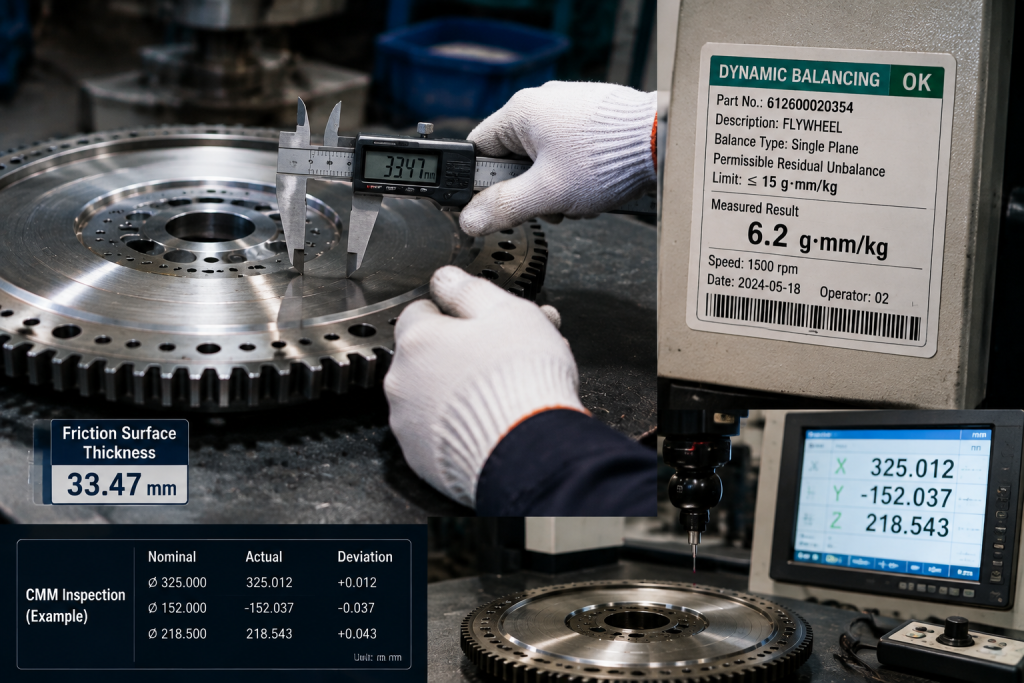
Regardless of brand, evaluate replacement flywheel quality through these indicators:
Material certification — verify the material grade, request certifications from the supplier, and confirm hardness and tensile strength through documentation.
Dimensional inspection — friction surface flatness within tolerance, pilot bore concentricity with the friction surface, mounting bolt-hole pattern accuracy, and ring gear seat diameter for proper heat-shrink fitment.
Dynamic balancing — every flywheel should be dynamically balanced. Request balance grade documentation. An unbalanced flywheel causes vibration that damages crankshaft bearings and drivetrain components.
Surface finish — friction surface roughness within specification, no machining marks, chatter, or tooling defects, and a consistent finish across the entire surface.
3. Supplier Evaluation
When selecting a flywheel supplier for agricultural applications, evaluate:
- Manufacturing capability — appropriate CNC machining, heat treatment, and balancing equipment.
- Quality system — IATF 16949 or ISO 9001 certification.
- Application experience — experience with agricultural engine platforms.
- Inspection capability — CMM inspection, surface finish measurement, and dynamic balance verification.
- Traceability — material traceability and production records.
At Changwei, these criteria are met through our IATF 16949 certified quality system, 40,000 sqm production facility, and comprehensive inspection capabilities. Our experience across eight product series — covering Chinese, Japanese, and European engine platforms — provides the application knowledge necessary for agricultural flywheel manufacturing.
4. Imported vs. Domestic Brand Considerations
Imported brands (John Deere, New Holland, Fendt, Massey Ferguson)
- Advantages: established engineering and manufacturing track records, comprehensive dealer and service networks, extensive parts availability, advanced technology integration (particularly Fendt).
- Considerations: higher initial equipment and parts cost, some proprietary designs limiting aftermarket options, specialized service requirements on advanced models.
Domestic Chinese brands (YTO and others)
- Advantages: lower initial cost, simpler designs enabling field-level maintenance, improving quality and capability, strong domestic parts availability.
- Considerations: more basic design and technology levels, variability in manufacturing consistency, limited advanced features.
For flywheel and clutch sourcing, both imported and domestic brands require the same fundamental quality verification — material certification, dimensional accuracy, dynamic balancing, and surface finish. The brand of the tractor does not change the engineering principles that govern flywheel performance and longevity.
Practical Selection Checklist
Use this checklist when selecting an agricultural flywheel or clutch-flywheel combination:
- Identify exact tractor model, engine variant, and transmission type.
- Verify flywheel dimensions: diameter, thickness, friction surface specs.
- Confirm mounting bolt pattern matches the crankshaft flange.
- Verify ring gear specifications match the starter motor.
- Request material certification from the supplier.
- Confirm dynamic balancing is performed and documented.
- Verify friction surface finish meets specification.
- Evaluate supplier quality system certification (IATF 16949 / ISO 9001).
- Check supplier experience with the specific engine platform.
- Compare total cost of ownership, not just initial parts cost.
Common Selection Mistakes to Avoid
Mistake 1: Selecting on price alone. A lower-cost flywheel that lacks proper balancing, material certification, or dimensional accuracy will cost more over time through premature failure, vibration damage, and clutch system wear.
Mistake 2: Assuming all flywheels for a model are equivalent. Different manufacturers produce flywheels to different quality standards, even for the same nominal application. Verify manufacturing quality, not just dimensional fitment.
Mistake 3: Overlooking ring gear quality. The ring gear is critical for reliable starting. Poor fitment or tooth quality causes starting problems that can be misdiagnosed as starter motor failure.
Mistake 4: Ignoring dynamic balancing. An unbalanced flywheel may appear identical to a balanced one but will cause vibration, bearing wear, and potential crankshaft damage. Always verify balancing.
Mistake 5: Mismatching clutch-flywheel combinations. The flywheel, pressure plate, and clutch disc must be matched as a system. Mixing components from different manufacturers or design generations causes engagement problems and accelerated wear.
Conclusion
Selecting the right agricultural flywheel and clutch-flywheel combination requires understanding both the operational demands of agricultural equipment and the manufacturing quality indicators that determine component reliability. Whether the equipment is a John Deere, New Holland, Fendt, Massey Ferguson, or a domestic brand like YTO, the same engineering principles apply.
Key takeaways for buyers, dealers, and repair professionals:
- Agricultural clutch-flywheel systems prioritize reliability and simplicity over sophistication.
- Each major brand follows this philosophy with different emphases and engineering approaches.
- Component selection must match the exact tractor model, engine variant, and transmission configuration.
- Manufacturing quality — material certification, dimensional accuracy, dynamic balancing, surface finish — determines field reliability regardless of brand.
- Supplier evaluation should verify quality systems, manufacturing capability, and application experience.
- Total cost of ownership, not initial parts cost, should drive purchasing decisions.
For specific flywheel requirements for agricultural or other engine applications, contact our engineering team to discuss specifications, quality requirements, and OEM/ODM manufacturing options.
About Changwei: Weifang Changwei Intelligent Equipment Co., Ltd. is an IATF 16949 certified engine flywheel manufacturer based in Weifang, China. With a 40,000 sqm production facility and 20+ years of engineering expertise, Changwei supplies flywheels, gear rings, and housing parts to customers in 20+ countries. Contact us for OEM/ODM flywheel solutions.