
Ring Gear Identification: Count Teeth, Measure ID, Match the Part Number
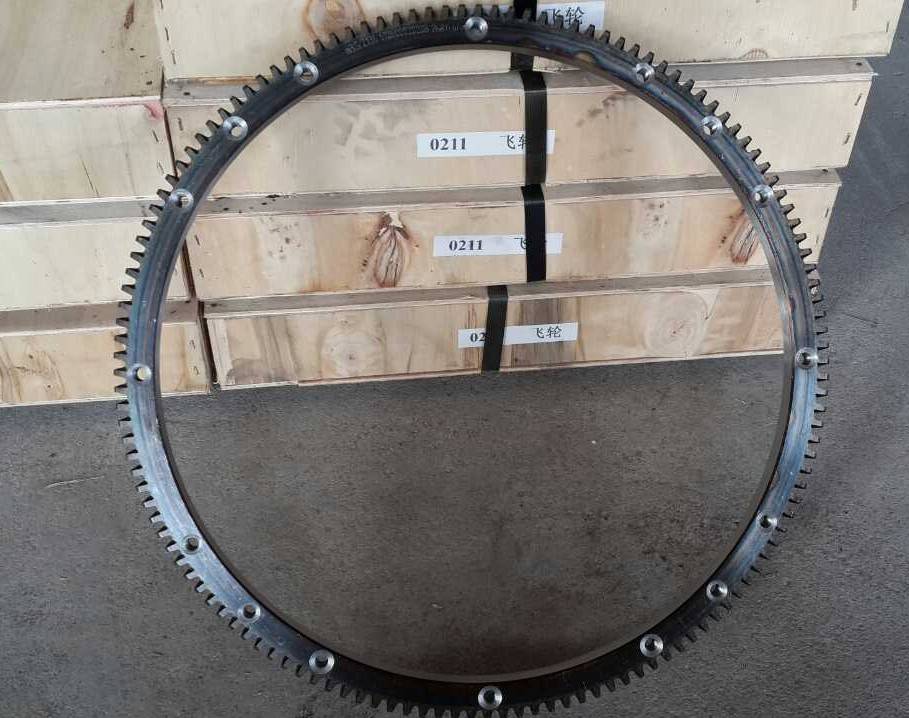
Ring Gear Identification: Count Teeth, Measure ID, Match the Part Number
A ring gear is one of the few engine parts where a single tooth of difference makes it scrap. It is also one of the cheapest parts on the truck and one of the most annoying to get wrong, because a wrong ring gear usually shows up as a starter that screams, a flywheel that has to come back out, and a second freight bill.
This page is the buying side of ring gears. Not how they are made, but how you work out which one you need, how to measure the one in your hand, and what numbers actually appear on Weichai, Sinotruk and ISUZU ring gears. Every dimension below comes from either a real drawing we have run or an OEM service specification, and we say which.
If you want the manufacturing and quality-control side instead, that is covered in the ring gear production and QC note.
Table of Contents
- What a Ring Gear Has to Do
- The Four Numbers That Define a Ring Gear
- Why Tooth Count Alone Is Not Enough
- How to Measure the Ring Gear You Have
- Reading the Interference Fit
- Fitting Temperature: 200 to 230 °C, and Why 350 °C Ruins It
- Part Numbers: Weichai, Sinotruk and ISUZU
- Two Real Drawings: What a Ring Gear Spec Sheet Looks Like
- Material and Hardness
- The 159-Tooth Trap and Other Common Mix-Ups
- What to Send Us for a Quote
- FAQ
- Get a Ring Gear Quote
What a Ring Gear Has to Do
The ring gear sits on the outer diameter of the flywheel and does one job: it takes torque from the starter pinion and turns the engine over until it fires. After that it does nothing at all for the rest of the drive.
That is exactly why it fails. A part that only works for two seconds a day still has to survive the full life of the truck, thousands of starts, from -20 °C cold mornings to a heat-soaked engine bay. The teeth take the load, the body of the ring holds the teeth in place, and the interference fit keeps the whole thing from spinning on the flywheel shoulder.
Two failure modes cover most warranty claims we see. Worn or chipped teeth on the starter side, because the starter pinion was not engaging cleanly. And a ring gear that has walked or spun on the flywheel, which is almost always an interference problem at fitting rather than a part defect.
The Four Numbers That Define a Ring Gear
To specify a ring gear you need four things. Miss any one and the part will not fit.
| What | How it is written | Why it matters |
|---|---|---|
| Tooth count | Z136, 136T, “136 teeth” | Sets the gear ratio to the starter pinion. Wrong count = starter will not mesh or will not crank |
| Inside diameter | ID, e.g. Ø432.000–432.155 mm | Must create the correct interference on the flywheel shoulder |
| Width / thickness | e.g. 18.4–18.6 mm, or 29.15 mm on a blank drawing | Too narrow does not carry the load; too wide fouls the housing |
| Outside diameter or pitch diameter | OD, or PCD | Determines where the teeth sit relative to the starter |
Tooth count and inside diameter are the two people get wrong most often. Tooth count is easy to check. Inside diameter is easy to assume and hard to verify, which is why it deserves its own section.
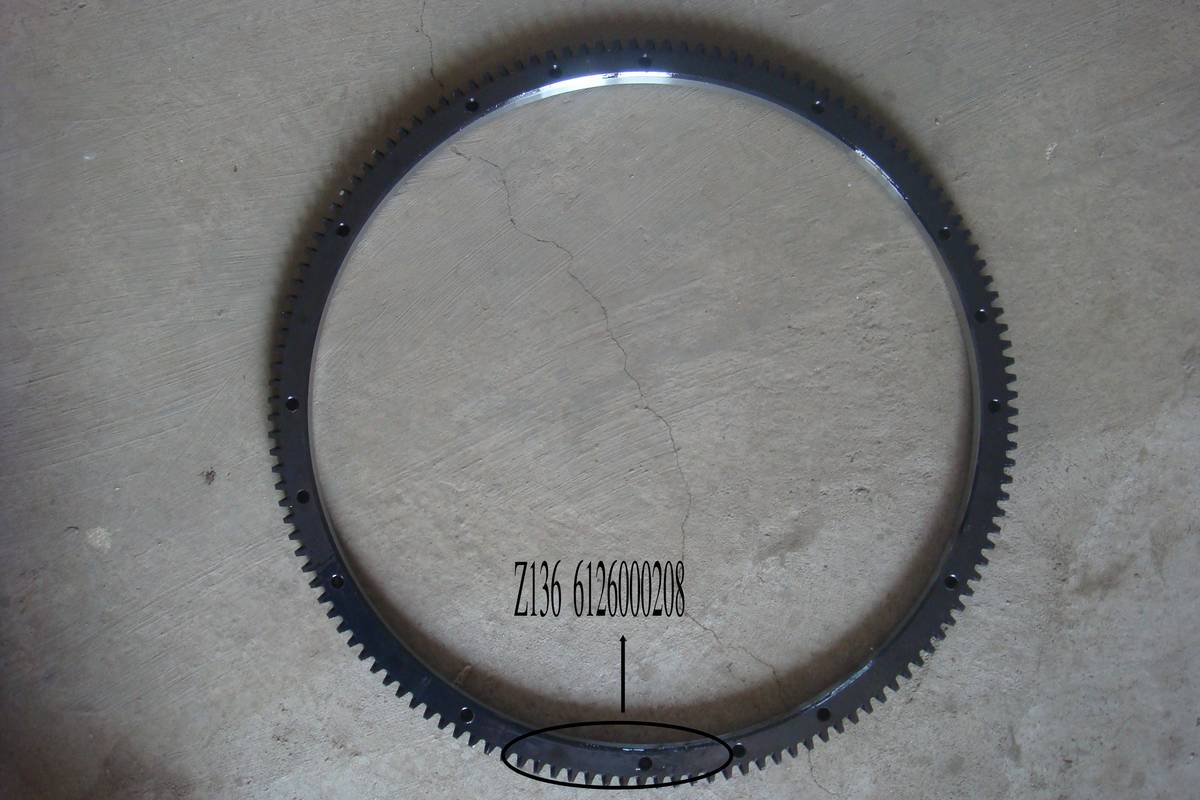
Weichai ring gear, Z136, part number 612600020208.
Why Tooth Count Alone Is Not Enough
Buyers habitually quote a ring gear by tooth count only. “I need a 136-tooth ring gear.” That is a starting point, not a specification.
The same tooth count appears on completely different ring gears. Looking at what we have run and what the catalogues show, Weichai alone uses 136 teeth across ring gears that are not interchangeable, and the same 136 appears alongside a 159-tooth version of the same part family.
A real example from a supplier listing we checked:
| Part number | Specification as listed | Brand |
|---|---|---|
| 612600020208 | 136 teeth, 159 teeth | Weichai / Sinotruk |
| 81400020015 | cross-reference for the same part | — |
Two tooth counts listed against one part number is not a mistake in the listing. It means the number is used loosely across variants, and the only reliable way to pin it down is tooth count plus inside diameter plus the engine it came off.
So the rule is: a tooth count narrows the field, it does not close it. Confirm inside diameter and fitment before ordering.
How to Measure the Ring Gear You Have
You can get everything you need with a caliper, a straight edge and about ten minutes. Do it on a clean bench, and take a photograph of each measurement against the caliper jaws rather than writing the number down from memory.
Step 1 — Count the teeth. Mark the first tooth with a paint pen and count all the way round. Do it twice. For a 136-tooth gear it is worth marking every tenth tooth as you go, because losing count at 120 and restarting is how the wrong number gets quoted.
Step 2 — Measure the inside diameter. Take at least three readings, roughly 120 degrees apart, and use the largest and smallest as your range. A ring gear that has been in service can be slightly out of round, and an oval reading tells you the gear has been overheated or forced on. On a new part from a drawing, expect a tolerance band rather than a single number, for example Ø432.000 to Ø432.155 mm.
Step 3 — Measure the width. Take three readings around the circumference. Compare against the drawing tolerance, for example 18.4 to 18.6 mm.
Step 4 — Measure the outside diameter or tooth tip diameter. This confirms the tooth height and gives a cross-check on the tooth count.
Step 5 — Note the tooth form. Look at the tooth tip. Some ring gears have a chamfer or lead-in on the teeth, some are squared off. This affects how the starter pinion enters and it is not captured by tooth count.
Step 6 — Photograph both faces and the tooth profile from the side. This single photo set resolves most identification questions faster than any written description.
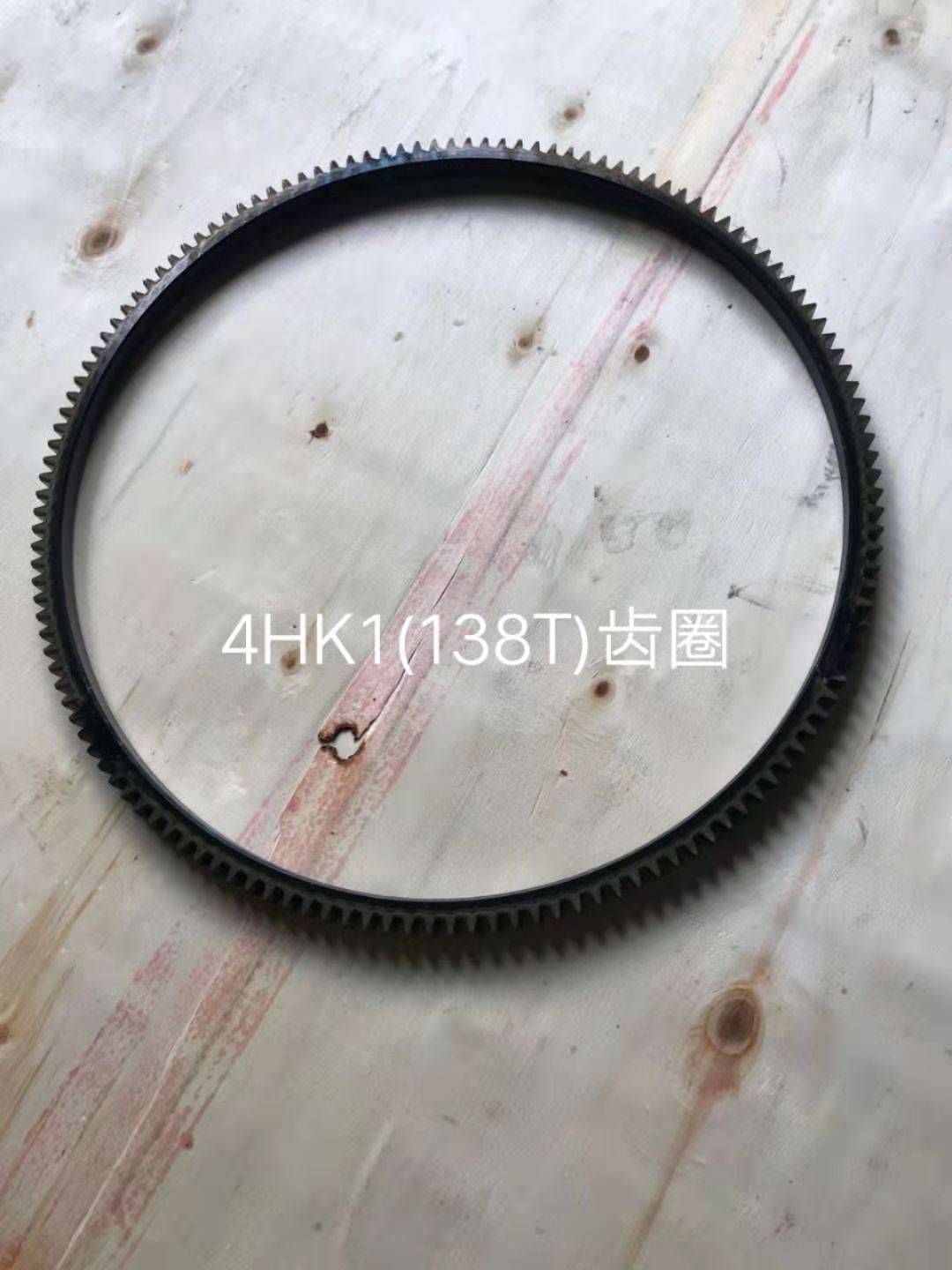
ISUZU 4HK1 ring gear, 138 teeth. The tooth count is annotated on the photograph, which is how we prefer to receive it.
Reading the Interference Fit
The ring gear does not float on the flywheel and it is not glued or welded on a manual-transmission truck. It is held by an interference fit: the ring gear inside diameter is slightly smaller than the flywheel shoulder, and the ring is heated to expand it, dropped over the shoulder, and allowed to shrink as it cools.
Get the interference wrong in either direction and you create a problem.
| Interference too small | Interference too large |
|---|---|
| Ring gear can creep or spin on the shoulder | Ring will not seat fully during the heat window |
| Starter load eventually walks the gear | High hoop stress in the ring, risk of cracking |
| Often reappears as a repeat starter failure | Teeth may not run true relative to the flywheel |
Published figures vary by engine. General guidance for shrink-on ring gears puts the interference between ring gear inside diameter and flywheel at roughly 0.20 to 0.50 mm. A Detroit Diesel MBE 4000 service manual gives a tighter band for that specific engine: flywheel shoulder 432.450–432.645 mm, ring gear inside diameter 432.000–432.155 mm, giving an interference fit of 0.295 to 0.645 mm.
The important number is not ours, it is the one in your engine’s service manual. Measure the flywheel shoulder diameter and the new ring gear inside diameter separately, then subtract. If the result falls outside the manual’s band, do not fit it.
Fitting Temperature: 200 to 230 °C, and Why 350 °C Ruins It
Heating is where ring gears get damaged before they ever turn a tooth.
| Parameter | Value | Source |
|---|---|---|
| Recommended fitting temperature | 200–230 °C | Detroit Diesel MBE 4000 service manual |
| General shrink-fit guidance | around 200 °C | industry shrink-fit practice |
| Never exceed | 350 °C | above this the tooth hardness is affected |
| Typical removal temperature | around 300 °C | for taking an old gear off |
Three fitting points that decide whether the ring survives:
Do not use a gas burner with a concentrated flame. Uneven heating creates large temperature differences around the ring, and the ring distorts. An oven is the right tool if you have one.
Do not cool it down with compressed air or coolant. Let it cool in still air against the location shoulder. Quenching a hot ring is how you get a crack that appears three months later.
Do not press a cold ring on. A cold press puts heavy local stress into the hardened tooth zone. The fit is meant to be achieved by thermal expansion, not force.
Check radial runout after fitting. The MBE 4000 allows no more than 0.5 mm runout once the ring is on the flywheel. Runout here is what makes a starter sound like it is grinding even when every part is nominally correct.
A 136-tooth ring gear seated on its flywheel shoulder. Our export crates for flywheels are labelled with the part number suffix, 0211 here meaning 612600020211.
Part Numbers: Weichai, Sinotruk and ISUZU
Ring gears carry part numbers in the same families as the flywheels they fit. For Weichai, the old twelve-digit series encodes the functional group in the middle digits, and ring gears sit in the same group as the flywheel and drivetrain parts.
| Part number | What it is | Fitment noted | Teeth |
|---|---|---|---|
| 612600020208 | Flywheel ring gear | Weichai WP10 Euro III, Shaanxi / Howo | Z = 136 |
| 81400020015 | Cross-reference for 612600020208 | Sinotruk / Weichai | 136 / 159 variants listed |
| 612600020354 | Flywheel assembly (ring gear sold with it) | Weichai WD615 / WP10 | — |
| 612600020220 | Flywheel assembly, 430 mm | WD615 / WP10 / WP12 | — |
The 612600020208 identification comes from an engine parts catalogue index showing the part number, the Chinese part name, the English name “Ring gear”, and its position in the WP10 Euro III truck manual under the crankshaft and flywheel group, with the specification listed as Z=136 for Shaanxi and Howo, and a separate supplier listing giving 81400020015 as a cross-reference. Multiple independent supplier listings quote it as 136-tooth.
For ISUZU, ring gears are usually quoted with the engine code rather than a bare number, for example the 4HK1 ring gear at 138 teeth. We keep and run these alongside the matching flywheels.
When you have a ring gear with no legible number, the engine code and the tooth count are usually enough to identify it, because the tooth count narrows the field to one or two candidates per engine family.
Two Real Drawings: What a Ring Gear Spec Sheet Looks Like
Most buyers never see the drawing for the part they are ordering. Here are two we have run, to show what the numbers actually look like in practice.
Drawing RPAL 111B1431 — starter ring gear blank:
| Property | Value |
|---|---|
| Type | Machined blank |
| Material | SAE 1010 |
| Outside diameter | Ø143.95 ± 0.04 mm |
| Inside diameter | Ø119.0 ± 0.04 mm |
| Thickness | 29.15 ± 0.04 mm |
| Perpendicularity | 0.08 mm |
| Edge break | 0.20 mm max × 45° ± 3° |
Drawing RPAL 111B1501 — second size in the same family:
| Property | Value |
|---|---|
| Type | Machined blank |
| Material | SAE 1010 |
| Outside diameter | Ø150.95 ± 0.04 mm |
| Inside diameter | Ø115.0 ± 0.04 mm |
| Thickness | 23.95 ± 0.04 mm |
| Perpendicularity | 0.08 mm |
| Edge break | 0.20 mm max × 45° ± 3° |
Both drawings carry the same chemical composition specification for SAE 1010, and both are marked “all dimensions are in mm”. These are the tolerances we hold to when a customer sends a drawing rather than asking for a catalogue part.
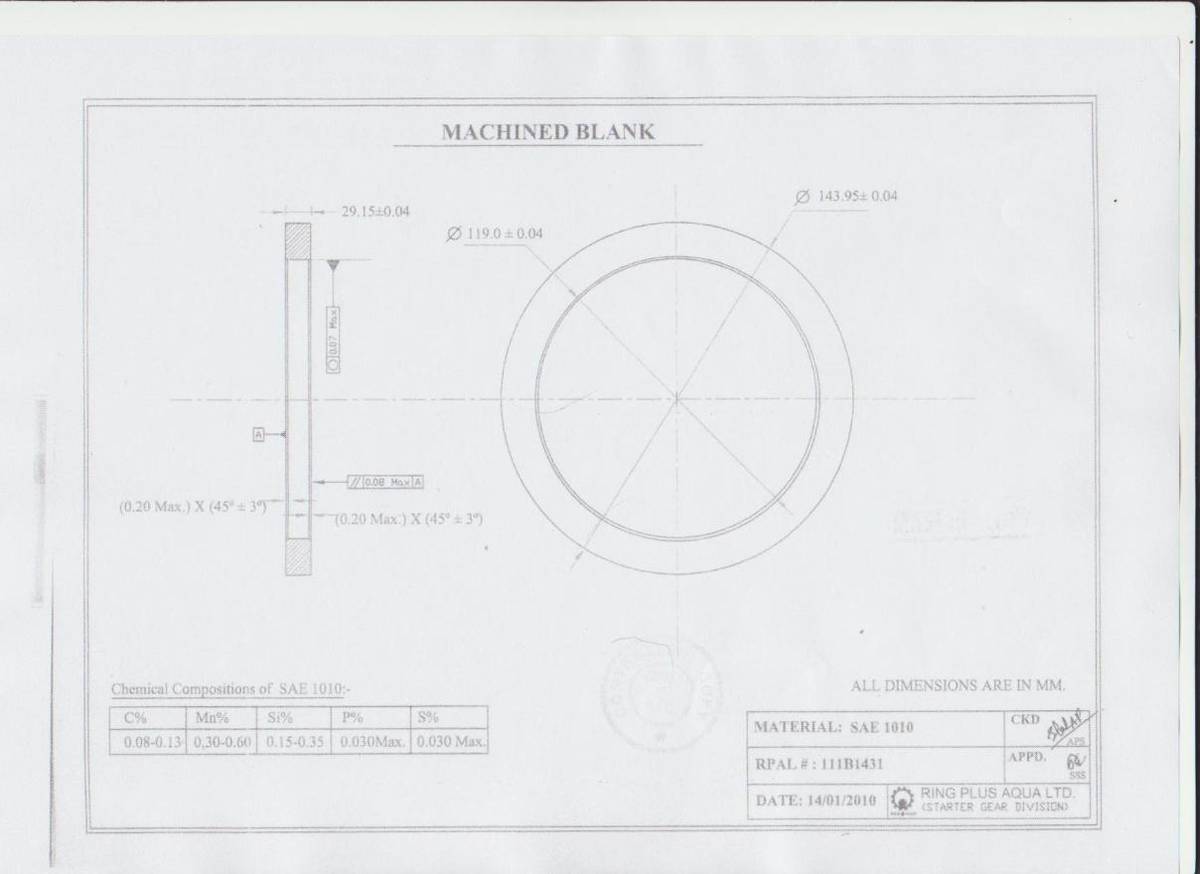
Drawing RPAL 111B1431: machined blank, SAE 1010, Ø143.95 mm outside, Ø119.0 mm inside, 29.15 mm thick.
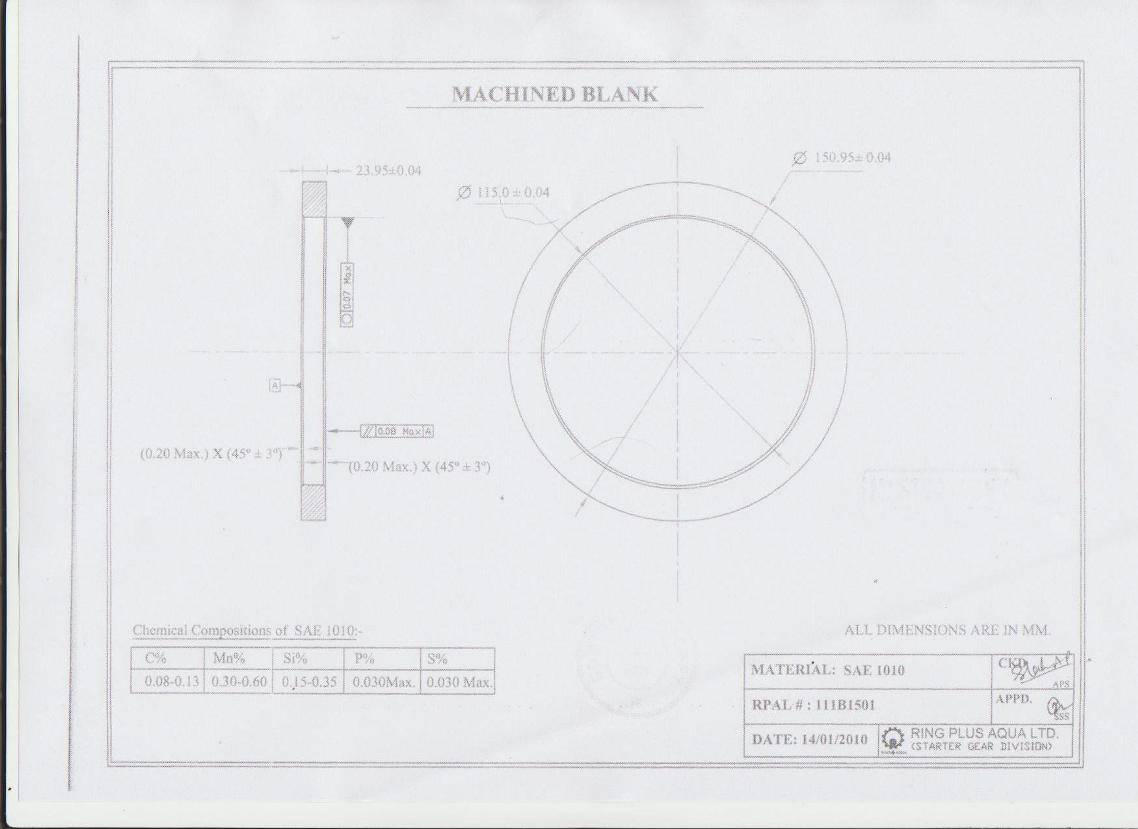
Drawing RPAL 111B1501: the second size in the same family, Ø150.95 mm outside, Ø115.0 mm inside, 23.95 mm thick.
Note what the tolerances tell you. A ± 0.04 mm band on a 143.95 mm diameter is not a rough casting. It also tells you why the inside diameter has to be measured properly and not eyeballed, because 0.04 mm is far below what you can judge by hand.
Material and Hardness
Starter ring gears are made from medium carbon steel. The two grades that appear on real drawings and in catalogue specs are SAE 1010 for the machined blank, and similar medium-carbon grades for finished toothed rings. The chemical composition on our drawings for SAE 1010:
| Element | Range |
|---|---|
| Carbon | 0.08–0.13 % |
| Manganese | 0.30–0.60 % |
| Silicon | 0.15–0.35 % |
| Phosphorus | 0.030 % max |
| Sulphur | 0.030 % max |
Hardness is specified at three depths, because that is where the load goes. The tooth face takes the sliding contact with the starter pinion. The root takes the bending. Below the root, hardness buys nothing and costs toughness.
| Location | Hardness |
|---|---|
| At pitch circle diameter | 45–55 HRC |
| At tooth root | about 40 HRC |
| 2 mm below root | 35 HRC max |
| Ring body | generally left untreated |
The ring body being left soft is deliberate. A hard, brittle body would crack under hoop stress, and the body’s job is to hold the teeth, not to resist wear.
This is also why a ring gear is usually not cast in the same iron as the flywheel. The flywheel is grey or ductile iron for damping and cost. The ring gear is a formed and heat-treated steel ring, shrunk or bolted on. Casting the teeth into iron would give a gear that wears out fast.
The 159-Tooth Trap and Other Common Mix-Ups
A few mix-ups account for most wrong ring gear orders.
136 versus 159. Both appear in Weichai ring gear catalogue listings, sometimes against the same base part number. They are not interchangeable and they are not visually obvious until you count. Count.
Ring gear alone versus ring gear on the flywheel. On some Weichai numbers, the ring gear is only supplied as part of the flywheel assembly, for example 612600020354 and 612600020220. If your truck uses one of those, buying a loose ring gear may not be an option and you may be ordering the flywheel.
Worn teeth mistaken for a starter fault. A starter that grinds is often diagnosed as a starter problem. Look at the ring gear teeth first. If the teeth are chewed on one arc rather than all round, the problem is the starter engagement, and a new ring gear will be chewed the same way.
A ring gear that has been hot. Discolouration, a blue or straw tint on the teeth, means the ring was overheated at some point, either at fitting or in service. Check the interference and the hardness, because the tooth hardness may already be gone.
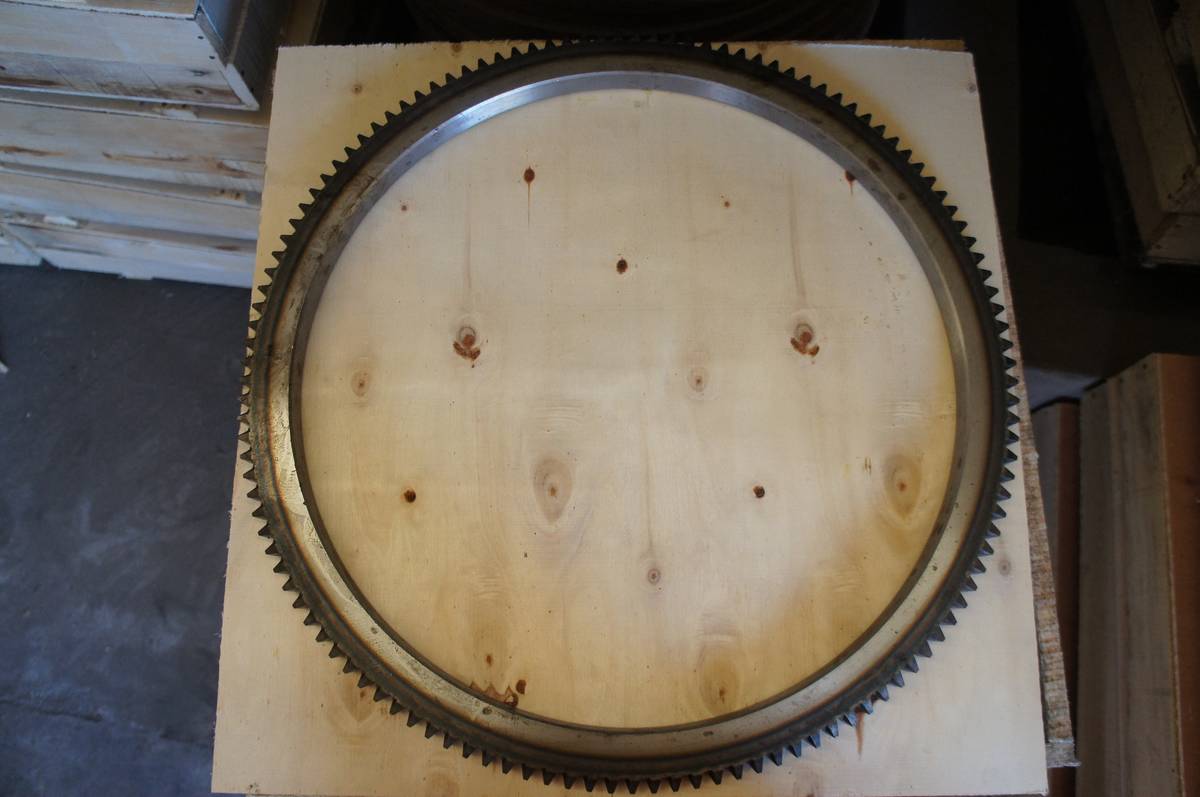
A ring gear stood on edge, the view that shows body width and tooth form together.
What to Send Us for a Quote
Send these and we can quote without a round of questions:
- Tooth count, counted twice
- Inside diameter in mm, three readings
- Width or thickness in mm
- Outside diameter or tooth tip diameter
- Engine make and model the part came off
- Part number if any is legible, or a photograph of it
- Photographs of both faces and the tooth profile from the side
- Whether you need the ring gear alone or the complete flywheel assembly
If it is a new part rather than a replacement, send the drawing. We work to drawings routinely, including tolerances in the ± 0.04 mm range and specified perpendicularity.
FAQ
What is the tooth count on a Weichai WP10 ring gear?
The 612600020208 ring gear is listed as Z=136, fitting WP10 Euro III in Shaanxi and Howo applications. A 159-tooth variant appears in the same catalogue family. Always confirm against the engine rather than assuming 136.
Can I identify a ring gear by tooth count alone?
No. Tooth count narrows the field but several ring gears share a count. You also need inside diameter, width, and the engine family.
What interference fit should a ring gear have?
General guidance is roughly 0.20 to 0.50 mm between the ring gear inside diameter and the flywheel shoulder. The Detroit Diesel MBE 4000 manual specifies 0.295 to 0.645 mm for that engine. Use the figure in your own engine’s service manual.
What temperature do I heat a ring gear to?
200 to 230 °C. Above 350 °C you start losing tooth hardness. Heat it evenly, ideally in an oven, not with a gas flame.
Can I cool the ring gear with compressed air after fitting?
No. Let it cool in still air against the location shoulder. Forced cooling risks cracking the ring.
Can I press a cold ring gear onto the flywheel?
Not recommended. Cold pressing puts high local stress into the hardened tooth zone. The fit should be achieved by thermal expansion.
What runout is acceptable with the ring gear fitted?
The MBE 4000 specification allows 0.5 mm maximum radial runout after fitting. Excess runout causes a grinding starter even when the parts are nominally correct.
Why did my new ring gear wear out in a few months?
Look at the wear pattern. Wear on one arc points to a starter engagement problem, not a ring gear material problem. Check starter pinion, shims, and the flywheel-to-starter centre distance before replacing the ring gear again.
Do you supply ring gears to drawing?
Yes. Send the drawing with material, dimensions, tolerances and hardness requirements. We also match existing OEM ring gears from a sample or from the part number plus engine code.
What is your MOQ and lead time?
MOQ and lead time depend on whether the part is a current production size or a one-off against drawing. Send the specification and we will confirm both.
Get a Ring Gear Quote
Send a photograph of the ring gear with the teeth visible, plus the tooth count and inside diameter, and we will come back with a price and a lead time. If you are not sure of the measurement, send the photograph first and we will tell you what to measure.
Irene
changweiintl.com
[email protected]
+86 19953662121 (phone, WeChat, WhatsApp)
Factory: Wangke Industrial Zone, Changyi, Weifang, Shandong, China
IATF 16949 certified foundry. FOB Qingdao.
Related reading:
– Ring gear manufacturing process and quality control
– ISUZU 4HF1 flywheel, 138 teeth, 325 mm
– Weichai flywheel part numbers, 6126000 and 1000 series
– All flywheel and ring gear products
– Request a quote