
Volvo 11L Flywheel Longevity: 4 Manufacturing Factors Behind 200,000+ km
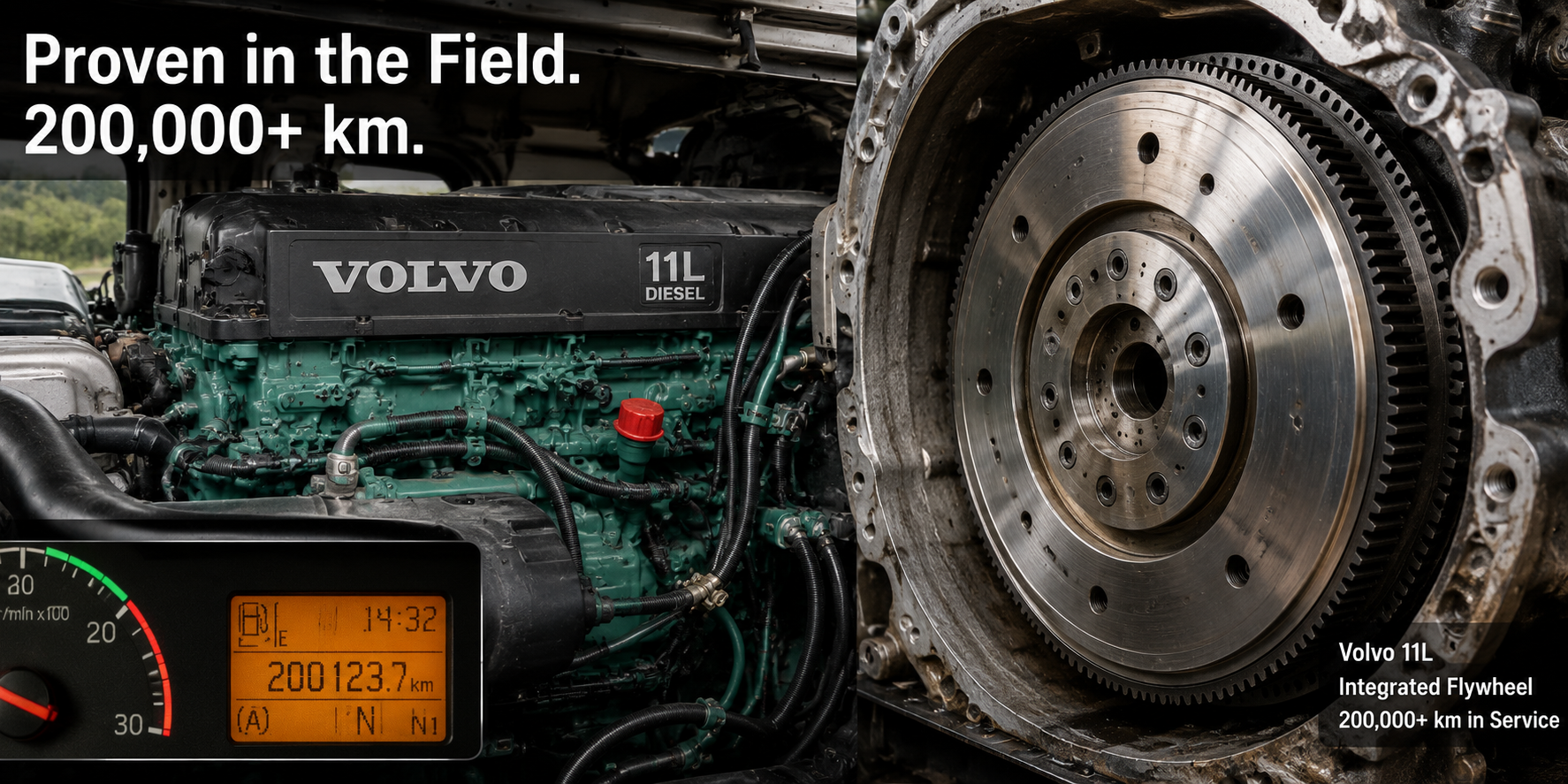
The Volvo “Bianda” 11L diesel has earned a reputation for staying power — accumulating over 200,000 kilometers of operation on the Euro III emission standard and still running reliably. While much of that reliability is credited to the engine’s overall design, the truth is that longevity is built component by component. Among them, the Volvo 11L flywheel contributes more to long-term durability than many operators and technicians realize.
This article examines the specific manufacturing factors that enable a flywheel to survive 200,000+ km — material quality, machining precision, dynamic balancing, and heat treatment — rather than treating the flywheel as a simple rotating mass. As a manufacturer of European-series flywheels including Volvo applications, Changwei’s production experience offers practical insight into what makes flywheels last.
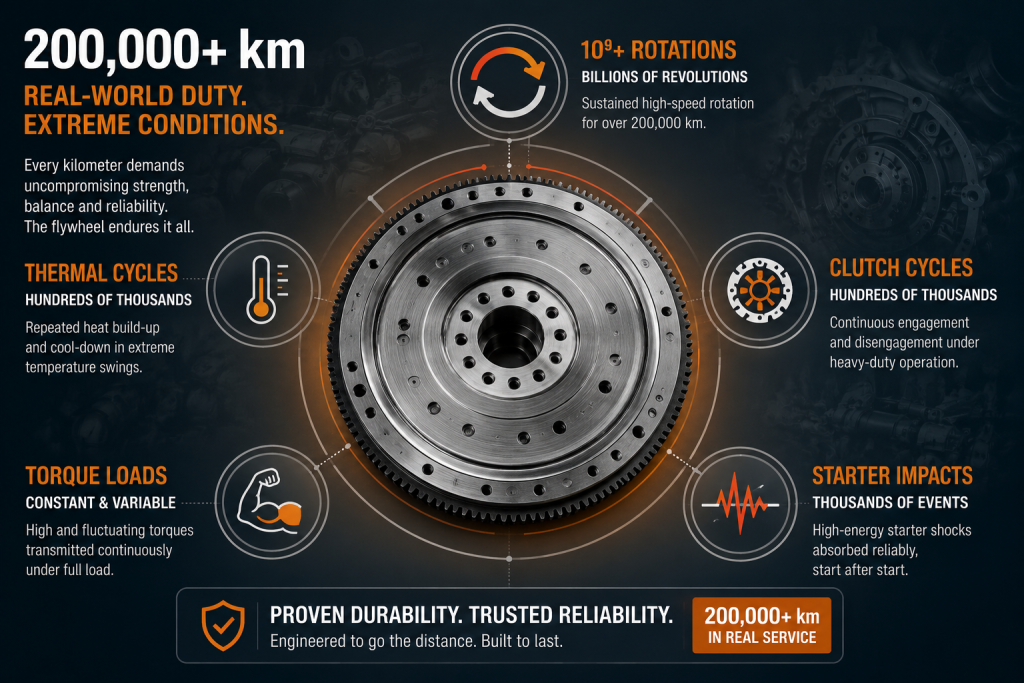
What the Flywheel Endures Over 200,000 Kilometers
Over that distance, a flywheel is subjected to relentless, repeating demands:
- Billions of rotations — at an average 1,500 RPM across 200,000 km, the flywheel completes well over a billion revolutions, each a cyclic load.
- Thermal cycling — heat from combustion proximity and clutch friction drives thousands of expansion-contraction cycles.
- Clutch engagement cycles — every engagement adds friction heat and mechanical stress to the friction surface; in commercial duty this happens thousands of times a year.
- Torsional loading — the flywheel must absorb and dampen the engine’s combustion-pulse torsional vibration to protect the drivetrain.
- Starter engagement — each start impacts the ring-gear teeth with starter-motor pinion shock.
For the flywheel to survive these over 200,000+ km, four manufacturing attributes are critical: material quality, machining precision, dynamic balancing, and proper heat treatment.
Factor 1: Material Quality
The foundation of flywheel durability
Material selection is the most fundamental determinant of flywheel life. The Volvo 11L flywheel, like most heavy-duty diesel flywheels, is typically high-grade cast iron or forged steel. The grade sets four properties:
- Tensile and compressive strength — the flywheel must hold the pressure-plate bolt clamp and combustion loads transmitted through the crankshaft. Inadequate strength leads to bolt-hole elongation and friction-surface deformation that compound into failure.
- Thermal stability — over 200,000 km the flywheel undergoes continuous thermal cycling; poor stability warps, cracks, or builds internal stress. The Volvo 11L’s demonstrated longevity points to material that holds dimension under prolonged thermal stress.
- Wear resistance — the friction surface must resist scoring and glazing from clutch-disc contact.
- Damping capacity — cast iron’s inherent ability to absorb vibrational energy eases stress on the crankshaft, transmission, and drivetrain.
Material quality in practice
At Changwei, flywheel production begins with verified material. As an IATF 16949-certified manufacturer, material traceability and incoming inspection are built into the quality system: certifications are checked against specification and mechanical properties are verified before production starts. A flywheel made from substandard material — even one visually identical — will not deliver equivalent service life.
Factor 2: Machining Precision
Why dimensional accuracy matters over time
Machining precision governs how the flywheel meets surrounding components, and those interactions compound over 200,000 km:
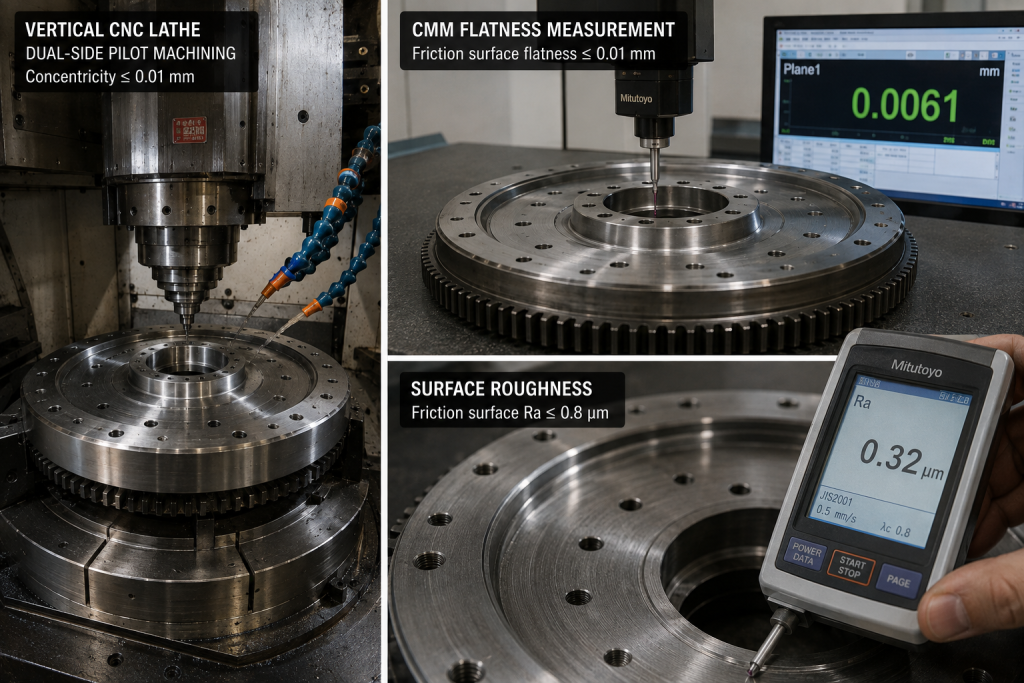
- Friction surface flatness — must hold tight tolerances; micron-level deviation causes uneven clutch contact, local hot spots, and eventual warping. Precise flatness spreads wear evenly, extending flywheel and clutch-disc life.
- Pilot bore concentricity — the pilot bore locates the flywheel on the crank and must be concentric with the friction face and bolt circle; eccentricity causes off-center rotation, imbalance, and uneven engagement.
- Bolt-hole pattern accuracy — mislocated or mis-sized holes create uneven clamping, leading to loosening, fretting, or stress-concentration cracking.
- Ring-gear fitment surface — the seat diameter must be machined to the correct size for a proper heat-shrink fit; oversize means ring-gear spin or chatter, undersize means excess stress that can crack the rim.
Production capability
Holding these tolerances demands the right equipment and process control. Changwei’s facility includes 20 vertical CNC lathes, 30 machining centers, and 20 gear-hobbing machines, supported by CMM inspection — enabling the flatness, concentricity, and surface finish that feed flywheel longevity.
Factor 3: Dynamic Balancing
The hidden factor in long-term reliability
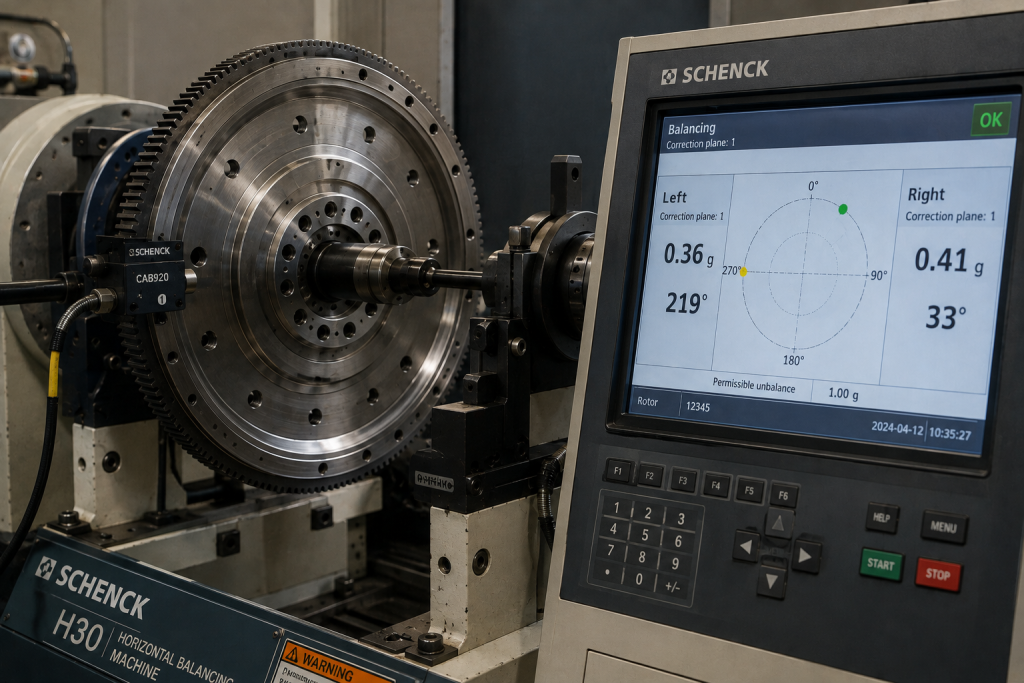
Dynamic balancing is the most critical yet underappreciated factor in flywheel durability. An unbalanced flywheel generates centrifugal force that rises with the square of rotational speed, so even a small imbalance at diesel RPM becomes a large periodic load. Over 200,000 km its cumulative effect is severe:
- Crankshaft bearing wear — imbalance forces transmit through the crank to the main bearings, accelerating wear.
- Crankshaft fatigue — cyclic loading contributes to crack initiation over extended operation.
- Engine-mount stress — forces pass through the block to the mounts, accelerating their deterioration.
- Drivetrain vibration — imbalance transmits through the clutch to the transmission and beyond.
- Flywheel self-fatigue — the forces also act on the flywheel’s own structure at stress points.
A well-balanced flywheel — meeting or exceeding the original engine’s balance spec — eliminates these forces. Balancing measures rotational imbalance and corrects it by adding or removing material at precise locations; Changwei performs dynamic balancing verification as a standard QC step so every flywheel ships to its application’s balance specification.
Factor 4: Proper Heat Treatment
Structural integrity through thermal processing
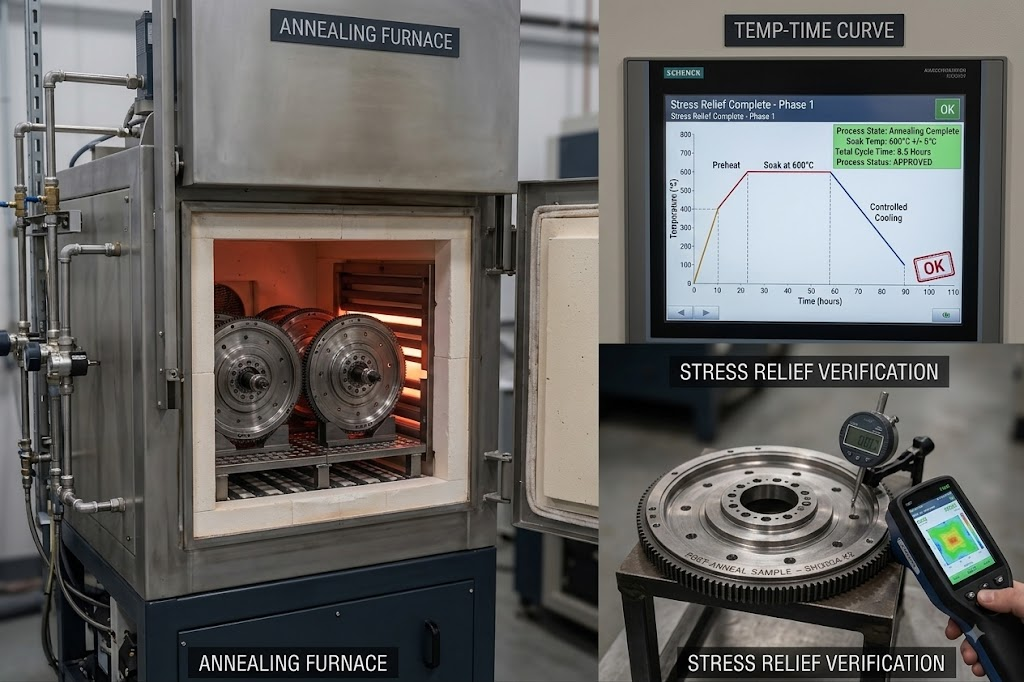
Heat treatment gives the flywheel its final mechanical properties. For cast iron this typically involves:
- Stress-relief annealing — after casting and rough machining, internal stresses are released by heating to a set temperature and cooling under control, preventing warpage during service thermal cycling. Without it, the flywheel may distort in normal operation, causing imbalance and friction-surface deterioration.
- Surface hardening (where applicable) — some applications need localized friction-surface hardening for wear resistance, carefully controlled to avoid brittleness or cracking. The Volvo 11L’s 200,000+ km life suggests its original heat treatment was correctly specified and executed.
- Consistency — variation in furnace temperature, soak time, or cooling rate between batches changes mechanical properties; a flywheel from a badly treated batch looks identical but fails early. Process control and documentation, integral to IATF 16949, ensure consistency.
How the Four Factors Work Together
No single factor — material, machining, balancing, or heat treatment — can independently produce a durable flywheel. Engine longevity results from all four being executed correctly: high-quality material provides the foundation, precision machining ensures proper fit and function, dynamic balancing eliminates destructive vibration, and proper heat treatment ensures structural stability under thermal stress. When any one is deficient, flywheel life drops and the engine’s overall longevity suffers. The Volvo 11L’s 200,000+ km performance demonstrates what is possible when all four are done right.
Practical Implications for Component Buyers
For fleet operators, maintenance managers, and procurement specialists sourcing replacement flywheels for Volvo applications, these four factors form a supplier scorecard:
- Verify material specifications — does the supplier meet the original engine maker’s grade, with certifications available?
- Assess machining capability — can they hold the required flatness, concentricity, and finish, with inspection to prove it?
- Confirm balancing procedures — is dynamic balancing performed on every flywheel, to what grade?
- Evaluate heat treatment — are processes documented and controlled, consistent batch to batch?
And always read the full flywheel part number, not just the suffix — two flywheels can share a suffix yet fit different engine platforms. We covered that trap in detail in our guide on why the same flywheel part number suffix can hide a different part; reading the full number is the simplest way to avoid specifying the wrong part. Contact our engineering team to discuss flywheel specifications for your Volvo or other European-engine applications.
Conclusion
The Volvo 11L flywheel contributes to the engine’s demonstrated 200,000+ km reliability through the combined effect of material quality, machining precision, dynamic balancing, and proper heat treatment. No single attribute is responsible; durability results from all four executed to specification. For anyone responsible for diesel maintenance or component sourcing, the practical takeaway is clear: judge a replacement flywheel by these four manufacturing factors and the supplier who can verify them — not by emission tier, and not by the part number alone.
About Changwei: Weifang Changwei Intelligent Equipment Co., Ltd. is an IATF 16949 certified engine flywheel manufacturer based in Weifang, China. With a 40,000 sqm production facility, 20+ years of engineering experience, and production equipment including 20 vertical CNC lathes, 30 machining centers, and 20 gear-hobbing machines with CMM inspection, Changwei supplies flywheels, gear rings, and housing parts — including Volvo and other European-series applications — to customers in 20+ countries. Contact us for OEM/ODM flywheel solutions.