
Timing Gear Housing Oil Leaks, Noise & Timing Faults: Diagnosis & Replacement Guide
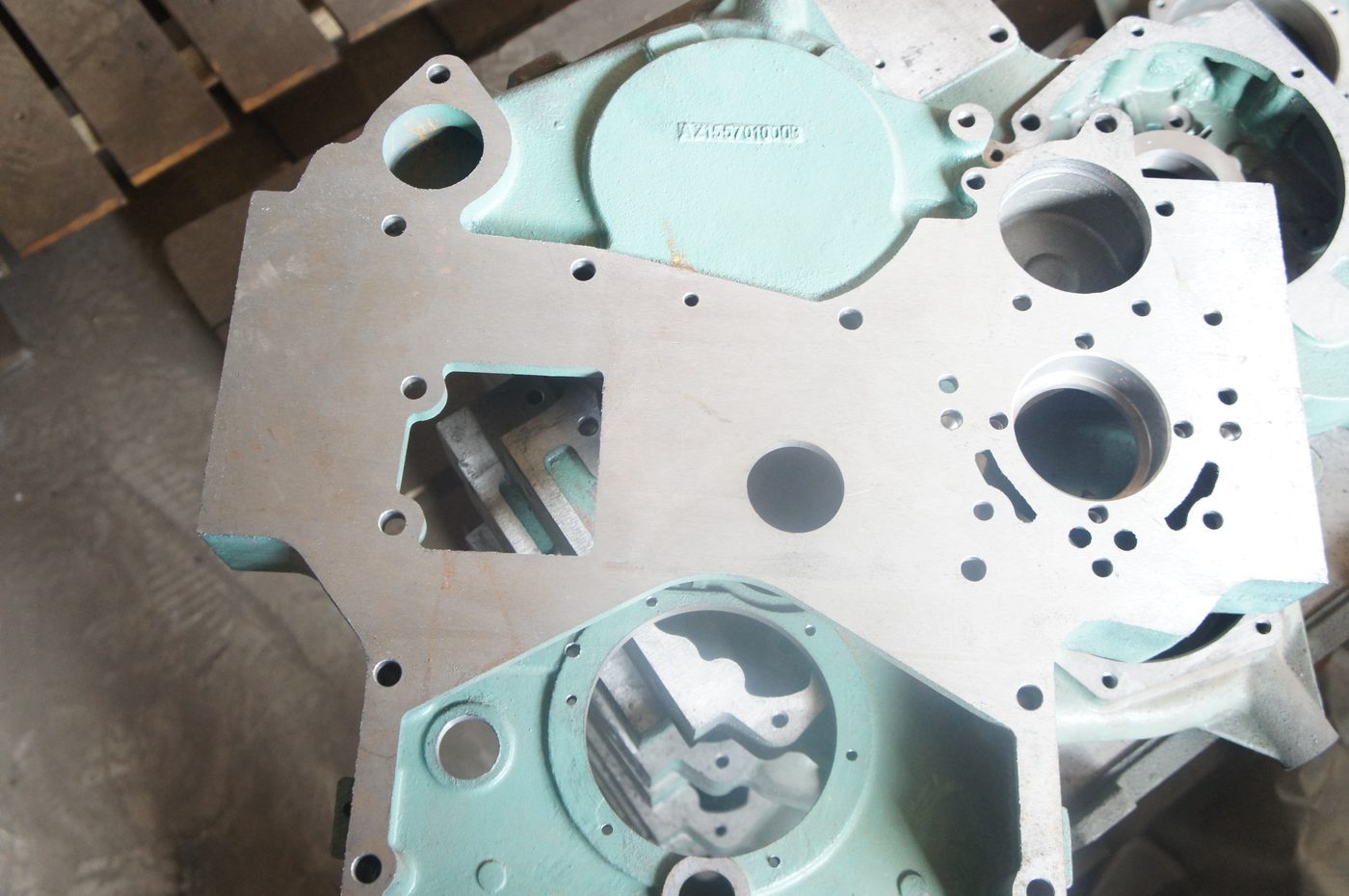
Timing Gear Housing Oil Leaks, Noise & Timing Faults: Diagnosis & Replacement Guide
A timing gear housing is not a wear item, but when it fails the consequences escalate fast. On a 4-valve heavy-duty diesel, even a small housing distortion will drift the timing marks; in the worst cases the piston climbs up and kisses the valve, and you end up pulling the engine. The real challenge in the workshop is not whether the housing can be swapped out — it is whether the symptom actually points at the housing at all. Front-end oil leaks, knocking noise and rough idle can come from the front crankshaft seal, the chain tensioner, the injection pump drive gear, or even a charge-air pipe.
This article is ordered the way a technician works the problem: confirm the housing is the cause, decide whether to repair or replace, then walk through the fitting steps where most mistakes happen. We are an IATF 16949 certified iron foundry and machining shop. We currently produce timing gear housings for both Sinotruk HOWO and Weichai platforms — HT250 by default, QT500-7 for high-load applications — so the parameters and failure cases below are drawn from real production and field data.
Table of Contents
- What a Timing Gear Housing Actually Does
- Six Common Symptoms at a Glance
- Oil Leaks: Is It the Housing or the Front Crank Seal?
- Knocking Noise: Gear Mesh vs Bearing
- Housing Distortion and Timing Drift
- Repair or Replace: Decision Table
- Fitting Notes: Mating Face, Dowel Pins, Sealant and Bolt Torque
- Material and Operating Conditions: HT250 vs QT500-7
- Sourcing Notes: Verifying the OE Part
- FAQ
- Talk to Our Engineering Team
What a Timing Gear Housing Actually Does
The timing gear housing is a cast-iron shell mounted on the front face of the cylinder block. It encloses three gear groups on a diesel engine:
- Crankshaft timing gear
- Camshaft timing gear
- Injection pump drive gear
On some platforms the air-compressor drive gear and the chain/belt tensioner sit inside as well. The housing does four things:
- Isolates the gear train from dust, water and mud
- Provides a rigid frame so gear center distances stay fixed
- Locates and supports the front crankshaft oil seal
- Carries the timing inspection port and alignment marks on the outer face
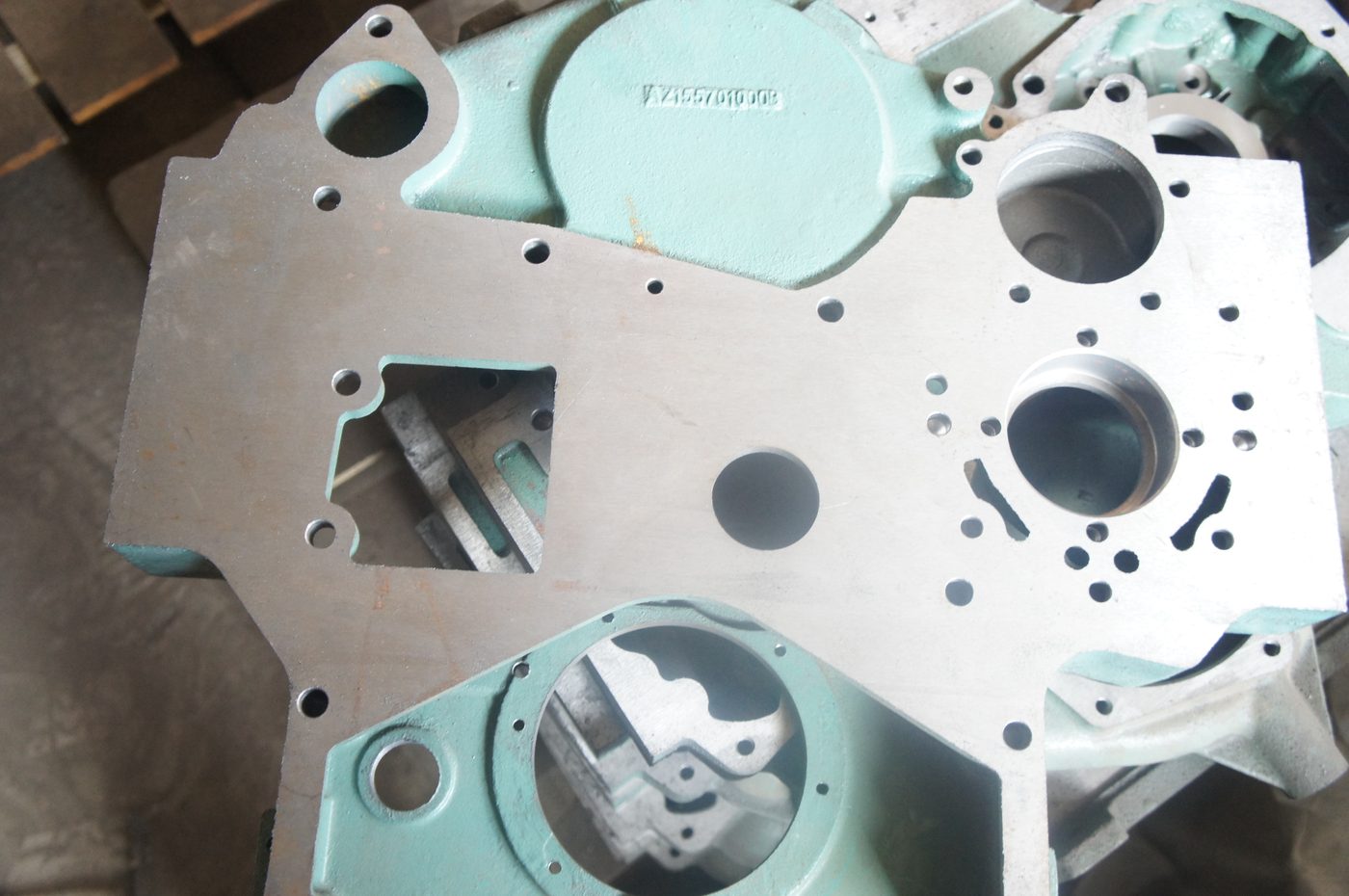
In terms of position on the engine, the timing gear housing sits at the front of the block; the flywheel housing sits at the rear. They are separated by the whole engine but share the same load and material logic.
Six Common Symptoms at a Glance
The table below lists the six most common complaints seen in the workshop, ordered by symptom — most likely cause — severity — first action. The diagnostic flow is: identify the symptom, narrow down the cause with the dedicated sections below, and only then take the housing off.
| Symptom | Most likely cause | Severity | First action |
|---|---|---|---|
| Heavy front-end oil leak, oil on ground after rest | Worn front crankshaft seal | Medium | Replace seal first |
| Seepage only at lower edge of housing, no oil on crank pulley | Housing mating face / gasket | Medium | Re-tighten bolts, inspect mating face |
| Idle knocking that fades as rpm rises | Worn tensioner or chain/belt | Medium | Listen + check tensioner |
| Rhythmic metallic knock at mid and high speed | Gear mesh issue / excessive backlash | Medium-High | Strip and check gears |
| Rough idle, rising fuel use, low power | Timing drift (crank/cam out of sync) | High | Check timing marks |
| External porosity or sand inclusion leaking | Casting defect on housing | High | Replace housing outright |
Of these six, front-end oil leak is the most common, but only about 30% actually point at the housing itself — the rest are the front crank seal or the tensioner. A wrong call costs dismantling time, a new seal, sealant and downtime — easily four figures.
Oil Leaks: Is It the Housing or the Front Crank Seal?
This is the most misdiagnosed pairing. The mechanic opens the front cover, sees oil, calls it a housing leak, replaces the housing — and the leak is still there, because the front crankshaft seal was the real culprit.
Four steps to tell them apart:
- Trace the oil trail. A leaking front crank seal throws oil radially along the crankshaft pulley — a star-shaped pattern around the pulley and oil pan front. A housing mating-face leak runs in a continuous line along the lower edge of the housing or the block joint.
- Clean and pressurize. Strip the pulley and front cover, pressurize the front of the crankshaft at 0.2–0.3 bar for 30 seconds, and watch for bubbles.
- Inspect the seal lip. Pull the seal out and check the lip under a strong light for hardening or wear grooves. If found, replace the seal before chasing anything else.
- Inspect the mating face. Mating face leakage usually comes from loose bolts, a scratched face, or aged sealant. Re-torque and clean the face often resolves it.
There is also a case that’s easy to miss: porosity or shrinkage cavities in the housing itself. These present as a “patch” of oil rather than a line, on the housing body — and should be caught by the 100% pressure test the foundry runs before shipment.
Knocking Noise: Gear Mesh vs Bearing
A metallic knock at idle or low rpm is often blamed on the gears, but in roughly 70% of cases the real culprit is the tensioner or the timing chain/belt.
Three checks:
- Listen at the right place. Gear-train knock is loudest from the front (outer) face of the housing. Bearing knock comes from the two flanks, sounds duller and more continuous.
- Compare RPMs. Hold at 800 rpm and 1500 rpm for 30 seconds each. Gear noise is usually tied to tooth-passing frequency and gets more obvious as rpm rises. Tensioner noise is loudest at low rpm and often fades as rpm climbs.
- Pull and measure the tensioner. If the tensioner can be removed, measure its travel — replace if travel is short. Replace the chain/belt if there is debris or flaking.
Once you confirm the noise is actually gear mesh — single-sided tooth contact, backlash above 0.3 mm, or chipped tooth flanks — then the housing matters. But note: most gear noise is not caused by housing distortion. It is gear wear or poor lubrication. Replacing the housing without replacing the gears leaves the noise right where it was.
Housing Distortion and Timing Drift
This symptom cluster is the toughest. Rough idle, rising fuel consumption, black smoke under load, low power — looks like a fueling problem, but swapping injectors doesn’t fix it.
Diagnostic sequence:
- Check timing marks. Pull the timing inspection port plug and look at the alignment between the crankshaft pulley mark and the timing mark cast on the housing. If they don’t line up, the timing has drifted.
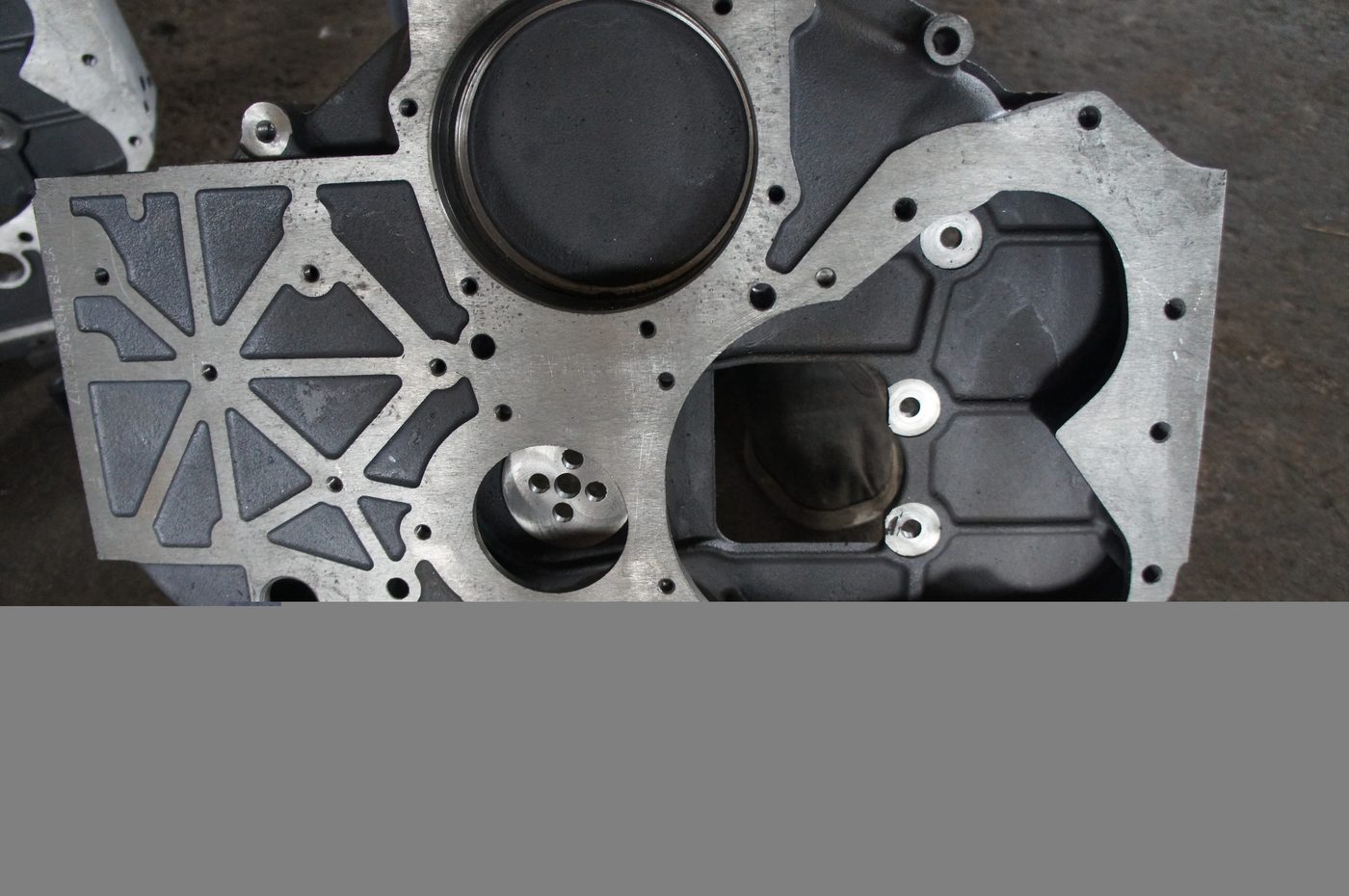
- Strip the front cover and inspect the gears. Once the housing distorts, the center distance between the crank gear and cam gear shifts — look for a single-sided wear band on the gear flanks.
- Measure the mating face flatness. Place the housing on a surface plate and use feeler gauges. Above 0.15 mm — scrap.
Two scenarios cause housing distortion:
- Cold-start heavy loading. Starting a cold heavy truck in high gear and pulling away — the gear impact overloads the housing.
- Uneven bolt torque. Wrong tightening sequence or under-torque during a prior service leaves the housing under internal stress; heat cycles gradually let it drift.
Once distortion is confirmed as the cause, do not try to hammer it back. Cold-worked cast iron carries internal stress; hammering introduces secondary warping. Replace.
Repair or Replace: Decision Table
| Inspection item | Repair / keep | Replace |
|---|---|---|
| External porosity or shrinkage leak | — | ✅ Any porosity leak |
| Mating face flatness ≤ 0.05 mm | ✅ Clean and keep | — |
| Mating face flatness 0.05–0.15 mm | May lap and keep | Depends on application |
| Mating face flatness > 0.15 mm | — | ✅ Recommend scrap |
| Block-to-housing dowel pin holes damaged | — | ✅ Must replace |
| Seal bore worn | Can be sleeved | Heavy-duty: replace |
| Internal bolt holes (threaded) stripped | Can be Helicoiled (non-standard) | Critical holes: replace |
| External rib cracked | — | ✅ Must replace |
Two simple rules: any seepage, don’t repair; any crack, replace. Welded repair of cast iron housings is rarely trustworthy — the weld changes the local hardness and the weld line becomes the new crack initiation site.
Fitting Notes: Mating Face, Dowel Pins, Sealant and Bolt Torque
Removing and refitting the housing is itself the most common cause of housing distortion. Six points:
- Mark before disassembly. The crank and cam gears already have alignment marks from the factory. Add your own set of pen lines before pulling the cover. If the gears haven’t moved, do not touch the timing.
- Bolt tightening sequence. Tighten in a diagonal star pattern, three stages (50%, 80%, 100%). Do not tighten in sequence. Reference torque for Sinotruk WD615 series housing bolts: 240 ± 20 N·m for M16, 160 ± 15 N·m for M14 (verify against the factory manual for your engine).
- Clean the mating face. Scrape all old sealant off the block face with a scraper — no scratches. Housings with deep scratches on the face should be replaced.
- Fit dowel pins first. The block has two locating dowels. They have to be seated before the housing comes down. Skipping this lets the housing sit 1 mm off center.
- Pick the right sealant. Silicone RTV (e.g. Loctite 5900) or anaerobic flat sealant (e.g. Loctite 510). For long-haul heavy trucks, plain RTV is not recommended because it swells in oil. Bead thickness 0.3–0.5 mm, in a figure-8 around the bolt holes.
- Replace the front crank seal at the same time. Once the housing has been off, the front seal lip is 80% disturbed. Replace it together and avoid a second strip-down.
Material and Operating Conditions: HT250 vs QT500-7
Two materials dominate timing gear housings. HT250 gray cast iron is the default — lower cost, good damping — and fits most on-road platforms. QT500-7 ductile iron is stronger and tougher, and is recommended for high-load service such as mining trucks, 6×6 dump trucks, and concrete mixers.
Material selection by operating condition (heavy-truck duty cycles):
| Operating condition | Recommended material | Reason |
|---|---|---|
| On-road standard haul (HOWO 7, HOWO A7, Shandeka on-road) | HT250 | Best cost, good damping |
| Mining trucks, 6×6 dump | QT500-7 | Impact and torsion resistance |
| High-altitude heavy haul (Tibet, Xinjiang) | QT500-7 + thicker section | Cold/hot cycling impact |
| Concrete mixer, concrete pump (with PTO) | QT500-7 | Torsion shock from PTO |
We produce seven Sinotruk HOWO timing gear housing part numbers — AZ1038010009, 612600010008, AZ1038010007, 612600010008A, 61260001958A, 612600010009, 612600010933 — covering WD615, WD618, WP10 and WP12 platforms. HT250 or QT500-7 can be specified per application. Full parameters and engine fitment are on the Sinotruk HOWO Timing Gear Housing product page.
Sourcing Notes: Verifying the OE Part
A wrong part costs more than a new housing — leak, gear noise, and in the worst case a cylinder head removal.
Three checks on receipt:
- Order by OE number. Use the part number (AZ1038010009, 612600010008, 612600010008A and so on), not “HOWO housing” or “WD615 housing” — those descriptions match too many parts.
- Check the stamp. Every housing leaves the foundry with the part number stamped on the side or top. Cross-check against the invoice before installation.
Three common traps:
- AZ1038010009 and 612600010009 are not the same part. The first is WD615 National III/IV; the second is WP10 National IV. Different housing outline, different seal groove. The numbers look alike; they are not interchangeable.
- 612600010008 and 612600010008A cannot cross-fit. The “A” suffix is a 2014+ revision with a new seal face and dowel pin holes. Old engine on new housing leaks; new engine on old housing sits loose.
- WD618 and WD615 housings do not interchange. WD618 is the 11.6L large-displacement platform; it is 2–3 kg thicker and has different bolt holes.
The safest path: send a clear photo of the old housing (showing the stamp) together with the vehicle VIN. We confirm the match within 1–2 hours.
FAQ
Front-end oil leak — first action?
Clean the area and pressurize. 70% of “housing leaks” are actually a worn front crank seal. Replace the seal first and you save a strip-down.
Does rough idle always mean timing drift?
No. Rough idle has a dozen possible causes (misfire, intake leak, fuel pressure, sensor faults). Timing drift is just one of them. But if there’s no oil consumption, the intake is fine, and the roughness varies with load, the timing check is the cheapest next step.
Can a porosity hole be weld-repaired?
Not recommended. Welded cast iron changes local hardness; the weld line becomes the new crack initiation site under load. Replace.
Can a distorted housing be hammered back into shape?
No. Cold-worked cast iron carries internal stress; hammering introduces secondary warping. Replace.
Gray iron or ductile iron?
On-road standard haul: HT250 is enough. Mining trucks, mixers, concrete pumps, high-altitude heavy haul: step up to QT500-7.
Can a WD615 housing be used on a WD618?
No. WD618 is the 11.6L platform; the housing is 2–3 kg thicker and bolt-hole patterns differ. Cross-fit causes sealing failure and gear interference.
How do I find the OE number on my truck?
Pull the old housing and read the stamp, check the engine nameplate (on the side of the block), or send the VIN to your supplier.
Can you build to a non-standard drawing?
Yes. We regularly work to customer drawings and samples, including non-standard bolt-hole and dowel pin patterns. Mold lead time is typically 20–30 days.
What is the lead time?
In-stock items: 7–10 days. Custom: 20–30 days. FOB Qingdao. Urgent orders can be expedited.
FOB or CIF?
Both. Default FOB Qingdao; CIF quoted against the destination port. Common ports: Lagos, Jakarta, Ho Chi Minh, Manila, Hamburg, Callao.
Talk to Our Engineering Team
Need a quotation to drawing, or want us to verify the OE number for a specific application? Send a photo of the existing housing (showing the part number stamp) plus the vehicle VIN. We will come back within 1–2 hours with a matching solution and a quotation. We are an IATF 16949 certified foundry and machining shop — FOB Qingdao.
- Email: [email protected]
- Phone / WeChat / WhatsApp: +86 19953662121
- Factory: Wangke Industrial Park, Changyi, Weifang, Shandong, China
- Online inquiry: https://www.changweiintl.com/en/inquiry
Related reading:
– Sinotruk HOWO Timing Gear Housing product page (7 part numbers)
– Weichai Timing Gear Housing product page (10 specs across WD615/WP10/WP12/WP13)
– Flywheel Housing: Function, Materials and Failure Signs
– Ring Gear Manufacturing: Process & Quality Control
– Common Cast Iron Defects in Engine Parts and Acceptance Standards