Same Code, Different Flywheel: Why WP10 and WP2 “0354” Flywheels Are NOT Interchangeable
In the heavy-duty engine parts world, shorthand is everywhere. Long OE part numbers get shortened to four-digit codes for convenience in conversation, text messages, and informal ordering. Most of the time, this works fine. But when it does not, the consequences are expensive.
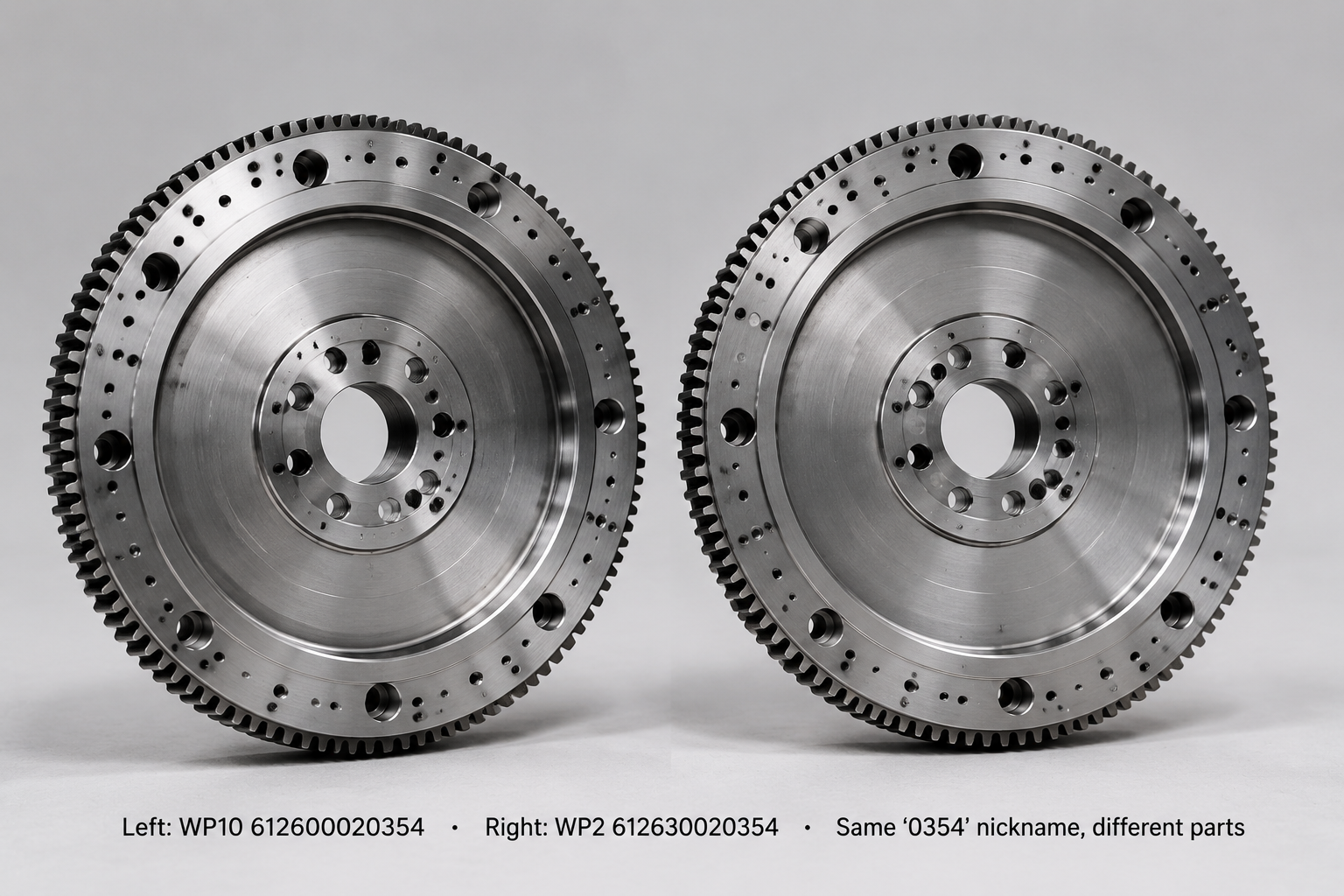
One of the most common and dangerous examples we encounter at Changwei involves two flywheels both commonly called “0354.” One belongs to the WP10 engine platform. The other belongs to the WP2 engine platform. They share a colloquial name, but they are completely different flywheels — and they absolutely cannot be interchanged.
This article explains the technical differences, the part number trap behind the “0354” nickname, and what happens when maintenance teams assume same-name flywheels are interchangeable.
The “0354” Confusion: Two Flywheels, One Nickname
The Two Part Numbers
Let us start with the facts. There are two flywheels commonly referred to as “0354”:
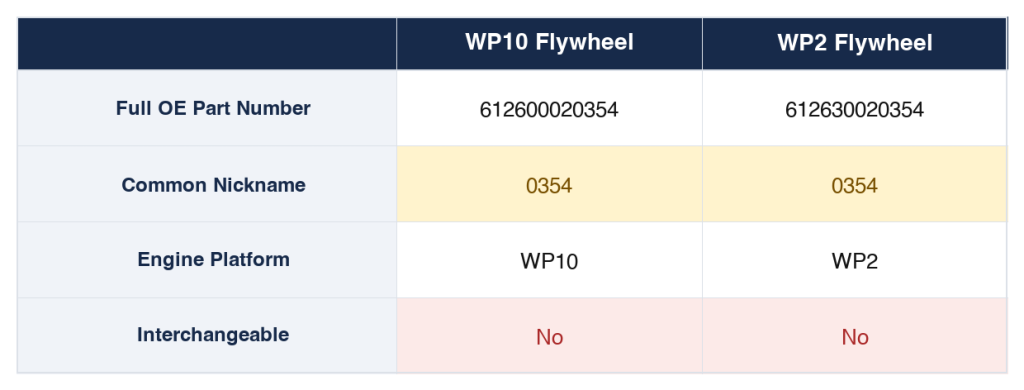
The critical difference is in the part number prefix: 61260 vs 61263. Specifically, the digit in the fifth position (0 vs 3) distinguishes the WP10 variant from the WP2 variant. When buyers and technicians shorten the part number to “0354,” they strip away exactly the information that distinguishes one from the other.
The Technical Differences
These two flywheels differ in two important structural ways:
1. Ball Stud Height (球杆)
The ball stud — the protruding stud on the flywheel that interfaces with the clutch release mechanism — is notably taller on one flywheel and relatively flatter on the other. This is not a minor dimensional variation. The difference in ball stud height is clearly visible when the two flywheels are placed side by side.
A taller ball stud changes the engagement geometry with the clutch release fork. If you install a flywheel with the wrong ball stud height, the clutch release mechanism will not engage correctly. The clutch may not disengage properly, or it may slip — either way, the vehicle is not drivable.
2. Crankshaft End Bolt Arc
The bolt pattern on the crankshaft end of the flywheel — specifically the arc or curve along which the mounting bolts are arranged — is different between the two flywheels. This means the flywheel physically will not mount correctly on the wrong engine’s crankshaft. The bolt holes will not align.
Even if force were used to attempt installation (which should never be done), the flywheel would not seat properly against the crankshaft flange. The result would be severe vibration, potential bolt shear, and catastrophic failure of the flywheel and possibly the engine.
The Danger of Flywheel Nicknames in Procurement
The “0354” nickname problem is not unique to WP10 and WP2 flywheels. Across the engine parts industry, long OE part numbers are routinely abbreviated to their last four digits in daily communication. This practice creates a systemic risk.
The Abbreviation Problem
When a workshop foreman calls a parts supplier and asks for “an 0354 flywheel,” which one do they get? Without the full part number or the engine model, the supplier has to guess. If the supplier’s default is the WP10 variant (612600020354) but the customer needs the WP2 variant (612630020354), the wrong flywheel ships.
The Catalog Problem
Some aftermarket parts catalogs list flywheels by their shortened code. A buyer searching for “0354” in a catalog may see results for both the WP10 and WP2 variants without a clear indication of which is which. If the buyer does not read carefully — or if the catalog does not clearly distinguish the engine applications — the wrong part ends up in the cart.
The Inventory Problem
In warehouse environments, flywheels are often stored and labeled by shorthand codes. If both the WP10 and WP2 “0354” flywheels are labeled simply as “0354” in the inventory system, a picker may grab the wrong one. This is especially likely if the two variants are stored near each other.
The Communication Problem
Text messages, WhatsApp messages, and informal emails between workshops and suppliers frequently use shortened part numbers. “Need 0354 flywheel urgent” is a message that could refer to either variant. Without the full part number, the supplier is left to infer which one is needed.
What Happens When You Install the Wrong “0354” Flywheel
Let us walk through the practical consequences of installing a WP10 “0354” flywheel on a WP2 engine (or vice versa).
Scenario 1: The Flywheel Does Not Mount
Because the crankshaft end bolt arc is different, the bolt holes on the wrong flywheel will not align with the crankshaft flange. The technician discovers the problem during installation — the flywheel simply does not bolt on.
Cost: Wasted labor time. The vehicle is on the lift, the old flywheel is already removed, and now the correct part must be sourced. Downtime extends while the correct flywheel is ordered and shipped.
Scenario 2: The Flywheel Mounts But Clutch Geometry Is Wrong
If the bolt pattern happens to be close enough that the technician forces the installation (again, this should never happen, but it does in practice), the ball stud height mismatch causes clutch engagement problems. The clutch may:
- Not fully disengage, making gear shifting difficult or impossible
- Slip under load, causing accelerated wear
- Engage unevenly, causing shudder and jerky operation
Cost: The vehicle may be drivable briefly but will soon require rework. The clutch components may be damaged by the incorrect engagement geometry, adding clutch replacement costs on top of the flywheel correction.
Scenario 3: The Wrong Flywheel Is Installed and the Problem Is Misdiagnosed
In the worst case, the technician installs the wrong flywheel, the vehicle exhibits clutch problems, and the problem is misdiagnosed as a clutch or hydraulic issue rather than a flywheel mismatch. Hours of diagnostic time are spent chasing the wrong cause before someone realizes the flywheel is the wrong variant.
Cost: Diagnostic labor, unnecessary clutch component replacement, extended downtime, and customer frustration.
The Full Part Number: Your Only Reliable Reference
The solution to the “0354” confusion is simple: always use the complete OE part number.
- 612600020354 = WP10 engine flywheel
- 612630020354 = WP2 engine flywheel
When you record, communicate, or order using the full 12-digit part number, there is no ambiguity. The supplier knows exactly which flywheel you need. The warehouse picker knows which bin to pull from. The technician knows which engine the flywheel fits.
Rules for Part Number Communication
- Never shorten part numbers in official orders. Purchase orders, quotes, and confirmations should always include the full OE number.
- Include the engine model as a cross-reference. Even with the full part number, including the engine model (WP10 or WP2) provides a second layer of verification.
- Verify shortened codes before acting on them. If someone says “0354,” ask: “Which full part number — 612600020354 or 612630020354?”
- Train your team on the shorthand traps. Make sure everyone who handles parts orders understands that “0354” refers to two different flywheels.
How Changwei Prevents Same-Name Flywheel Errors
As a manufacturer that produces flywheels for both WP10 and WP2 platforms, we have built verification into our ordering process to prevent exactly this type of error.
Pre-Production Verification
When a customer sends an order for an “0354” flywheel, our engineering team does not proceed without confirming the full part number. We ask for:
- The complete OE part number (612600020354 or 612630020354)
- The engine model (WP10 or WP2)
- If available, a photograph of the original flywheel showing the ball stud height and crankshaft end bolt pattern
This verification takes minutes but prevents the manufacturing and shipping of the wrong flywheel.
Manufacturing Documentation
Every flywheel we produce is documented with its full OE part number, engine application, and key specifications. This documentation is included with the shipment, so the customer receives a clear record of exactly which flywheel they received.
Technical Support
If a customer is uncertain which flywheel they need, our technical team can help identify the correct model from a physical sample, photograph, or engine serial number. We maintain detailed cross-reference records for WP10, WP2, and dozens of other engine platforms.
Beyond “0354”: The Broader Lesson
The WP10 vs WP2 “0354” situation is a specific example of a general problem in flywheel procurement. Across every engine platform — Chinese, Japanese, European — there are flywheels that share abbreviated names but are different parts.
The broader lesson: a shortened part number is never a reliable identifier. Every flywheel order must be based on the complete OE part number, verified against the engine application. For another real-world case where two flywheels look nearly identical but differ only in signal hole position, see our guide to the flywheel part number trap.
Best Practices for Maintenance Teams
- Label flywheel inventory with full part numbers — not “0354” shorthand. Label bins with 612600020354 (WP10) and 612630020354 (WP2).
- Include engine model on work orders alongside the full part number for double verification.
- Keep reference photographs showing the ball stud height difference and crankshaft end bolt pattern for technician comparison.
- Record the full OE part number before removing the old flywheel, ensuring the replacement order matches the actual installed part.
- Never assume same-name parts are interchangeable. If two parts share a nickname but have different full part numbers, assume they are different until proven otherwise.
Conclusion: The Full Number Is the Only Number That Matters
The WP10 “0354” (612600020354) and WP2 “0354” (612630020354) flywheels look similar enough to share a nickname, but they are completely different parts. Different ball stud heights, different crankshaft end bolt arcs, different engine applications. Installing one where the other belongs will not work — and forcing it will cause damage.
The “0354” shorthand is convenient for quick conversation, but it is dangerous for ordering, inventory, and installation. Always verify the complete OE part number before ordering or installing any flywheel. If you are not sure which variant you need, contact our engineering team — we will help you identify the correct flywheel before you invest in the wrong one.
About Changwei: Weifang Changwei Intelligent Equipment Co., Ltd. is an IATF 16949 certified engine flywheel manufacturer based in Weifang, China. With a 40,000 sqm production facility and 20+ years of engineering expertise, Changwei supplies flywheels, gear rings, and housing parts to customers in 20+ countries. Contact us for OEM/ODM flywheel solutions.