
Integrated Flywheel for Generator Sets: Why One-Piece Beats Two-Piece
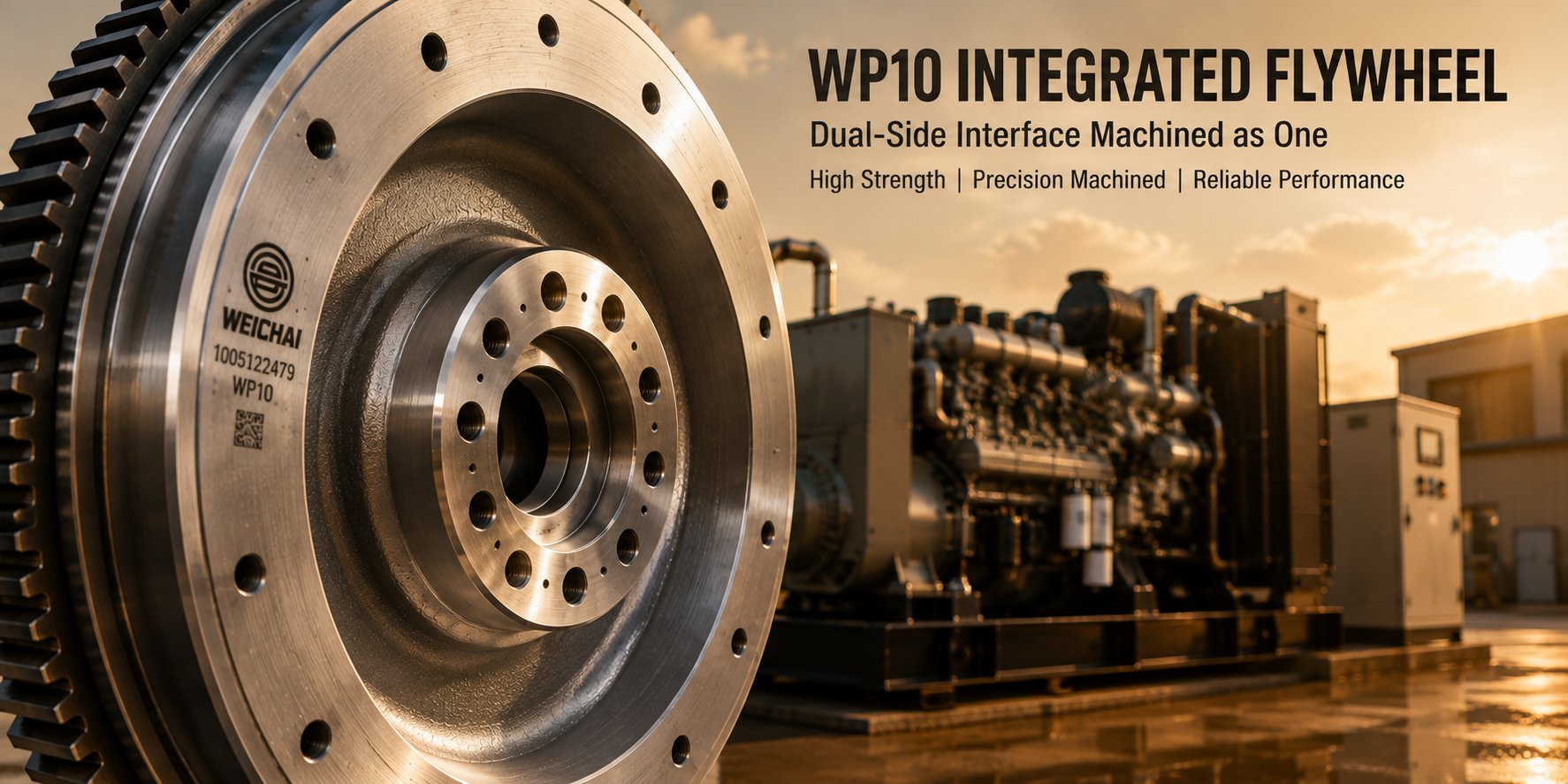
Unlike the WP10 concave-crankshaft design — which saves axial space by reshaping the crankshaft end — this article focuses on integrating the coupling ring into the flywheel itself to eliminate tolerance stack-up. Both remove bolted joints, but they fix different problems.
Vibration is one of the most persistent engineering challenges in generator set design. When a set runs at constant speed for thousands of hours, even a small flywheel imbalance becomes sustained, never-ending vibration that wears bearings, loosens couplings, and shortens the life of the whole machine. For generator-set builders, finding and removing the root cause of that vibration is not optional — it is the difference between a unit that runs for a decade and one that rattles itself apart.
One of the most common root causes is the two-piece flywheel: a standard vehicle flywheel plus a separate connection ring (adapter ring) bolted on to bridge the gap to the generator coupling. It works. But it builds the vibration problem in at the source.
How a Two-Piece Flywheel Creates Vibration
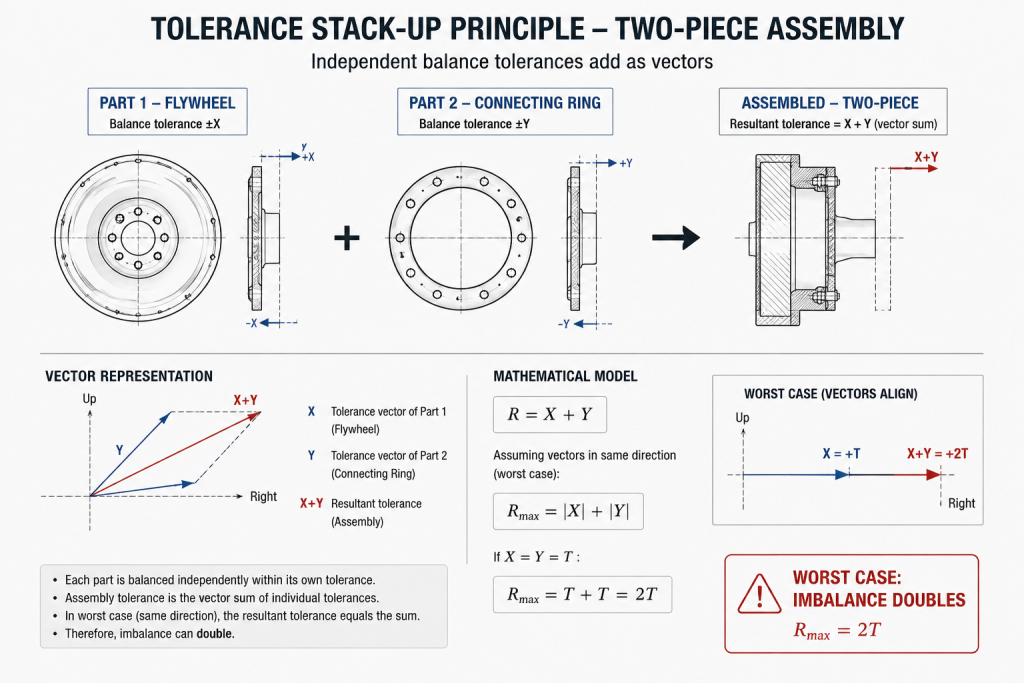
A two-piece system is two separately manufactured components. Each is made and balanced within its own tolerance band. Bolt them together and those bands combine — engineers call it tolerance stack-up.
If the flywheel carries a balance tolerance of ±X and the ring carries ±Y, the assembled unit can show imbalance up to X + Y — worse than either part alone. In practice the real number depends on how the two imbalance vectors happen to line up, but the worst case, where the heavy spots on both parts face the same way, is always on the table.
In a truck this might pass. The engine sweeps through a range of speeds, the vibration comes and goes, and the driver never notices. In a generator set the engine sits at 1500 or 1800 RPM for hours or days. A persistent imbalance becomes steady vibration at one frequency — exactly the condition that fatigues fasteners, bearings and coupling parts fastest.
Balance Tolerance Accumulation
The mechanism is straightforward, but the consequences are not small:
- Each part is balanced on its own. The flywheel passes; the ring passes. Both meet their individual spec.
- Joining them adds a new variable. The relative clocking of the two parts during assembly decides the combined balance. Line the heavy spots up and the imbalance doubles.
- There is no second chance. Because each part was already corrected individually, the assembly cannot be re-balanced without taking it apart and re-clocking — impractical on a production line.
This is not theoretical. Generator-set builders who use two-piece flywheels routinely trace vibration complaints back to exactly this stack-up between flywheel and ring.
The Other Costs of a Two-Piece System
Beyond vibration, the bolted ring brings more friction into the design:
- Installation complexity. The ring must be aligned to the flywheel, then torqued with specified fasteners, before the coupling goes on. One more step, one more chance to get it wrong.
- Operational instability. Under sustained load the ring joint lives on its fasteners. Over time they can fatigue and loosen.
- More failure points. Every bolted joint is a place to loosen, fret, or corrode. A two-piece system simply has more of them than a one-piece part.
The Integrated One-Piece Flywheel
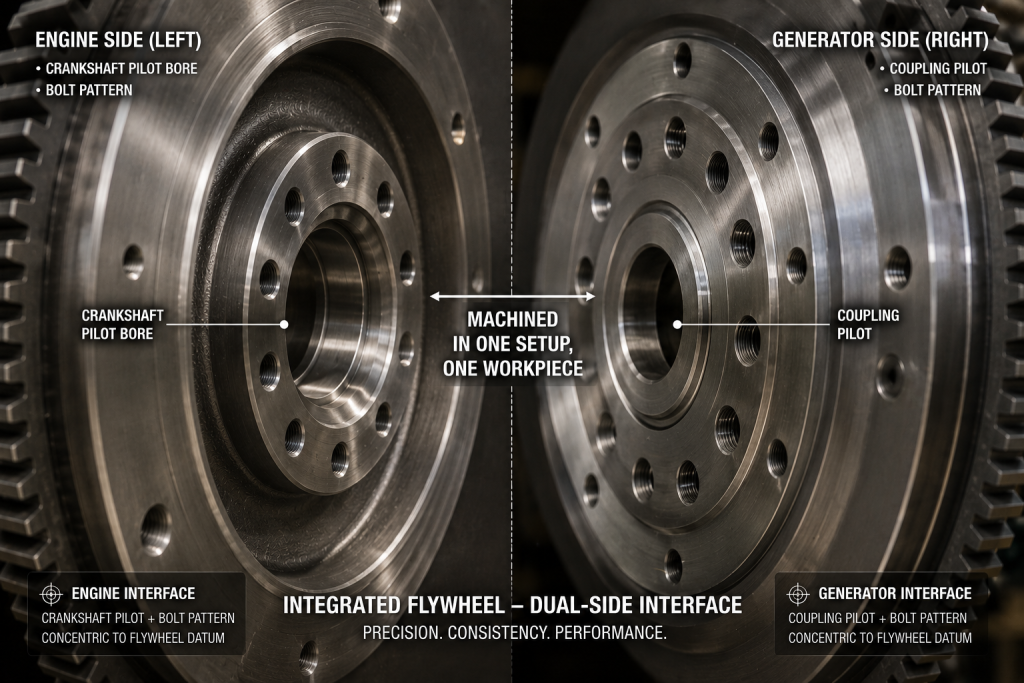
An integrated flywheel folds both the engine-side and generator-side interfaces into a single component. It attacks the problem where it starts.
Dynamic balance, solved at the source. There is one balance operation on one complete part. No second component means no stack-up. The finished flywheel meets its balance grade as a whole, and every unit that passes inspection meets the same spec — without the scatter that comes from combining two separately balanced pieces.
Installation simplified. The sequence drops from mount-flywheel → align-ring → torque-ring → couple, to mount-flywheel → couple-directly. The alignment and bolting step disappears. Fewer steps, fewer fasteners, fewer chances to misbuild.
Fewer failure points. The bolted joint between flywheel and ring does not exist in a one-piece design. No ring fasteners to loosen, no ring mating faces to fret, no dowel pins to shear. For a set running thousands of hours, removing those points is a direct reliability gain.
A Real-World Comparison: 500 kW Cummins Gen-Set
Numbers make the trade-off concrete. Take a representative 500 kW generator set on a Cummins QSK-series engine, built to the same coupling specification both ways — first with a standard vehicle flywheel plus a bolted connection ring, then with an integrated one-piece flywheel.
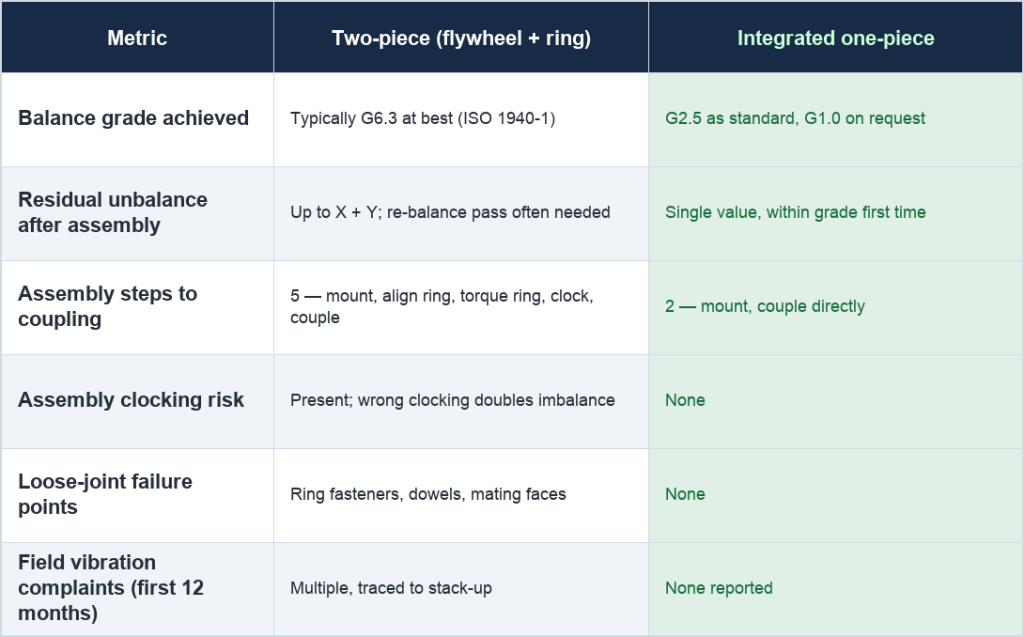
The two-piece build needed a re-balance pass on roughly one in four units because the stack-up occasionally exceeded the G6.3 allowance. The integrated part passed G2.5 on the first attempt, every time. For a fleet operator running dozens of sets, that gap shows up as fewer warranty calls and less unscheduled downtime — the kind of difference procurement notices at renewal.
It Works Across Engine Brands
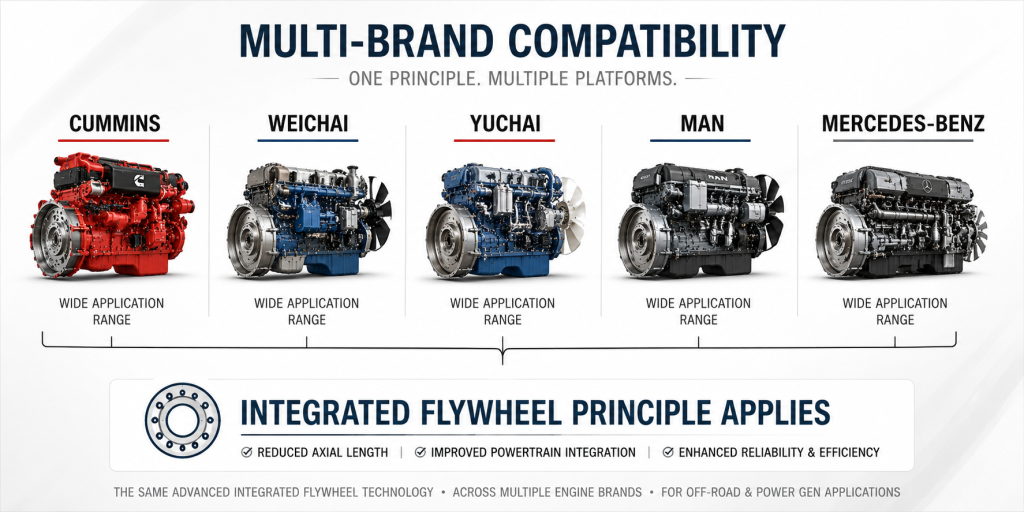
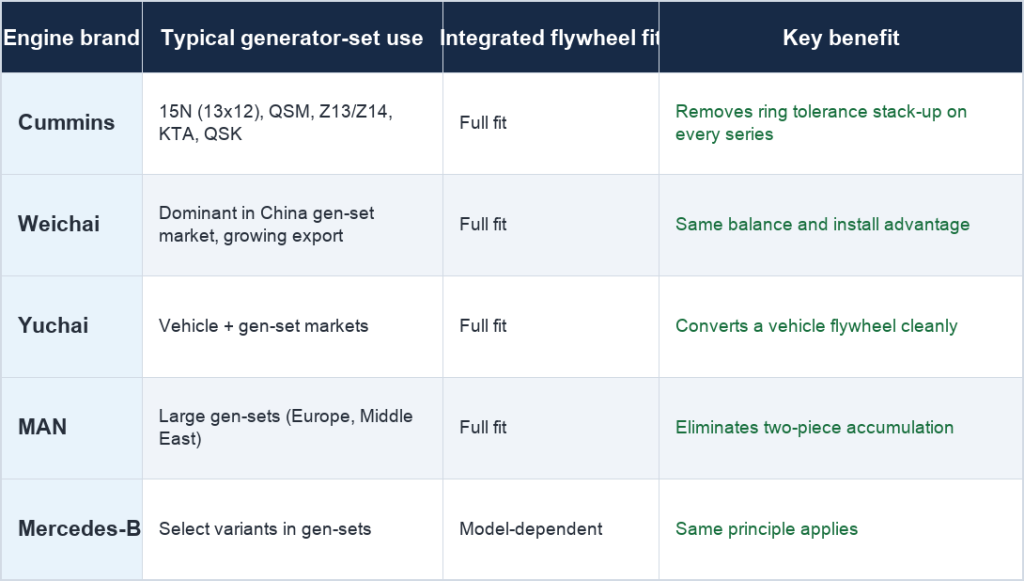
The advantage is not tied to one platform. The same logic applies wherever a vehicle-derived engine drives a generator coupling.
The point is that a single component beats a bolted pair for vibration, balance and assembly regardless of brand. The engineering is universal.
Design and Manufacturing Considerations
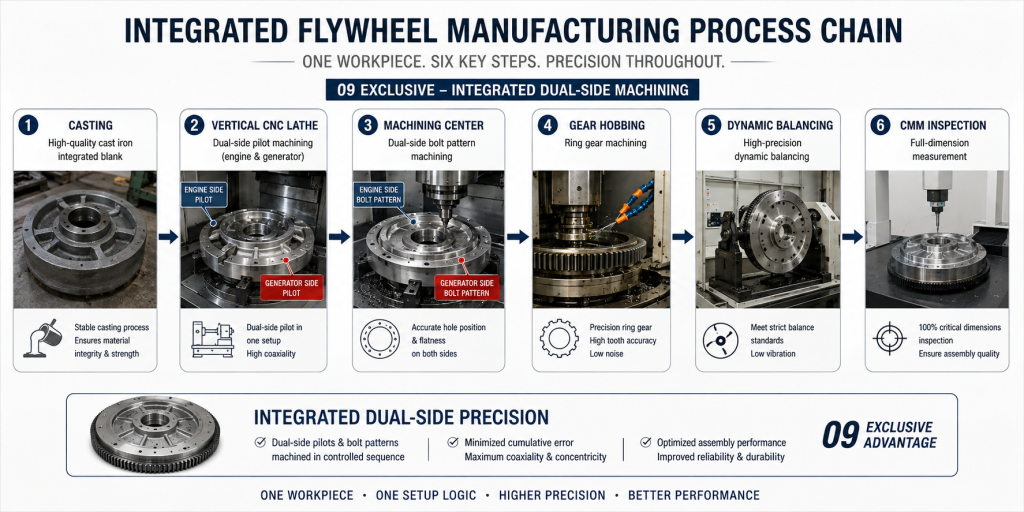
An integrated flywheel must carry two interface specs in one part: the engine side (crank bolt pattern, pilot bore, timing mark) and the generator side (coupling dimensions, bolt pattern, pilot). The positional relationship between them is set by the machining, not by assembling two parts — both interfaces are cut on the same workpiece, so their relative accuracy stays within the machine’s own capability. Because there is no second component to clock, the part is balanced to a single target: Changwei holds integrated flywheels to G2.5 per ISO 1940-1 as standard, with G1.0 available for premium gen-set duty, and residual unbalance held to single-digit g·mm.
At Changwei’s plant, integrated flywheels run on 20 vertical CNC lathes, 30 machining centers, 20 gear-hobbing machines and CMM inspection — the capacity to hold both interfaces on one component across multiple engine platforms, to IATF 16949, with final dynamic balancing verified to G2.5 / G1.0.
When to Specify an Integrated Flywheel
Specify the integrated design when:
- The set runs continuously — constant-speed duty makes stack-up vibration a standing problem, not an occasional one.
- Production volume justifies the tooling — the per-unit saving in assembly time and parts pays back the engineering.
- One coupling spec covers the range — a single integrated design serves the whole line.
- Long-term reliability is the priority — removing the ring joint matters for sets expected to run for thousands of hours.
For prototyping or very low volume where flexibility beats efficiency, the two-piece ring stays a valid option. But where quality, efficiency and reliability lead, the one-piece flywheel is the engineering-correct call.
Frequently Asked Questions
Can I retrofit an existing two-piece set with an integrated flywheel? Usually yes — provided the engine crank interface and the generator coupling interface are unchanged, which is exactly the condition an integrated design is built around. You replace the flywheel-plus-ring pair with one part. Confirm the signal hole position and timing mark before ordering (see our guide on the part-number trap).
Does an integrated flywheel cost more upfront? The single component can cost more than a flywheel plus a separate ring, because the tooling and machining are consolidated. But the assembly-step saving, elimination of ring fasteners, and lower warranty risk typically pay it back across a production run or a fleet.
What balance grade do I need for a generator-set flywheel? Most gen-set duty calls for G2.5 per ISO 1940-1, with G1.0 for premium or high-speed sets. A two-piece build struggles to hold G2.5 consistently because of stack-up; an integrated part reaches it as a single balanced component.
Does the integrated principle work on non-Cummins engines? Yes. The logic is universal wherever a vehicle-derived engine drives a generator coupling — Weichai, Yuchai, MAN and Mercedes-Benz gen-set engines all benefit the same way.
How do I specify the correct integrated flywheel? Read the full engine and coupling part numbers, confirm the crank bolt pattern, pilot bore, coupling dimensions and — critically — the signal hole position. The same suffix can hide a different part; get the signal hole drawing before you commit.
Will an integrated flywheel fit my existing generator coupling? If the coupling interface dimensions match, yes — the integrated design keeps the generator-side interface identical and only removes the separate ring. Match the coupling bolt pattern and pilot and the swap is direct.
Conclusion
The integrated one-piece flywheel solves four problems at once: vibration from tolerance stack-up, balance variability, instability from a bolted joint, and the extra steps of a two-piece assembly. By balancing one complete component and dropping the ring entirely, it delivers a tighter, more reliable, more efficient generator-set flywheel — on every major engine brand.
For generator-set manufacturers seeking to improve reliability and simplify assembly, the integrated flywheel is a technically sound and practically proven approach. Specifying the correct flywheel also means reading the full part number carefully — the same suffix can hide a different part, and the signal hole position is one detail that changes everything in practice. We covered that trap in our guide on why the same flywheel part number suffix can hide a different part. Always confirm the signal hole pattern before you specify.
About Changwei: Weifang Changwei Intelligent Equipment Co., Ltd. is an IATF 16949 certified engine flywheel manufacturer based in Weifang, China. With a 40,000 sqm production facility and 20+ years of engineering expertise, Changwei supplies flywheels, gear rings, and housing parts to customers in 20+ countries. Contact us for OEM/ODM flywheel solutions.