
Hino EP100 Flywheel Part Numbers: 2401, 2413 or 2761
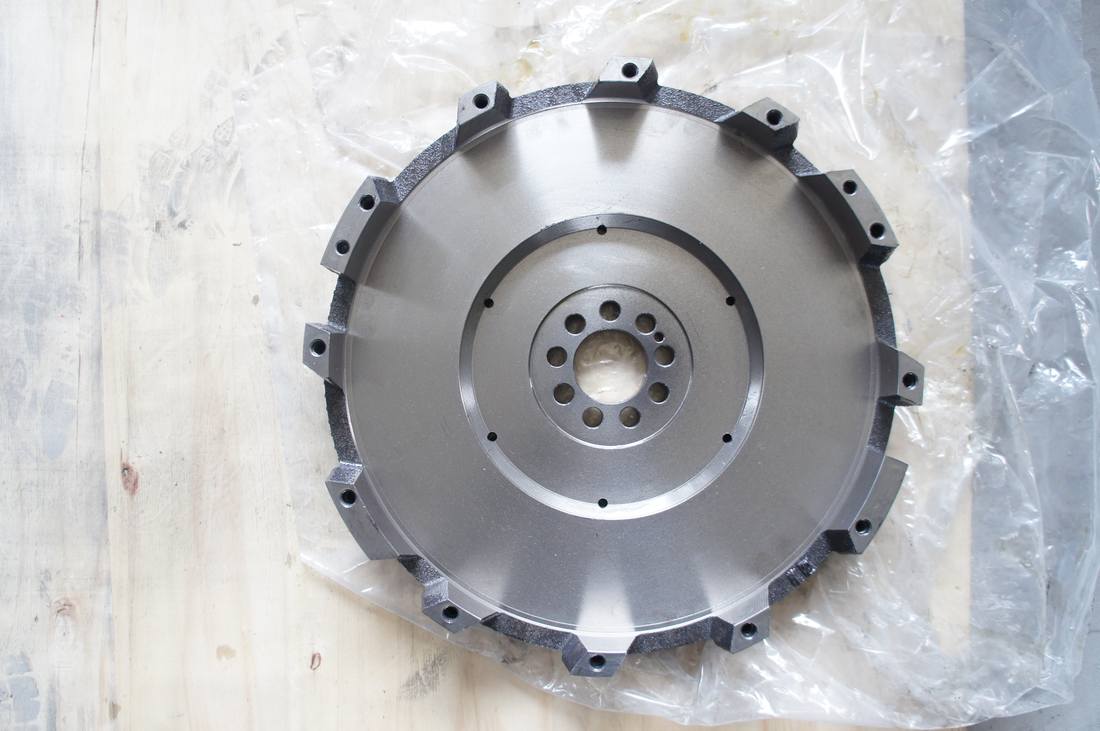
A Hino EP100 flywheel inquiry usually names the engine and stops there. EP100, 430 mm, 137 teeth, send price. On paper that is enough detail to sound precise. In a parts catalogue it lands on at least eight different numbers.
This page lists the numbers we can trace, grades the evidence behind each one, and shows where two catalogues name different engines for the same number. Every photograph here was taken on our own floor. Nothing on this page is a render.
The short version matters for anyone buying. Diameter and tooth count are shared across the whole Hino 17 inch family. The number changes with something else.
Table of Contents
- One Engine, Six Numbers
- The Numbers Buyers Quote
- What 430 mm And 137 Teeth Do Not Decide
- The Thickness Difference
- The Hole Count Difference
- Where The Catalogues Disagree
- The 2413 Number: EP100 Or K13C
- The 1203 Number: Two Different Owners
- The 2761 Number Crossed Back To 2401
- EP100 And P11C Share A Number, Not A Displacement
- What Our Own Castings Show
- Four Shelf Names, Four Castings
- What A Part That Has Been In Service Looks Like
- The Stamp That Is Not A Part Number
- Reading The Rim Before You Pay
- Measure The Outside Diameter
- Count The Teeth On The Part
- Measure The Rim Thickness
- Check The Hub And The Pilot Bore
- The Ring Gear Is A Separate Part
- Freight And Packing Arithmetic
- Questions Buyers Ask
- Sources And Evidence Level
- Send The Old Part Photograph
One Engine, Six Numbers
The Hino EP100 is an inline six diesel of 8,821 cc, with a bore and stroke of 120 by 130 mm. It belongs to the Hino P engine family, the same family that later produced the P11C at 10,520 cc. Both engines were fitted to buses and to medium trucks, and both remained in service long after production ended.
That long service life is why the aftermarket carries so many numbers. Suppliers copy each other, add their own cross references, and sometimes attach a number to the wrong engine.
The numbers we found in current trade listings are 13450-2401, 13450-2400, 13450-2413, 13450-2761, 13450-1203, 13450-E0240, 13450-E0K20 and 13451-2350. Eight numbers, one engine family, and not one of them carries a drawing with it.
For background on the 13450 numbering range itself, our earlier page on Hino 13450 flywheel numbers explains why the fifth digit group moves between assemblies, sub assemblies and ring gears.
The Numbers Buyers Quote
The table below is the core of this page. The evidence column is not decoration. It tells you how many independent sellers state the same thing, because one seller repeating a number twice is still one source.
| Number | Engines claimed | Size claimed | Evidence |
|---|---|---|---|
| 13450-2401 | EP100, EM100, P11C | 430 mm, 137 teeth | Three sellers (Hino parts shop, Guangzhou exporter, trade platform listing) |
| 13450-2400 | EP100 | 430 mm, 137 teeth | One seller, listed beside 2401 |
| 13450-2413 | EP100 (one seller) or K13C, K13D (another) | 430 mm, 137 teeth, 8 holes, 17 mm | Two sellers, engines conflict |
| 13450-2761 | P11C, EP100 | 430 mm, 137 teeth, 9 holes, 17 mm | Three sellers on engine, one on hole count |
| 13450-1203 | EP100H (one seller) or EK100 FM2P (older listing) | 430 mm, 137 teeth | Two sources, engines conflict |
| 13450-E0240 | EP100H | Not stated | One seller |
| 13450-E0K20 | EP100 | 430 mm, 137 teeth | One seller |
| 13451-2350 | EP100 | 430 mm, 137 teeth | One seller |
Read the table by column, not by row. The engines move. The size does not.
A buyer who searches for EP100 and takes the first number that appears will land on 2401, which is the best supported of the eight. That is not the same as safe. Two of the eight numbers are claimed for a different engine by a different seller, and the difference between 2401 and 2761 sits inside a dimension no photo can settle.
What 430 mm And 137 Teeth Do Not Decide
Diameter and tooth count belong to the ring gear and the housing, not to the flywheel casting. The Hino 17 inch family shares them. EF750 uses 430 mm with 137 teeth and six holes. EK100 versions use 430 mm with 137, 143 or 135 teeth and eight or nine holes. EP100, K13C and E13C sit in the same envelope.
This is the same trap that appears in the Cummins range, where a tooth count describes a ring gear that is fitted to several flywheel assemblies. Our guide to ring gear teeth counts covers that pattern in detail.
So the first thing to remove from a specification is confidence in diameter. It narrows the shelf. It does not pick the part.
The Thickness Difference
Catalogue lines for this family carry three rim thicknesses: 16.5 mm, 17 mm and 19.2 mm. The 19.2 mm figure belongs to an EF750 line. The other two appear inside the EP100 group itself, attached to different numbers.
Two numbers separated by 0.5 mm of cast iron are separated by a real assembly difference. A flywheel that is 0.5 mm thinner moves the friction face towards the gearbox. That changes where the release bearing sits at rest.
For a buyer, the practical consequence is that a supplier quoting “EP100 flywheel” without a thickness has not yet identified the part.
The Hole Count Difference
Hole count in these listings means the number of drilled holes in the mounting pattern, and most catalogues never say which pattern they mean. The trade writes it as 8H or 9H.
One number, 13450-2761, is listed as 9H. The number it cross references, 13450-2401, is listed as 8H by another seller and with no hole count by a third. That is the single most useful disagreement on this page, because it tells you the two numbers are not interchangeable just because both say 430 and 137.
Measuring a bolt circle is a shop job, and the method is simple geometry. Our page on measuring flywheel bolt circles gives the chord factors and the arithmetic.
Where The Catalogues Disagree
Honest sourcing means showing the conflicts instead of picking the tidier version. Three are worth writing down.
| Number | Claim A | Claim B | What we do |
|---|---|---|---|
| 13450-2413 | EP100, 430 mm, 137 teeth, 8H, 17 mm | K13C and K13D, 430 mm, 137 teeth, 8H | Show both, do not pick |
| 13450-1203 | EP100H | EK100 FM2P, 9H, 16.5 mm | Show both, do not pick |
| 13450-2401 | 8H, 16.5 mm | 9H, 17 mm by way of 2761 | Show both, do not pick |
None of these conflicts is a typo we can prove. All three involve numbers that sit close together in the same range, which is exactly where copying errors survive for decades.
The 2413 Number: EP100 Or K13C
One seller lists 13450-2413 as an EP100 flywheel at 430 mm, 137 teeth, 8 holes, 17 mm thick. Another seller lists the same number under K13C and K13D, with the same diameter and tooth count.
A Taiwanese foundry catalogue adds a third angle. Its 17 inch casting for EK100, K13C and K13D is listed at a 430 mm clutch diameter, a 6206 bearing, a 440 mm ring gear inner diameter and 137 teeth. That confirms the physical family. It does not settle which number carries which engine.
If your engine is EP100 and your supplier quotes 2413, ask which engine the number was catalogued for. The answer tells you whether you are talking to someone who reads the number or someone who reads a list.
The 1203 Number: Two Different Owners
13450-1203 appears in one current listing as part of an EP100H group, together with 2401 and E0240. An older listing in our own notes places 1203 against EK100 FM2P at 9 holes and 16.5 mm.
Both cannot be right in the narrow sense. Both can be right in the trade sense, because the same casting can be sold under a number that a different region attached to it. We do not choose between them on this page. We ask for the old part.
The 2761 Number Crossed Back To 2401
One seller lists 13450-2761 as a P11C and EP100 assembly, 17 inch, 137 teeth, 9 holes, 17 mm, and prints the cross reference 13450-2401 in the same line. Two more sellers list 2761 against P11C without a size.
A cross reference printed by the seller is a claim, not a certificate. When a number crosses to another number but the hole count differs, the two parts are not the same part. They are two parts that a distributor decided to stock under one line.
EP100 And P11C Share A Number, Not A Displacement
Here is the detail that changes how a buyer reads this family. EP100 displaces 8,821 cc. P11C displaces 10,520 cc. They are different engines with different bore and stroke.
Three sellers attach the same number, 13450-2401, to both. That is normal in the Hino range and it is not an error. The flywheel bolts to the crankshaft flange and carries the clutch, and those interfaces were carried over between the two engines.
So a number can outlive an engine. A buyer who orders by engine name alone is ordering by the wrong key. The number, the bolt pattern and the thickness are the keys, in that order.
Our earlier page on Hino flywheels by engine lists the whole range model by model for buyers who are still identifying what they have.
What Our Own Castings Show
We keep EP100 flywheels in the warehouse under four shelf names. The names are ours, written by the people who packed them. They are not OEM designations and we do not present them as such.
The four are a standard unit, a unit labelled 9 hole, a unit labelled thick, and a unit labelled EFI. Photographs of all four are on this page. The visible differences are real, and they are not the ones a buyer expects.
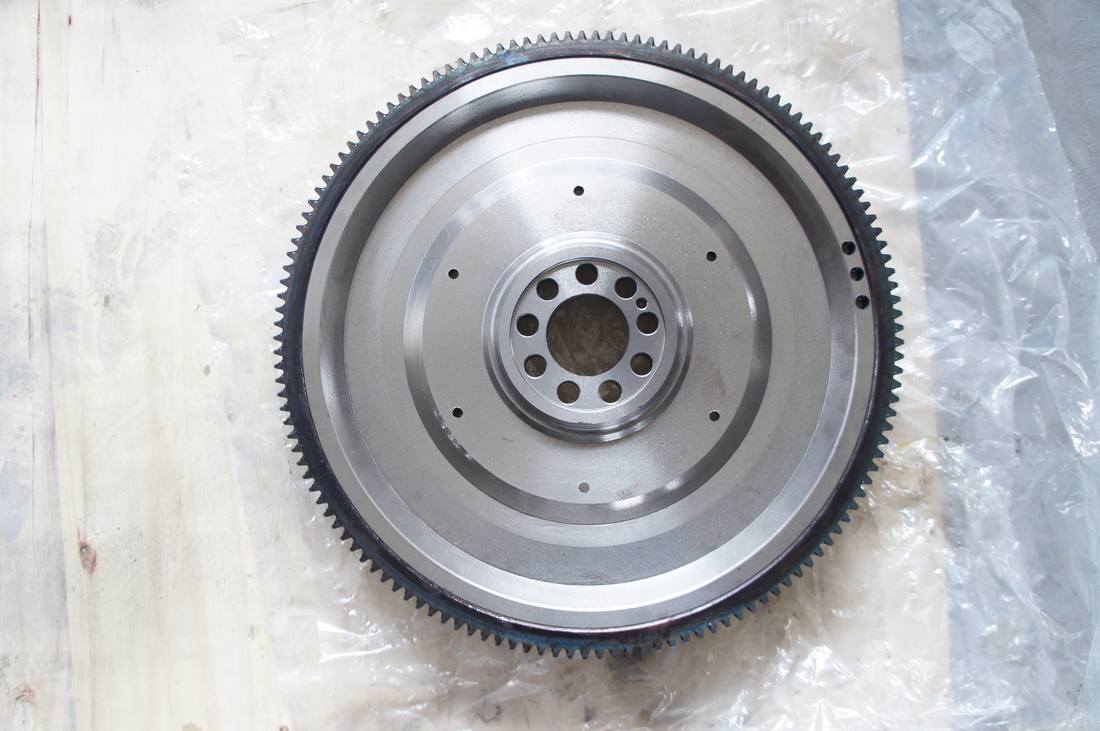
That is the crankshaft side of the unit our shelf calls 9 hole. The centre bore is bare, the bolt circle is clean, and the recess between hub and rim is shallow.
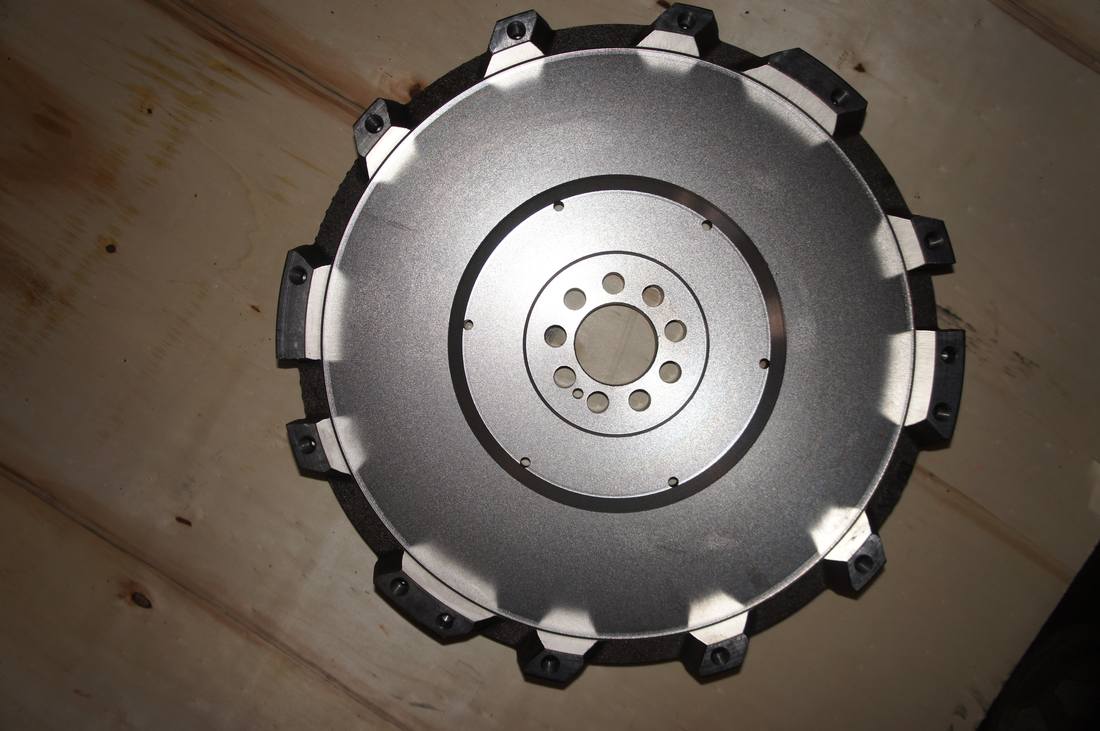
Turned over, the clutch face carries a ring of raised pads, each one drilled. The friction surface itself is flat and freshly machined. Nothing on either face states a number.
Four Shelf Names, Four Castings
The unit labelled thick has a much deeper dish on the crankshaft side. Light falls into the bowl and the hub sits at the bottom of it.
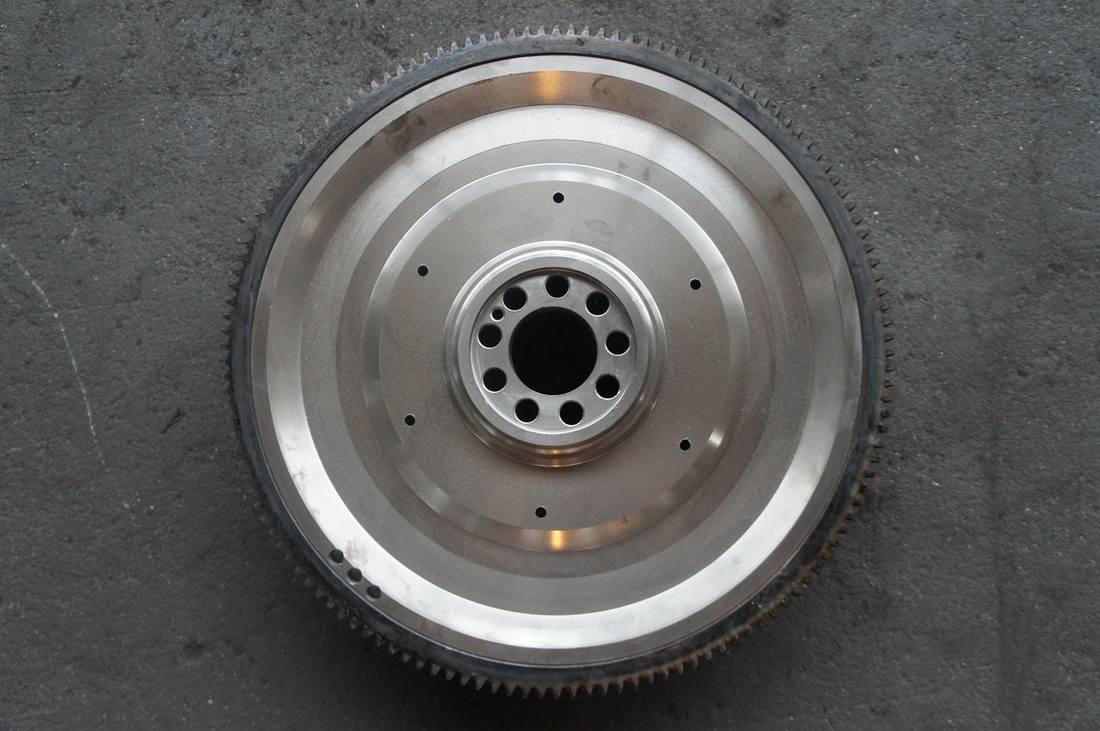
Its clutch face is the same idea as the first unit, with the same ring of drilled pads, but the friction ring sits on a taller shoulder.
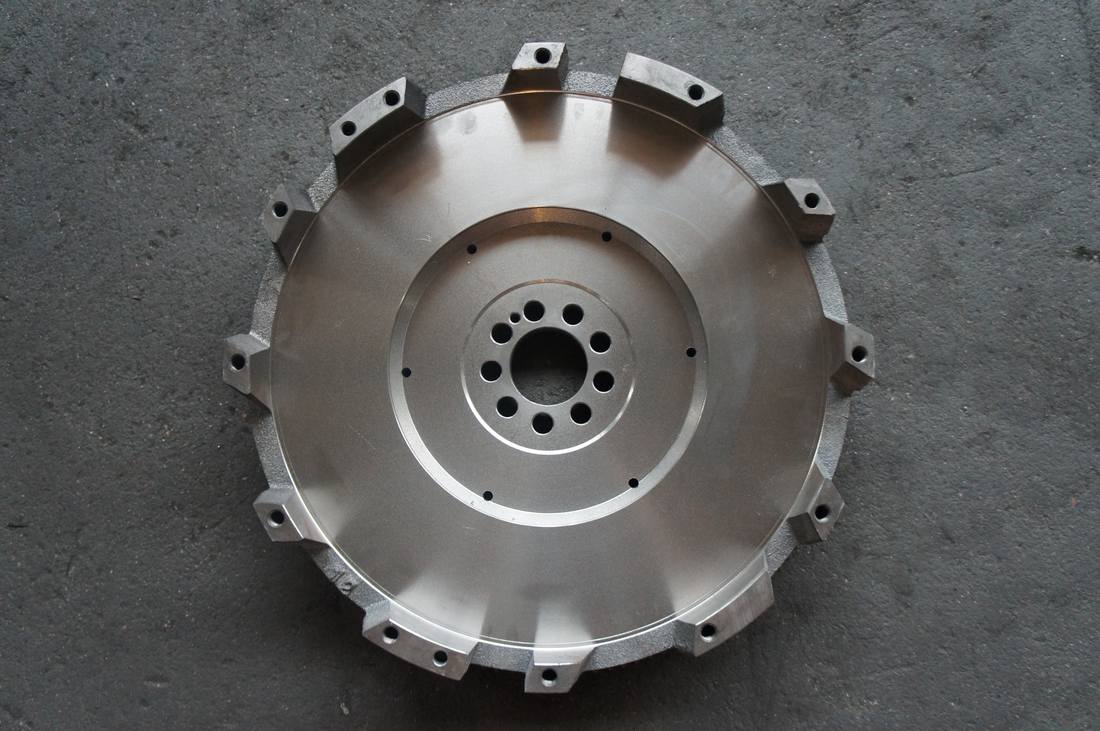
The unit labelled EFI differs again. The crankshaft side has a stepped ring machined around the hub, and four small holes drilled in the face at roughly quarter spacing.
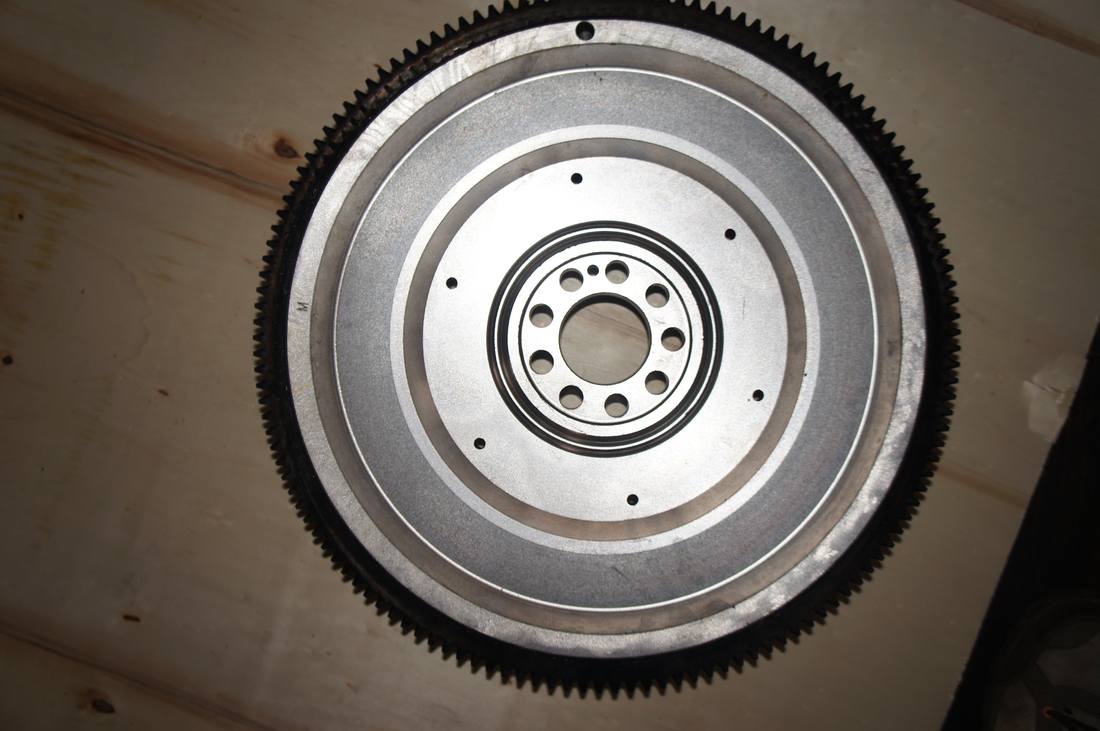
A second EFI unit from the same shelf shows the same step and the same four holes from a slightly different angle, which is useful when you are comparing a photo a customer sent.
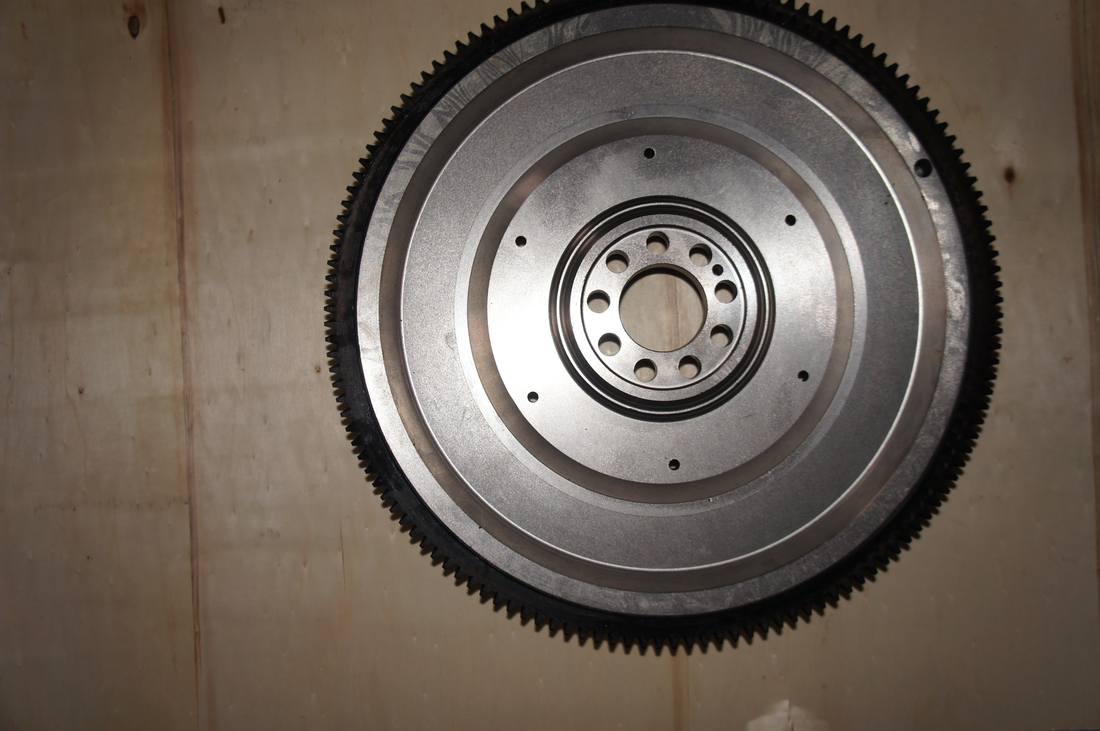
From the clutch side, the EFI unit looks close to the others. This is why a single photo of the clutch face cannot identify a flywheel in this family.
What A Part That Has Been In Service Looks Like
One unit on the rack came back from a customer and stayed there as a reference. It shows what three years of work do to the same casting.
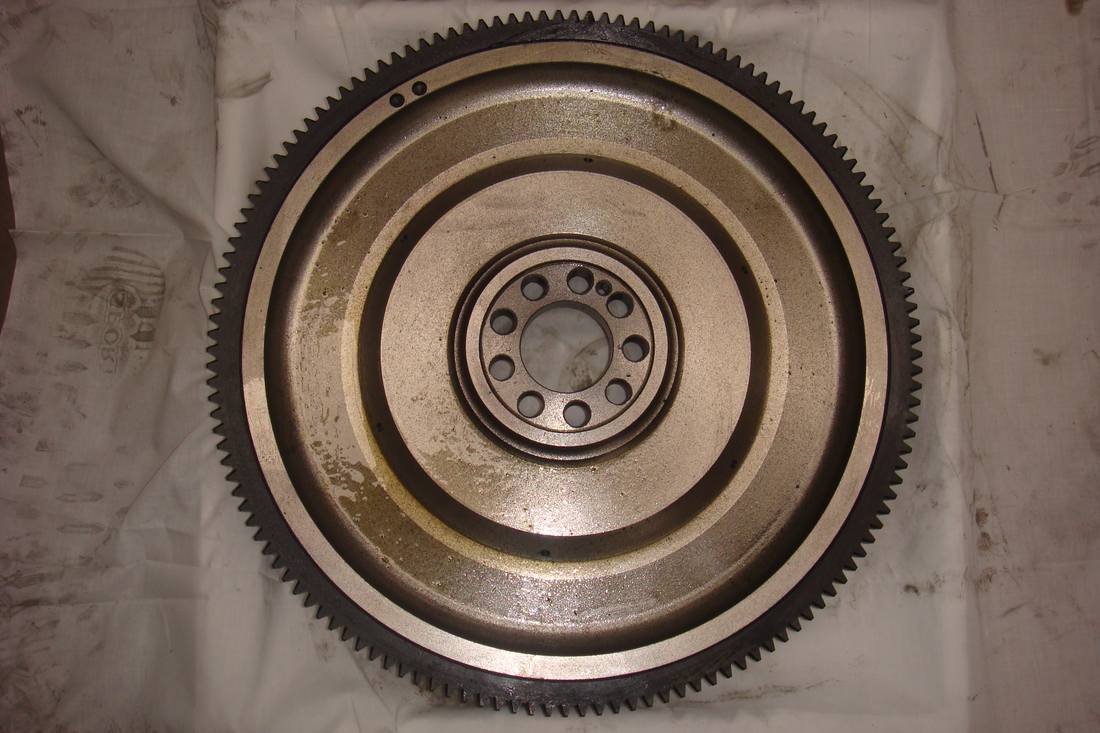
What matters on this face is the absence of cracks between the bolt holes. Radial cracks at the bolt circle are a scrap condition, not a machining job.
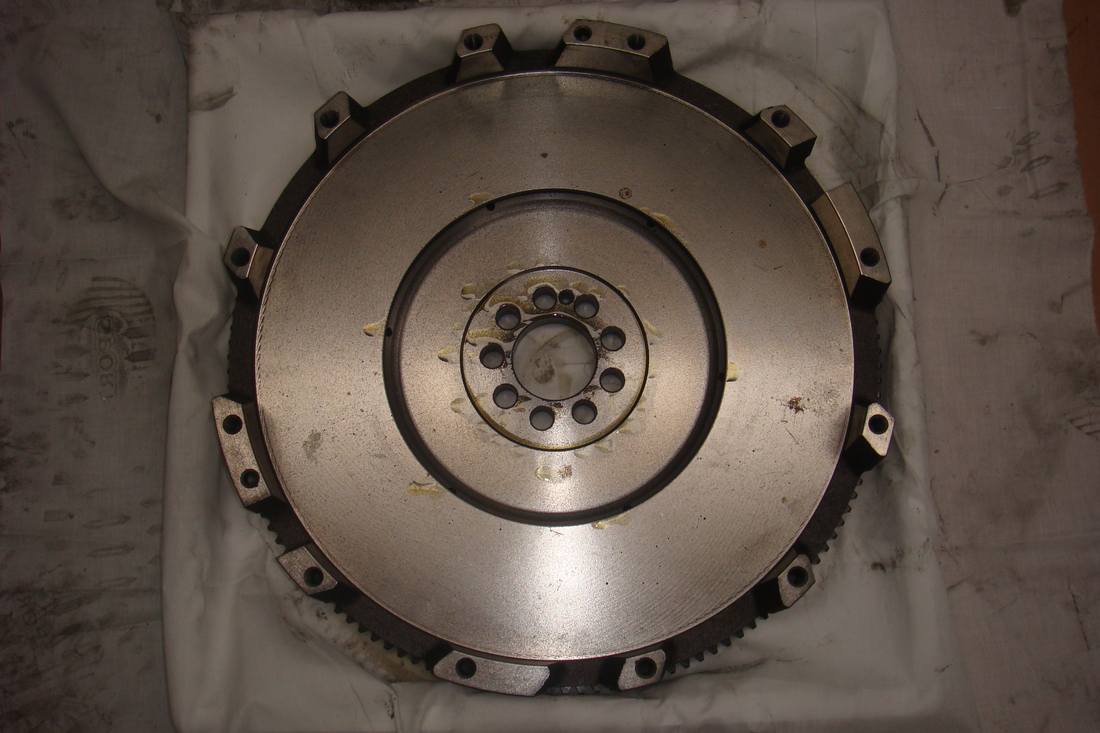
The yellow daubs beside the pads are torque marks applied at the last installation. When you buy a used unit, marks like these tell you somebody has been inside it. They do not tell you how much the face has been machined.
The Stamp That Is Not A Part Number
One rim in the batch carries a single stamped letter M on the machined band between the teeth and the friction face. That is all.
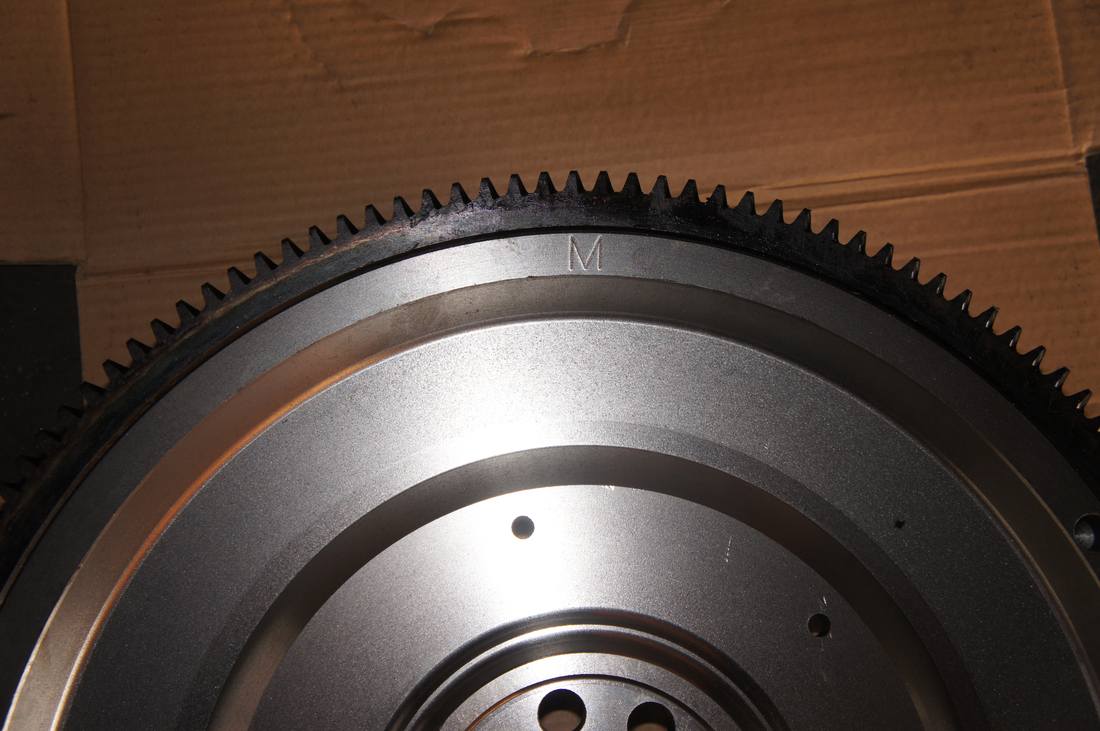
A single letter is a station mark from machining or balancing. It is not a part number, it does not decode to a number, and it should never be read as one. Buyers send us photographs like this one every week and ask us to identify the part from the letter. We cannot, and neither can anyone else.
What the rim does tell you is condition. The teeth in this photograph are complete, evenly worn and free of the hooked profile that appears when a starter has been misaligned. Our page on starter pinion clearance explains that wear pattern.
Reading The Rim Before You Pay
Five measurements decide this family. All of them can be taken on the old part with tools a workshop already owns. None of them requires a catalogue.
Do them in this order, because each one can eliminate a number before you spend time on the next.
Measure The Outside Diameter
Measure across the ring gear teeth, not across the machined face. On this family the answer should come out at 430 mm, but confirm it, because a 380 mm unit sits in the same parts books and looks similar in a photograph from above.
Count The Teeth On The Part
Count the teeth on the old ring gear. Do not count them on a photograph, and do not accept a tooth count from a listing as proof of what is on your engine. The same engine family is listed with 135, 137 and 143 teeth depending on version.
If the count does not match 137, stop. You are not looking at this article’s family any more.
Measure The Rim Thickness
Measure the total thickness across the rim with a caliper, jaws on the outer edges. Our own photograph shows the method on the unit labelled thick.
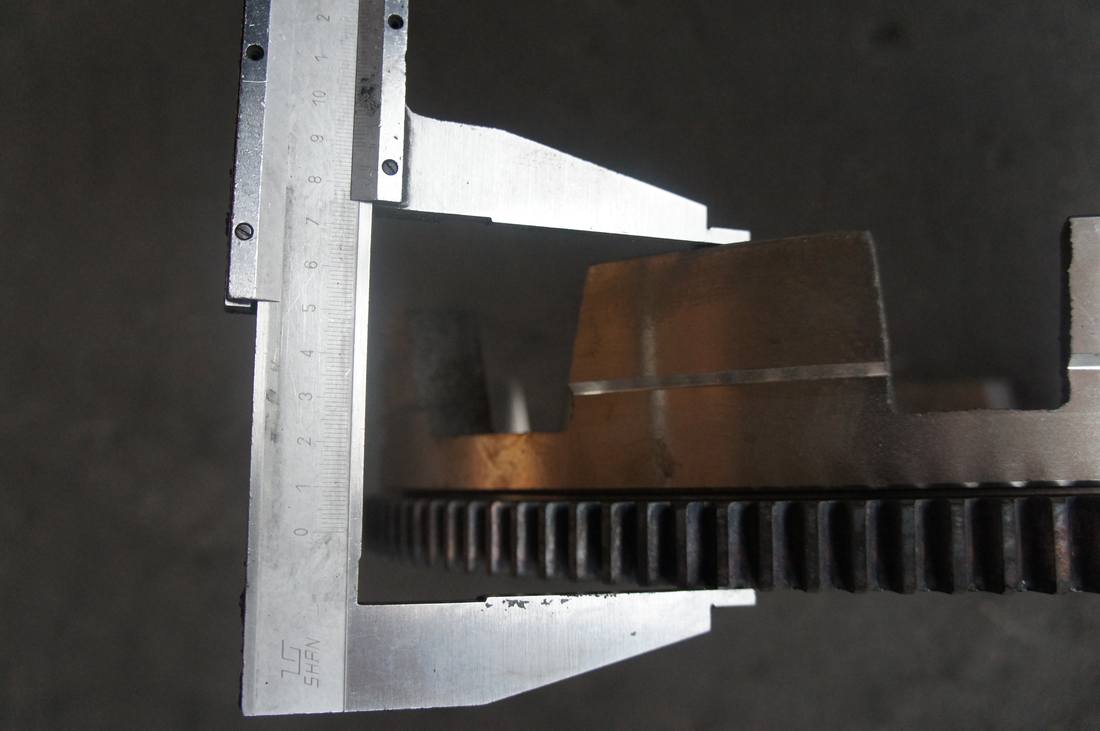
Write the reading down with the date. When a supplier later quotes 16.5 mm or 17 mm, you will have a number to compare instead of a memory of a number.
Check The Hub And The Pilot Bore
Look at the centre. A bare bore, a bore with a bearing seat, and a bore with a separate pressed insert are three different parts. The Taiwanese catalogue for this family specifies a 6206 bearing, which gives you a reference point for the pilot bore on the 17 inch castings.
Then measure the bolt circle. If it reads eight holes on one part and nine on the other, the two numbers in the table above stop being a mystery.
The Ring Gear Is A Separate Part
The edge photograph shows it best. The toothed ring sits on a machined shoulder and is a separate piece of steel from the cast iron disc.
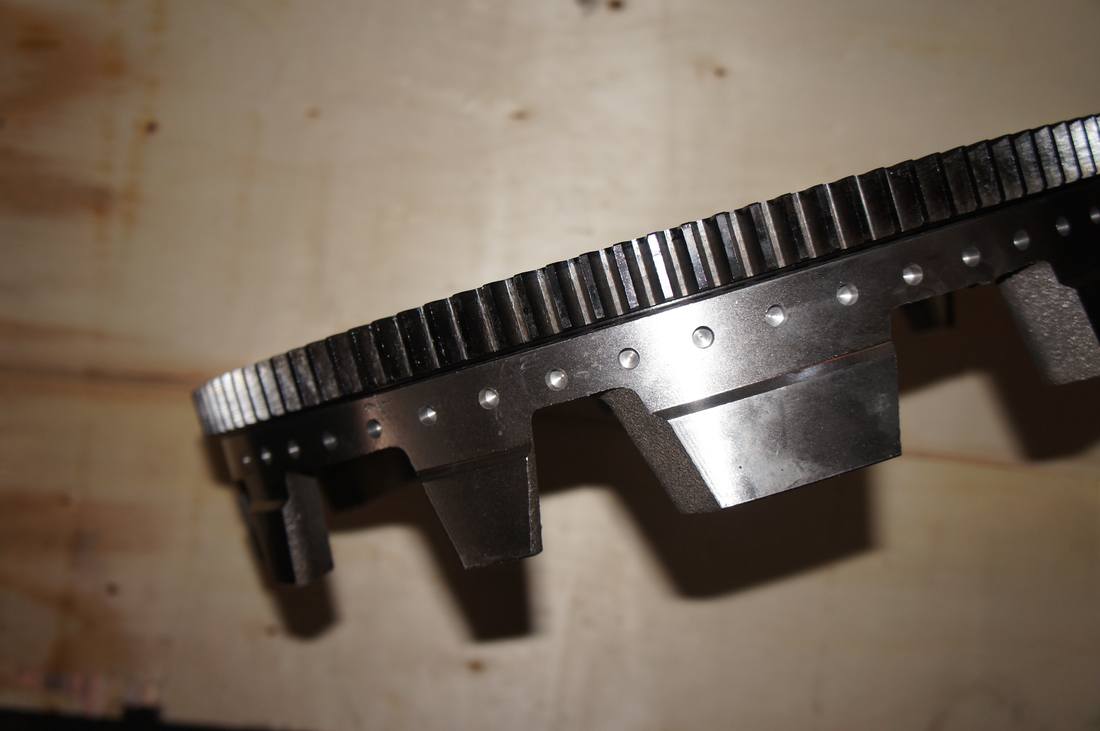
That matters for two reasons. A worn ring gear can be replaced without replacing the flywheel. And a flywheel can be sold with a ring gear fitted, or without one, under the same base number plus a suffix.
When a quotation is cheaper than the others by a wide margin, ask whether the ring gear is included. The answer is often no.
Freight And Packing Arithmetic
One seller lists 13450-2401 at 40 kg with a packing size of 50 by 50 by 20 cm. That is a single source, so treat it as an estimate rather than a specification.
It is still useful. At 40 kg gross, a 20 foot container holds roughly 600 pieces by weight and rather fewer by volume once crates are stacked. A buyer planning a mixed container should treat the flywheel as the dense item and plan the light parts around it.
If you are replacing a flywheel because of a scored friction face rather than a cracked casting, machining may be the cheaper route. Our page on flywheel resurfacing limits covers how much can be removed before the step height fails.
Questions Buyers Ask
Which number fits my EP100?
We cannot answer that from an engine name, and no honest supplier can. The number depends on the ring gear, the rim thickness and the clutch pattern on your engine. Send photographs of both faces, the rim thickness and the bolt circle, and we will match against the castings we hold.
Is 13450-2401 the same as 13450-2761?
They are cross referenced by one seller and listed with different hole counts. Treat them as different parts until a physical comparison proves otherwise.
Can you supply from a photograph of the old part?
Yes, if the photograph shows both faces, the rim edge and a ruler across the diameter. A photograph of the clutch face alone is not enough in this family.
Do you cast these, or resell them?
We are a foundry. Flywheels are cast, machined and balanced in our own plant, and we can work from a drawing or from a sample. Our Hino range is listed on the Hino engine flywheel page. Ring gears are a separate line, covered on the gear ring page.
Sources And Evidence Level
| Claim | Source type | Level |
|---|---|---|
| 13450-2401 covers EP100, EM100 and P11C | Three independent sellers | Triple |
| 13450-2761 covers P11C and crosses to 2401 | One seller, engine confirmed by two more | Double on engine, single on cross reference |
| 13450-2413 is EP100 at 8H and 17 mm | One seller | Single |
| 13450-2413 is K13C and K13D | One different seller | Single, conflicts with the row above |
| 430 mm, 137 teeth, 8 holes for the 17 inch family | Taiwanese foundry catalogue plus two sellers | Triple |
| EP100 is 8,821 cc, 120 by 130 mm | Engine reference wiki, P engine family page | Double |
| P11C is 10,520 cc, 122 by 150 mm | Same reference | Double |
| 40 kg and 50 by 50 by 20 cm packing for 2401 | One seller | Single, estimate only |
Two things we deliberately did not do. We did not count teeth from our photographs, because a photograph at this angle cannot be counted reliably. We did not measure the rim in the caliper photograph and report a value, because the scale cannot be read with confidence from the image. Both numbers belong to you and your caliper, not to a marketing page.
Send The Old Part Photograph
If you are holding an EP100 flywheel and cannot place the number, send four photographs. Both faces, the rim edge, and the bolt circle with a rule across it. Add the rim thickness if you have a caliper.
We will come back with the numbers that match, and with the ones that do not, including the two where our own sources disagree. That answer is more useful than a confident guess.
Send your part number or photographs for a quote.
Irene
Changwei International
Email: [email protected]
WhatsApp and WeChat: +86 199 5366 2121
Weifang, Shandong, China. FOB Qingdao.