
Flywheel Ring Gear Teeth: Why 136T, 138T and 159T Are Not Interchangeable
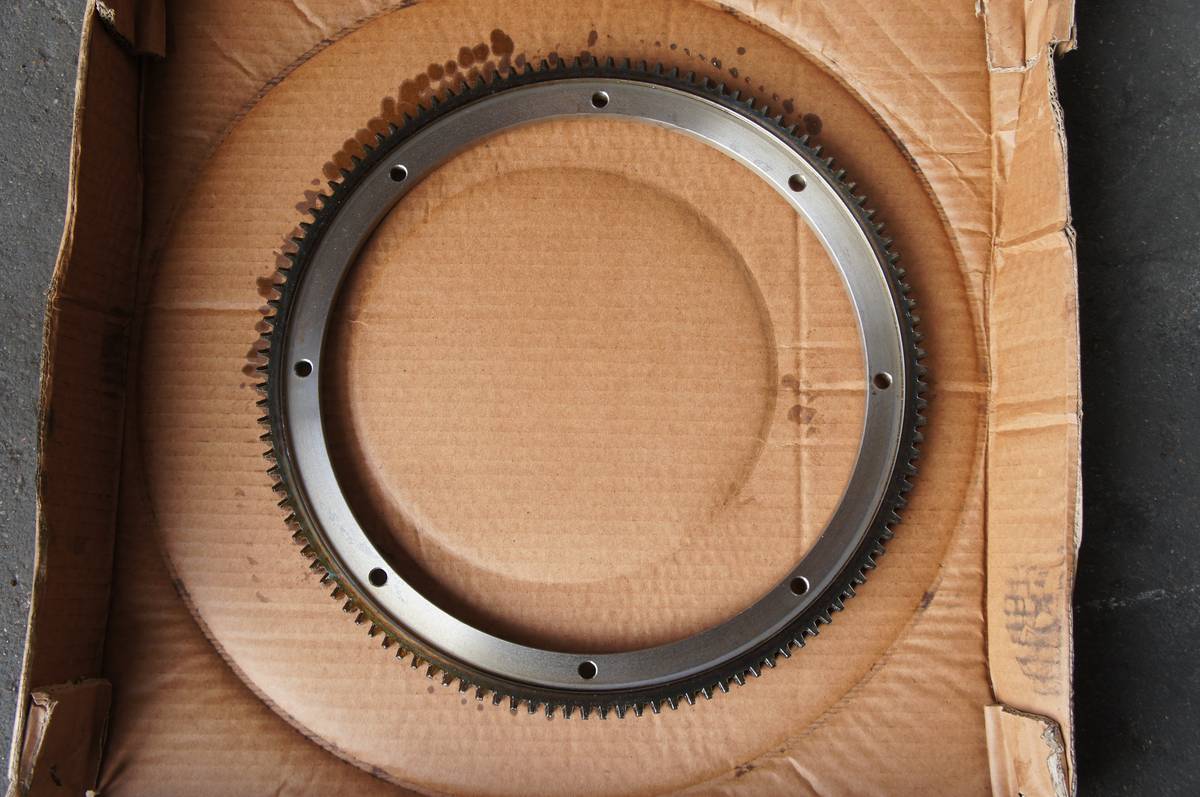
Flywheel Ring Gear Teeth: Why 136T, 138T and 159T Are Not Interchangeable
A ring gear is the cheapest part in the starting system and the most expensive one to get wrong. It costs a fraction of a flywheel, but if the tooth count is off by a few teeth, the starter will not mesh. It will grind, chew the teeth, and the truck does not start.
The confusing part is that the same engine brand uses several tooth counts. Cummins uses four. Weichai uses four. They look almost identical in a photo, and the supplier catalogue only gives you a part number that looks similar to three others.
This guide covers how many teeth the common diesel ring gears actually have, why the same brand uses different counts, and how to count your own in three steps before you order.
Table of Contents
- Why tooth count is the whole specification
- The tooth counts by brand
- Why the same brand uses different tooth counts
- The four ring gear construction types
- How to count your ring gear in three steps
- Why the ring gear fails before the flywheel does
- Ordering: what to send us
- FAQ
- About Changwei
- Related reading
Why tooth count is the whole specification
The ring gear does one job: it lets the starter pinion turn the crankshaft. The pinion has roughly 9 to 12 teeth. The ring gear has 100 to 200. They are designed as a matched pair, and the meshing only works when the tooth pitch on both sides is the same.
Get the tooth count wrong and one of two things happens. The teeth clash instead of sliding in, so the starter grinds and spins without turning the engine. Or the pinion engages partially, which is worse, because it looks like it works for a while and then tears the tooth tips off.
There is no universal standard. Tooth count is baked into each engine’s design, which is why there is no single answer to “what ring gear fits a Cummins.”
The tooth counts by brand
These are the counts we produce and stock. They are grouped by engine family, because that is how the ring gear is actually selected.
Weichai / Sinotruk
| Series | Number of teeth |
|---|---|
| WEICHAI / SINOTRUK | 136 |
| WEICHAI / SINOTRUK | 143 |
| WEICHAI / SINOTRUK | 159 |
| WEICHAI / SINOTRUK | 160 |
The 136-tooth version is the one most often asked for. On the WD615 platform the ring gear runs 136 teeth and matches a 430 mm clutch disc, with the flywheel held by 9 crankshaft bolts and the clutch by 16 bolts. If your engine is a WD615 or WP10 and you are ordering against part number 612600020208, this is the count you should be verifying.
Note that the same Weichai part number 612600020208 is also listed by some suppliers against a 159-tooth version. This is exactly why the part number alone is not enough.
Cummins
Cummins is the most commonly mis-ordered brand, because it uses four different ring gear sizes and they are all still in service.
| Series | Number of teeth | Typical part number |
|---|---|---|
| Cummins | 127 | 3905427 |
| Cummins | 138 | 3908546 / 3902127 |
| Cummins | 159 | 3901774 |
| Cummins | 173 | 3903309 |
| Cummins | 158 | 3907308 |
| Cummins | 149 | — |
| Cummins | 152 | — |
| Cummins | 118 | — |
| Cummins | 103 | — |
The four main counts are 127, 138, 159 and 173. The 173-tooth version is the largest and is often mistaken for the 159-tooth one, because both fit B-series and C-series engines. The 127-tooth gear is mostly found on 6CT applications. The 138-tooth gear is used on both 4BT/6BT and 6CT, which is a good example of why the count has to be checked rather than assumed from the engine model.
If you are holding a ring gear with 173 teeth and a part number ending in 3903309, you have the largest variant. Do not substitute a 159-tooth gear just because the diameter is close.
Deutz / Dachai
| Series | Number of teeth |
|---|---|
| Deutz Dachai (BF4M, BF6M, TCD 2012/2013) | 115 |
| Deutz Dachai (BF4M, BF6M, TCD 2012/2013) | 131 |
| Deutz Dachai (BF4M, BF6M, TCD 2012/2013) | 145 |
ISUZU Trucks & Diesel Engine Applications
| Series | Number of teeth |
|---|---|
| ISUZU trucks and diesel engines | 108 |
| ISUZU trucks and diesel engines | 129 |
| ISUZU trucks and diesel engines | 138 |
| ISUZU trucks and diesel engines | 139 |
| ISUZU trucks and diesel engines | 140 |
| ISUZU trucks and diesel engines | 164 |
Hino
| Series | Number of teeth |
|---|---|
| Hino commercial trucks and diesel engines | 121 |
| Hino commercial trucks and diesel engines | 129 |
| Hino commercial trucks and diesel engines | 137 |
| Hino commercial trucks and diesel engines | 145 |
A 121-tooth Hino gear and a 121-tooth Weichai gear are not the same part. Tooth count narrows the field, it does not close it. Diameter, bore, mounting hole pattern and ring thickness all have to match as well.
Why the same brand uses different tooth counts
This is the question customers ask most, and the answer is usually one of three things.
First, the engine got bigger. A larger displacement engine needs more cranking torque, and the starter supplier solves that with a different gear ratio between pinion and ring gear. Changing the ratio means changing the tooth count on one side of the pair.
Second, the starter was changed. When a manufacturer switches starter suppliers between model years, the new pinion may need a different ring gear to keep the same cranking speed. The engine is unchanged but the ring gear is not.
Third, the application changed. A truck engine and the same basic engine built as an industrial or marine unit can be fitted with different flywheel housings, and the ring gear follows the housing.
This is why “it is the same engine” is not a safe assumption. A 4BT in a truck and a 4BT in a generator set can use different ring gears.
The four ring gear construction types
Tooth count is the specification, but the shape tells you which family you are dealing with. These are all parts we make, photographed in our own shop.
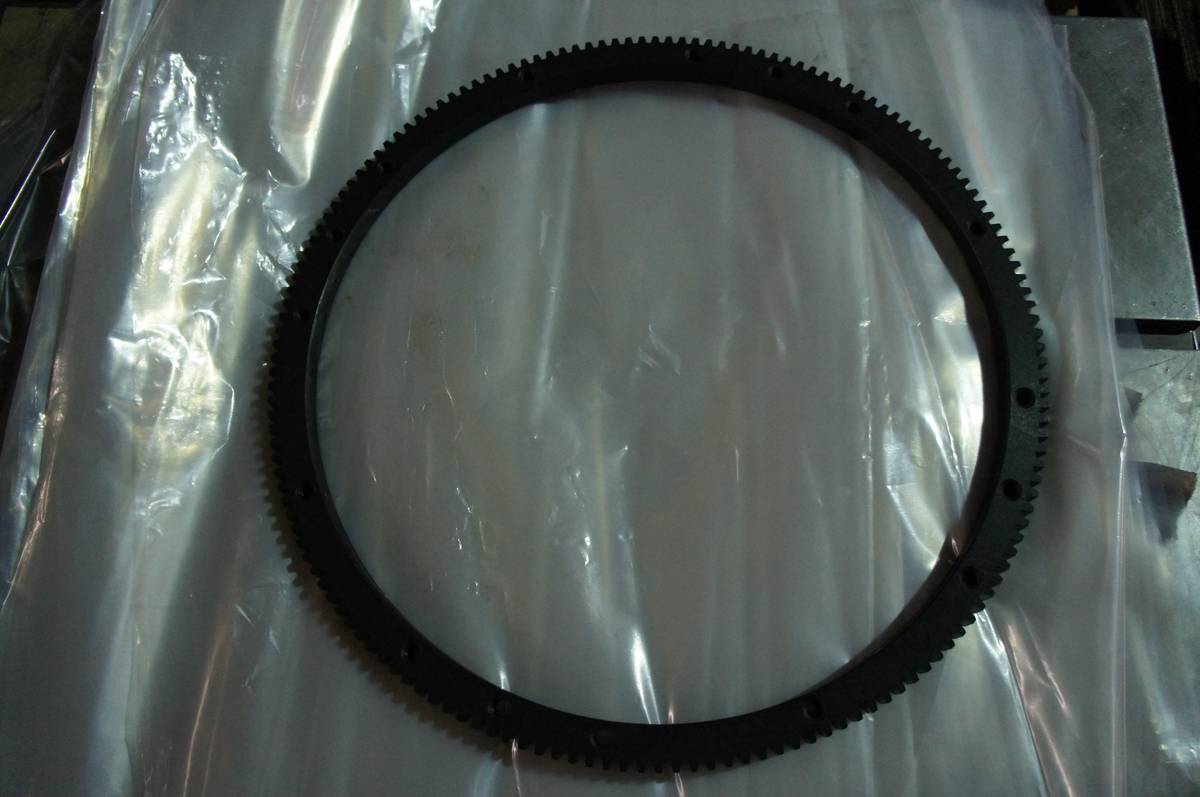
This is the 136-tooth Weichai pattern. Plain ring, evenly spaced mounting holes on the inner flange, uniform tooth pitch. This is the shape most people picture when they say “ring gear.”
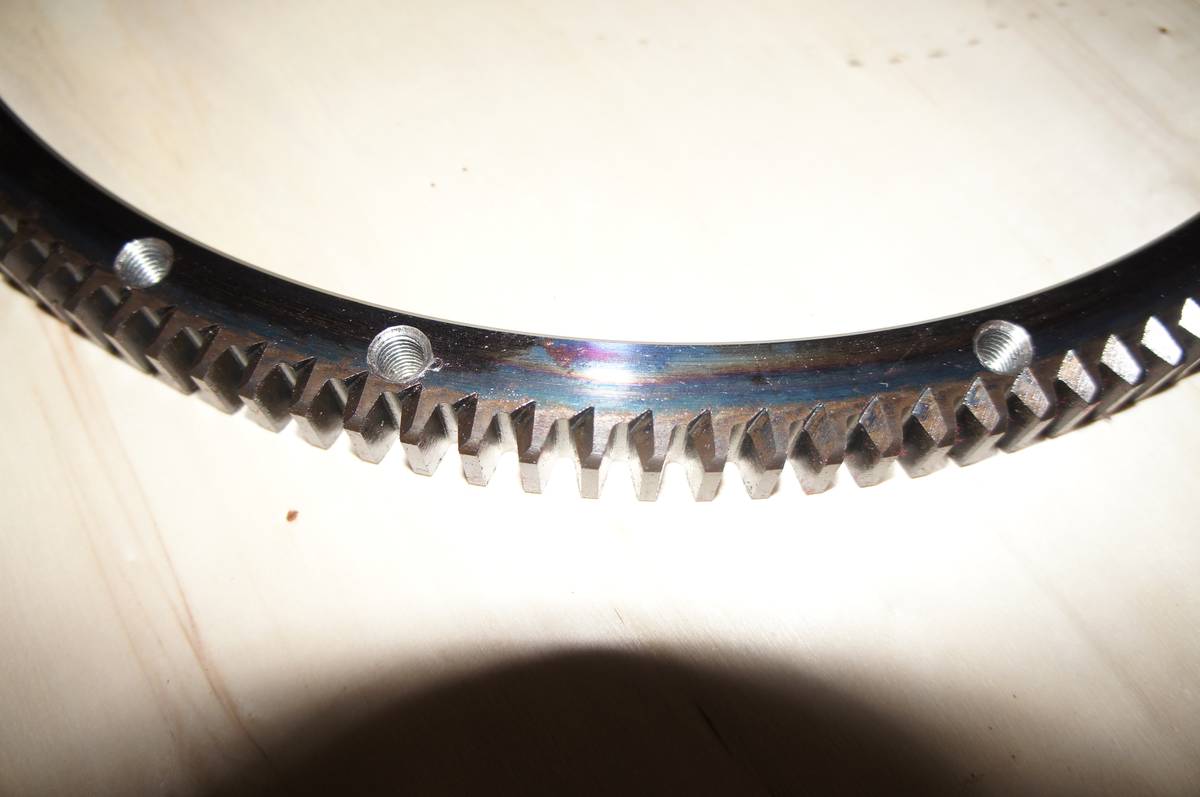
Up close you can see the chamfer on the tooth tips. That lead-in is what lets the pinion slide into mesh instead of hitting the tooth head-on. The heat tint on the ring next to the teeth is from induction hardening. A ring gear that is not hardened will round its teeth off within a season of daily starts.
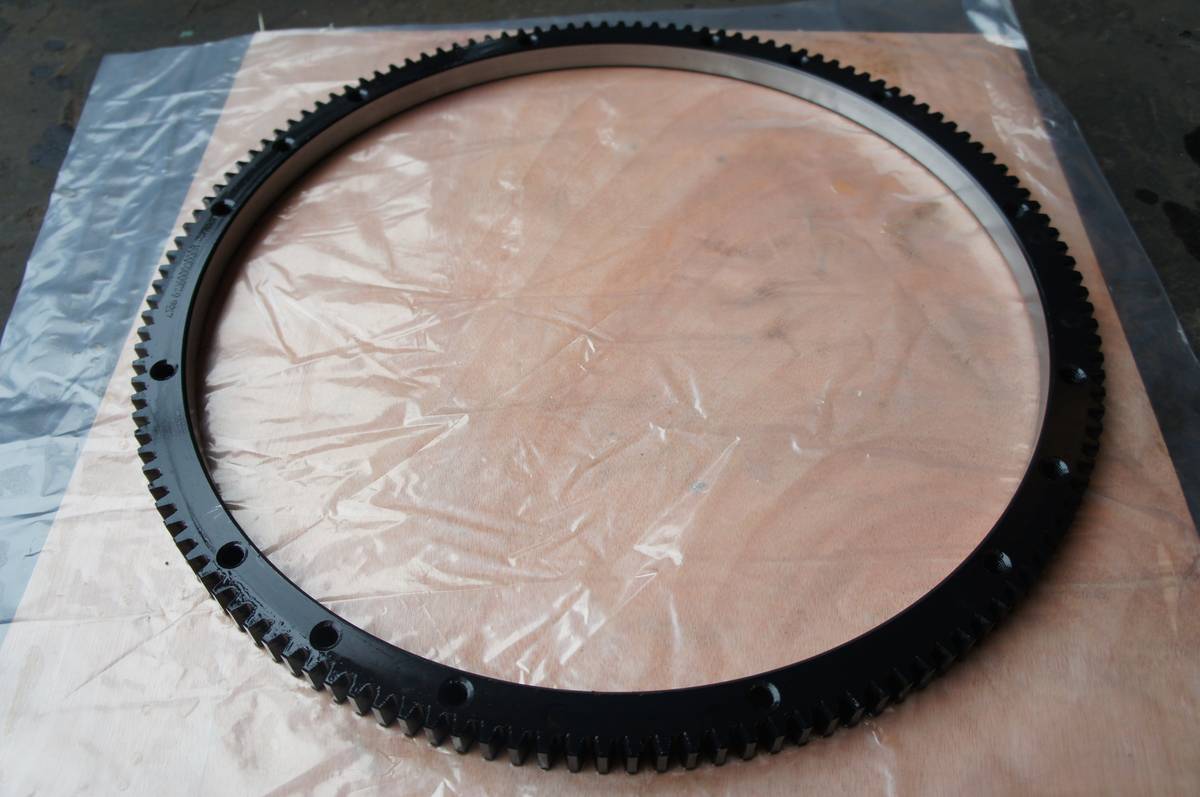
The larger diameter gears carry the bolt holes on an internal flange. Note the raised lip on the inner edge. That lip locates the gear on the flywheel during shrink fitting, and its height varies between applications.
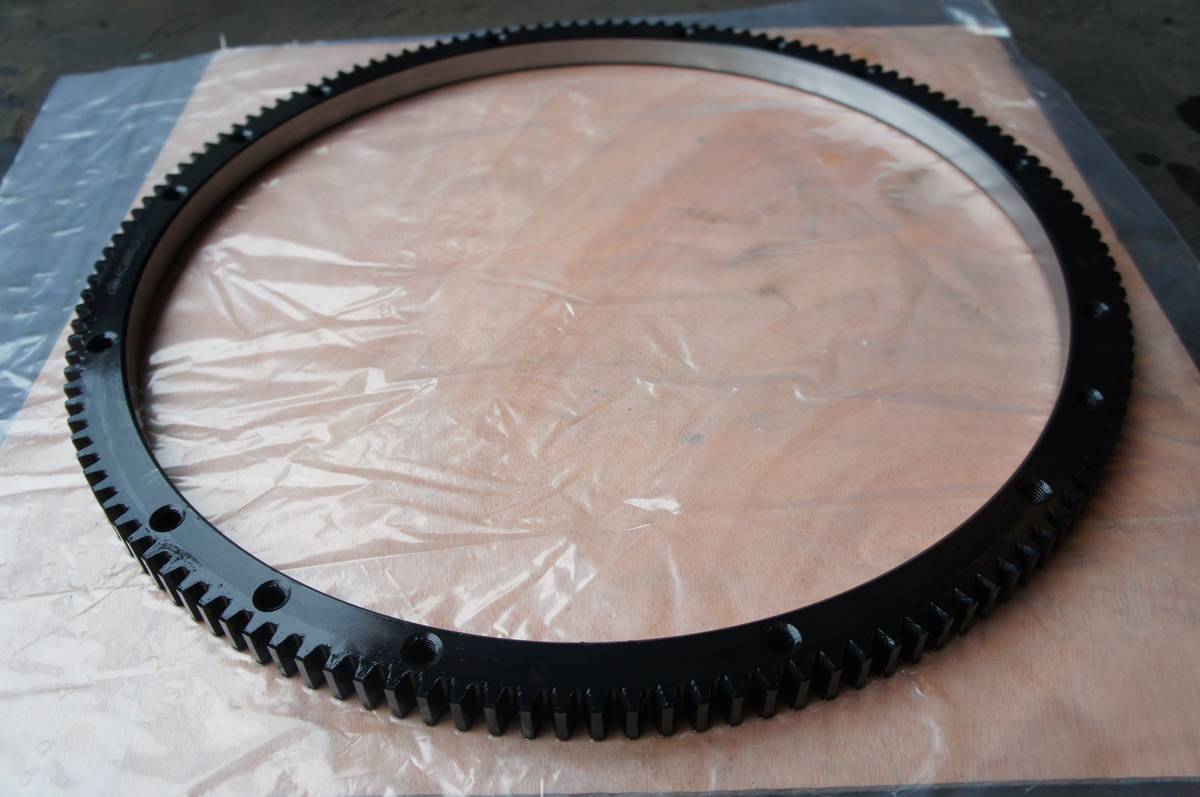
The same family after black oxide. The finish is cosmetic and anti-corrosion; it has no effect on the tooth engagement.
This one is different in kind, not just in size. There are internal splines on the bore in addition to the mounting holes. If your ring gear looks like this, you are not looking at a plain shrink-fit ring, and the tooth count alone will not identify it.
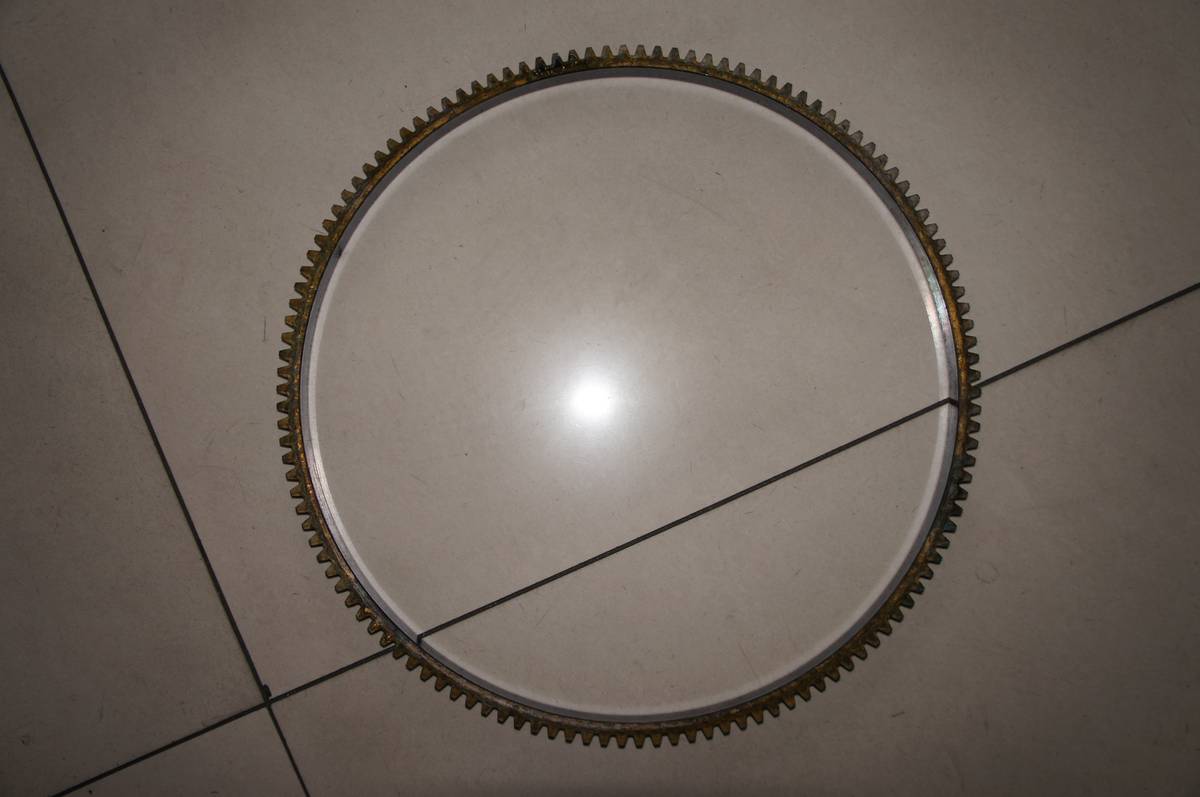
The Perkins 126-tooth gear shows a two-material construction, with a distinct hardened band around the tooth edge. This is a wear indicator worth knowing: when the band disappears on one section of the circumference, the teeth there have worn down.
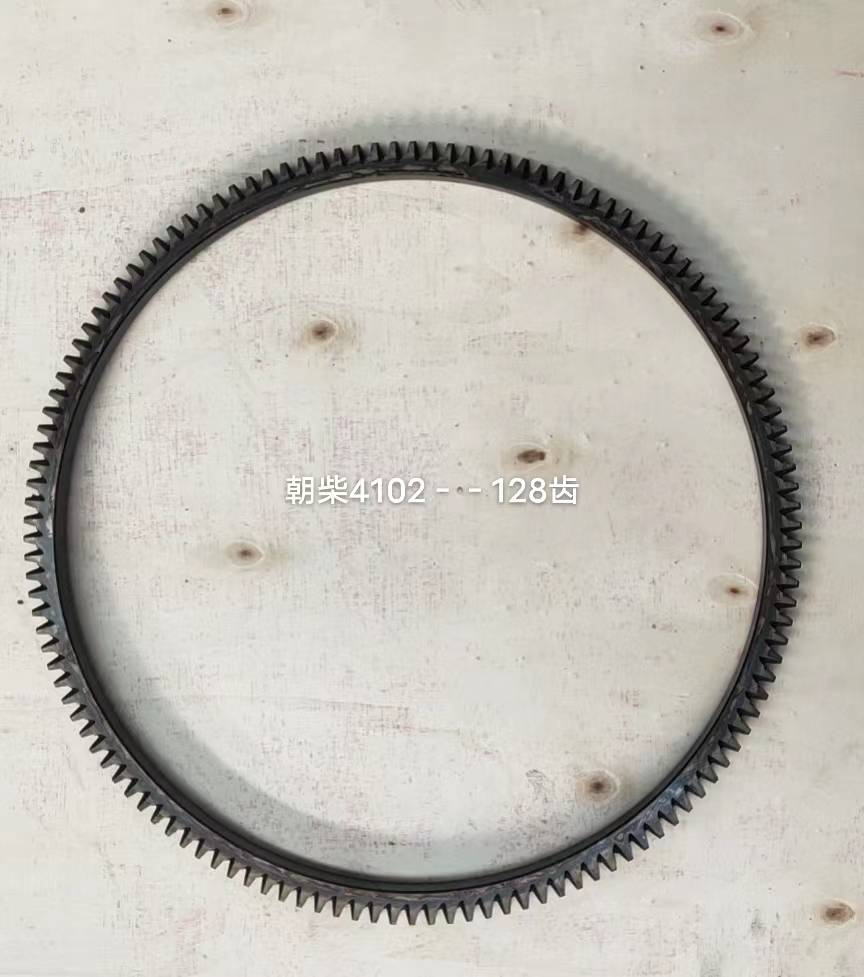
A 128-tooth gear for the Chaochai 4102. This particular count does not appear in any of the brand tables above, which is the point I keep coming back to.
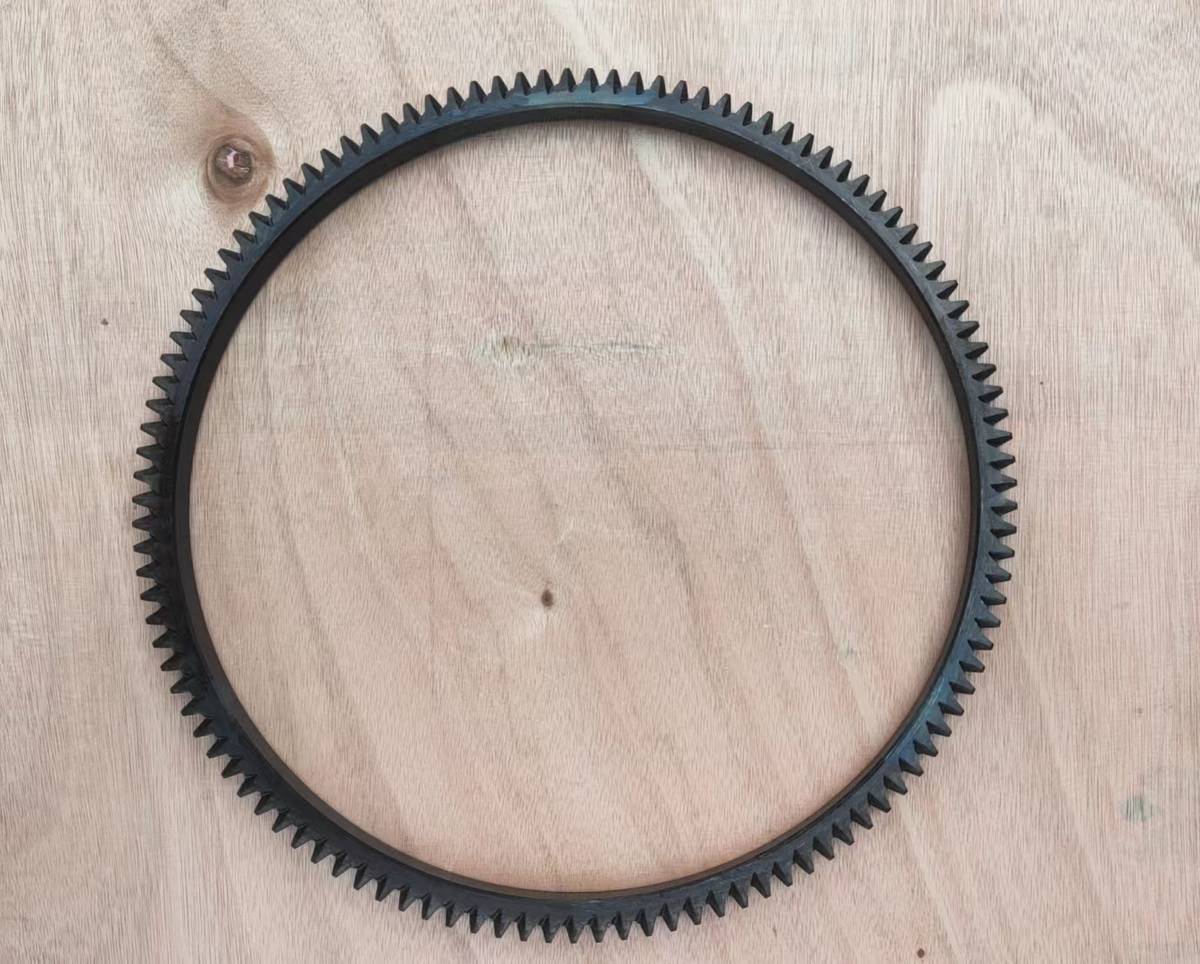
This export pattern has visibly coarser teeth than the 136-tooth Weichai gear at the top of this section. Coarse pitch means fewer, larger teeth for the same diameter. Two gears of similar diameter can have very different counts, and this is the clearest example of it. Put them side by side and the difference is obvious. Look at them separately in a catalogue photo and they are easy to confuse.
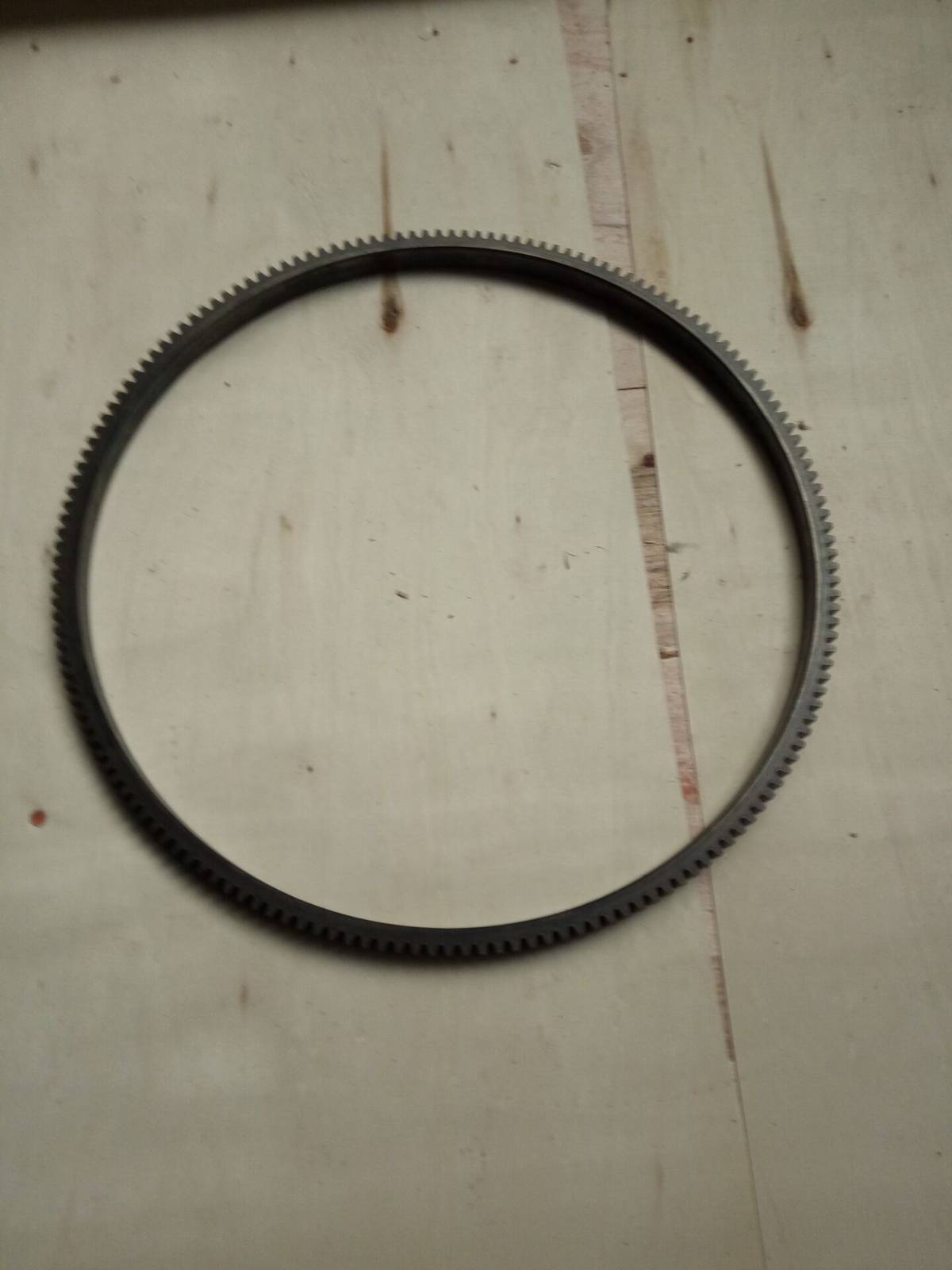
A 164-tooth gear, the highest count in our range.
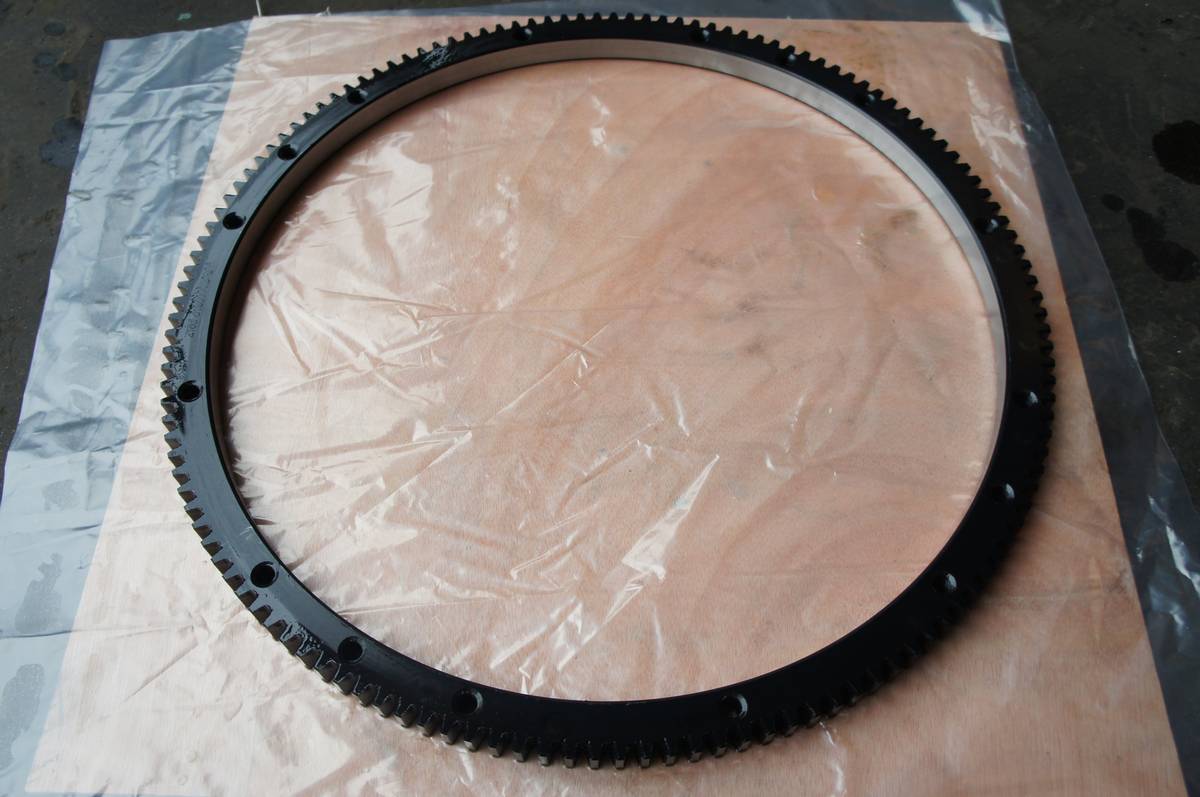
The side view matters more than most buyers expect. Ring thickness and the position of the mounting flange have to match the flywheel groove they fit into. A gear with the right teeth and the wrong section height will not seat.
How to count your ring gear in three steps
Do this before you order, not after. It takes ten minutes.
Step one. Mark one tooth with a paint pen or a piece of tape. This is your starting point. Without a mark you will lose count somewhere past sixty and start over.
Step two. Count every tooth around the full circumference until you are back at the mark. Count in groups of ten and write the running total down. Do not count by eye in pairs or by dividing the circumference, and do not trust a photo.
Step three. Count twice. If the two counts differ, count a third time. On a 159-tooth gear, being one tooth out is easy, and one tooth out means the part is wrong.
Then measure the outside diameter across the tooth tips, the inside diameter of the bore, and the ring section height. Take a photo of the gear from directly above and one from the side. Those four numbers and two photos let us confirm the part without you shipping anything.
One caution: if the teeth are worn or chipped, count in a clean section and extrapolate, or send us the photo. A worn gear can be one or two teeth ambiguous at the damaged area, and that is exactly the region where the count gets lost.
Why the ring gear fails before the flywheel does
The ring gear takes every start. The pinion hits the same few teeth near top dead centre where the engine usually stops. On a truck doing thirty starts a day, those teeth see thousands of impacts a year while the rest of the circumference stays nearly new.
The failure sequence is predictable. The tooth tips mushroom and round over. The starter engages a little shallower each time. Grinding starts. Because the damage is localised, the problem is intermittent at first, which is why so many trucks run for months with a starter that grinds every third or fourth start.
By the time it grinds on most starts, a ring of 15 to 30 teeth is usually damaged. Replacing the ring gear at the first grind is a fraction of the cost of replacing it after the starter has also been destroyed and the flywheel face has been scored.
A loose or misaligned starter damages a ring gear faster than anything else. If the mounting bolts are not torqued to spec, or the mounting face is not square, the pinion sits at the wrong depth and chews the tooth tips on every engagement. If you have replaced a ring gear and it failed again quickly, check the starter mounting before blaming the part.
Ordering: what to send us
Send these and we can quote the correct part first time:
- Tooth count, counted twice
- Outside diameter across the teeth
- Inside diameter of the bore
- Ring section height
- Engine model and, if you have it, the OEM part number
- A photo from directly above and one from the side
We cast and machine ring gears in our own foundry, so if your count is not in the tables above it is not a problem. That is a normal request. Same for a gear with a non-standard section height or an internal spline.
FAQ
Can I use a 159-tooth ring gear in place of a 173-tooth one?
No. The starter pinion is matched to the tooth pitch of the ring gear. If you change the count on the ring gear side of the pair, the pinion no longer meshes correctly. In practice the starter will grind and will not crank the engine reliably.
My engine is a 6BT. Which count do I need?
The 6BT appears with 138, 159 and 173 teeth depending on the build and the application, so the engine model does not settle it. Count the teeth on the gear you are replacing. The same warning applies to the 6CT, which appears with 127, 138 and 158 teeth.
Do I have to replace the whole flywheel?
Usually not. The ring gear is a separate part from the flywheel on most of these engines, and it is replaced on its own once the flywheel is out. What has to be checked is the flywheel face for heat cracks and scoring, and the mounting groove where the gear seats. If the groove is worn, a new ring gear will not hold its position.
How do I know if my worn ring gear can still be used?
If the damaged teeth are fewer than about eight and they are not adjacent, the starter will usually engage on a healthy section and the gear can run for a while. If there is a continuous bald patch of six or more adjacent teeth, the starter will eventually land on it and fail to crank. That gear needs replacing.
Why is the ring gear so much cheaper than replacing the flywheel?
Because it is a plain hardened steel ring rather than a machined casting. The cost is not in the part, it is in the labour to get to it, which is why grinding starters should be dealt with in days rather than months. The part is cheap, the access is not.
Do you supply ring gears that are not on your standard list?
Yes. We work from a drawing or a sample. If you send the tooth count, dimensions and photos, we can confirm feasibility and quote. Non-standard section heights and internal spline versions are normal work for us.
What material are your ring gears made from?
Medium carbon steel, hardened after machining. The tooth band is the working surface and it is the reason a ring gear can be replaced cheaply while the flywheel casting keeps running.
About Changwei
Changwei Intelligent Equipment is an IATF 16949 certified cast iron foundry in Changyi, Weifang, Shandong, China. We cast and machine flywheels, ring gears, flywheel housings, timing gear housings, cylinder blocks and cylinder heads for truck, industrial and agricultural diesel engines.
We supply both standard catalogue parts and custom parts made to drawing or sample. If you are looking for a ring gear and all you have is a tooth count and a photo, send it over and we will tell you what we can do.
Irene
Changwei Intelligent Equipment
Email: [email protected]
Phone / WeChat / WhatsApp: +86 19953662121
Wangke Industrial Zone, Changyi, Weifang, Shandong, China
FOB Qingdao
Related reading
- Ring gear product range: /en/product/gear-ring
- Cummins flywheel ring gear: /en/product/cummins-flywheel-ring-gear
- Weichai flywheel ring gear: /en/product/weichai-flywheel-ring-gear
- Hino flywheel ring gear: /en/product/hino-flywheel-ring-gear
- Cummins flywheel part numbers and which engine they fit: /en/blog/cummins-flywheel-part-numbers
- Weichai WP10 flywheel ring gear identification: /en/blog/flywheel-ring-gear-identification-guide
- Request a quote: /en/quote