
Cummins Flywheel Part Numbers: 6BT, 6CT, ISBE Explained
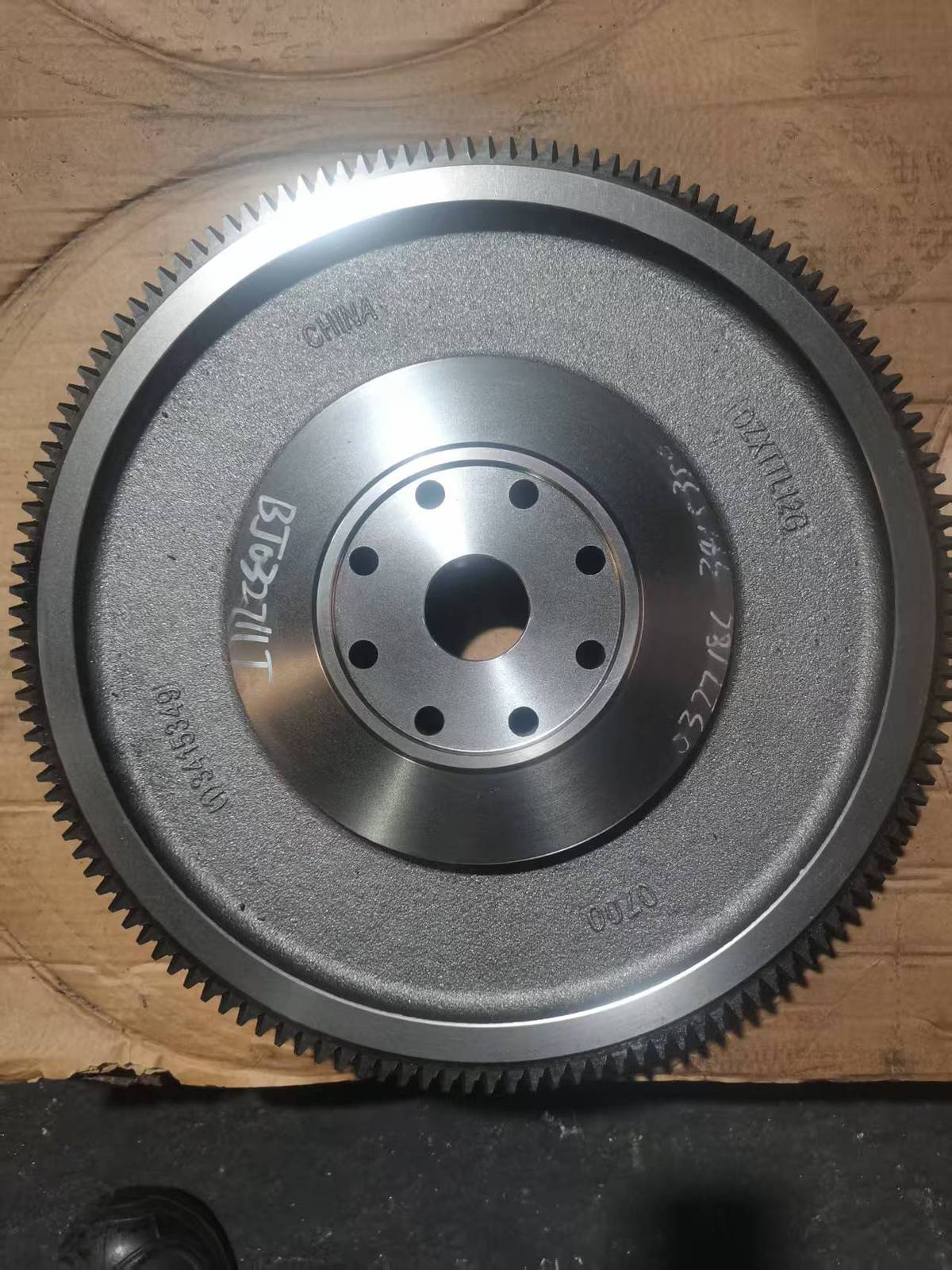
Cummins Flywheel Part Numbers: 6BT, 6CT, ISBE and QSL
The most common mistake we see on a Cummins flywheel enquiry is not a wrong part number. It is a correct part number quoted for the wrong engine. A number that reads clean in a Cummins parts list can cover sixty engine models, and the buyer assumes it means one.
This guide is about the numbers themselves: which ones cross which engine families, what each one actually specifies, and what to check on your own engine before the part ships. Every photograph is our own casting.
Table of Contents
- Why One Cummins Number Fits Several Engines
- The Engines Behind the Numbers
- What Actually Decides Whether a Flywheel Fits
- Four Numbers Worth Checking Before You Buy
- What the Cast Marks on a Flywheel Tell You
- EQ145 and EQ153 Are Truck Models, Not Engine Families
- How to Match a Flywheel Before You Order
- What to Send Us for a Quote
- FAQ
- Get a Cummins Flywheel Quote
Why One Cummins Number Fits Several Engines
Cummins numbers a flywheel by the assembly, not by the engine. If the same flywheel satisfies two applications, it keeps one number and both applications inherit it. That is why a flywheel listed for a 5.9 litre B series engine also appears under a 6.7 litre ISB, and why the same number shows up on a QSB industrial engine and a generator set.
The consequence for a buyer is simple. A part number search tells you the flywheel exists. It does not tell you whether it fits the engine in front of you. For that you need the dimensions, and the number alone will not give them to you.
There is a second layer. Cummins also uses what it calls a CPL or ESN prefix, the engine build code stamped on the data plate. Two trucks with the same engine model can carry different CPLs and different flywheels. This is why a supplier who only asks for the engine model will eventually ship the wrong part.
The Engines Behind the Numbers
Most Cummins flywheel numbers in circulation belong to the B, C and L families. Knowing the displacement and bore and stroke of each tells you what physical size of flywheel to expect.
| Engine family | Displacement | Configuration | Bore and stroke | Dry weight |
|---|---|---|---|---|
| 4BT | 3.9 L (239 cu in) | Inline 4, turbo | 102 x 120 mm | not quoted here |
| 6BT | 5.9 L (359 cu in) | Inline 6, turbo | 102 x 120 mm | approximately 465 kg |
| 6CT | 8.3 L (504 cu in) | Inline 6, turbo | 114 x 135 mm | 684 kg |
| 6CTA | 8.3 L (504 cu in) | Inline 6, turbo aftercooled | 114 x 135 mm | 702 kg |
The 6BT and 6CT figures come from Cummins published engine data. The two engines share a family name and almost nothing else. The 6CT carries 40 percent more displacement, a longer stroke and roughly 220 kg more mass. A flywheel sized for a 6BT will not carry a 6CT clutch, and the weight difference means the flywheel’s own inertia is a different figure.
There is one useful convention in the marine data: Cummins lists 6CT rotation as counterclockwise when facing the flywheel. If you are matching a flywheel to an industrial or marine 6CT, confirm rotation before anything else, because a flywheel drilled for the opposite rotation will not index correctly.
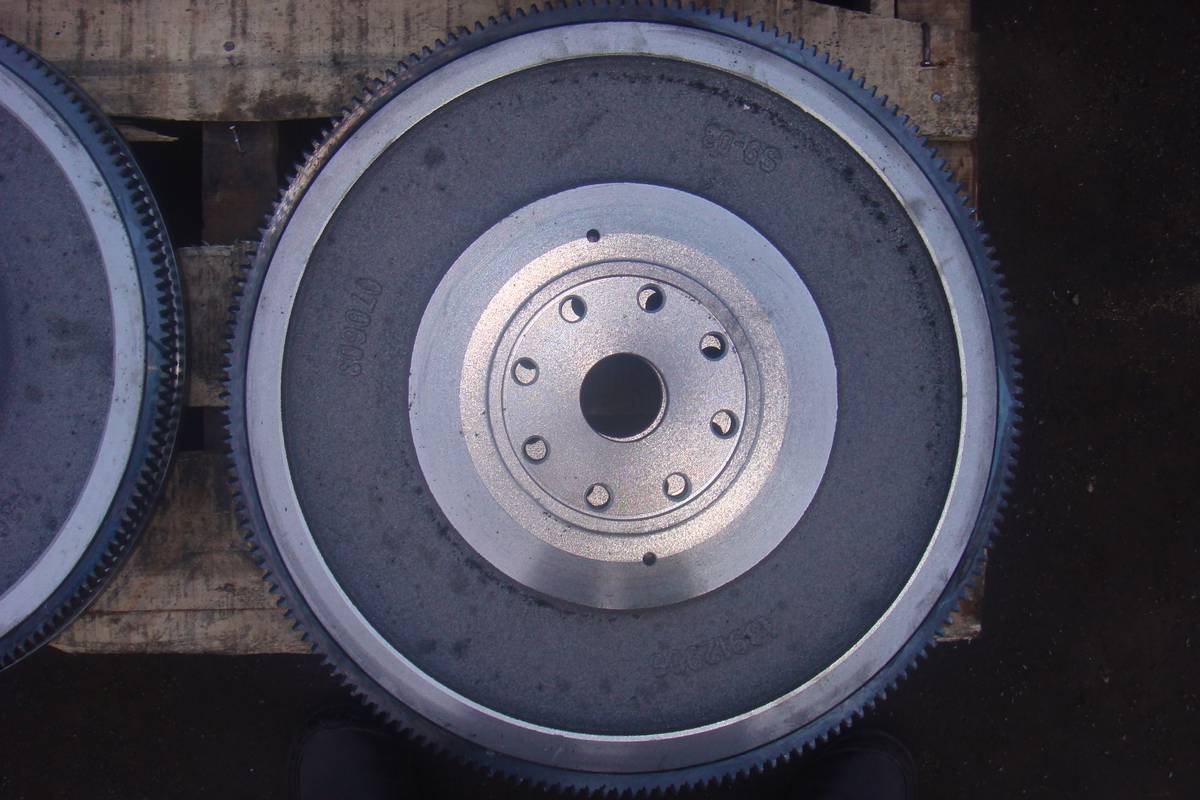
The 6BT flywheel has a shallow, nearly flat friction face. This is the shape most buyers picture when they think of a Cummins flywheel.
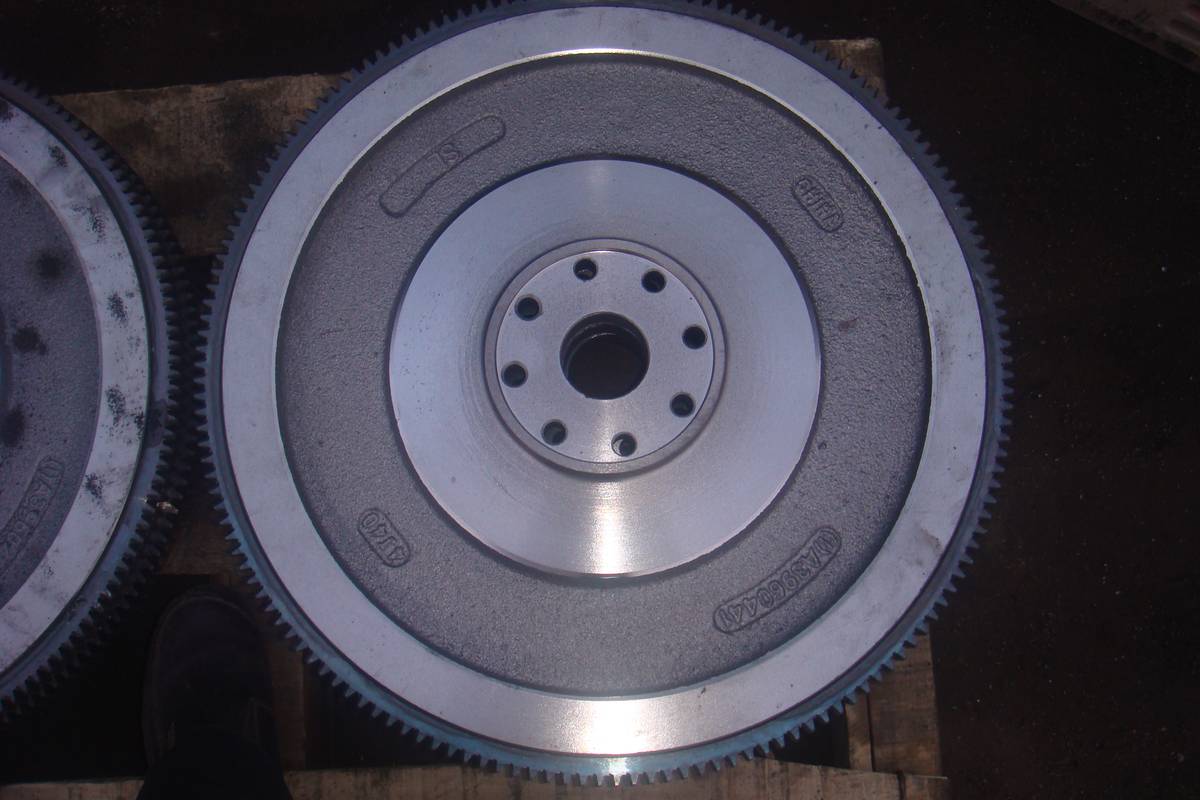
The 6CT flywheel is visibly a heavier casting. The friction ring sits proud of the web, and the whole assembly is sized for a larger clutch.
What Actually Decides Whether a Flywheel Fits
Five measurements decide it. A part number is only a shortcut to them.
The flywheel housing SAE size. SAE numbers describe the housing, and a lower number means a larger housing. SAE 1 is larger than SAE 2. The housing size dictates the flywheel’s outside diameter and the ring gear tooth count that the starter has to engage.
Ring gear tooth count and pitch. These travel together. A 10/12 pitch ring gear and an 8/10 pitch ring gear are not the same tooth form, and a starter pinion matched to one will not run correctly on the other.
Crank flange bolt pattern. The number of bolts and the dowel pin position both matter. The dowel locates the flywheel, so a flange with the dowel in the wrong place will not time correctly even if every bolt lines up.
Clutch mounting diameter and bolt circle. This is the face the clutch bolts to, and it is independent of the crank flange. A flywheel can be correct on the crank and wrong for the clutch.
Overall thickness and crank boss height. On a Cummins this is the dimension that quietly ruins a job. A flywheel that is 4 mm thinner moves the clutch 4 mm closer to the block, and the release bearing geometry changes with it. If the original is a recessed or dished design, a flat replacement will change the stack height.
Four Numbers Worth Checking Before You Buy
These four are in circulation now and we can document what each one specifies. They illustrate the range of what a Cummins flywheel number can mean.
A3912906, 3912906 and 3912907: SAE No. 2, 173 Teeth
The same flywheel carries three forms of the same number. The A prefix marks the assembly as a service part, so A3912906 and 3912906 describe the same casting, and 3912907 sits alongside it in the same group.
Documented specification: SAE No. 2 flywheel, 173 tooth ring gear, 10/12 ring gear pitch, ring gear part number 3903309.
Documented fitment: 4BT, 6BT and 6CT. Independent parts listings also place it across the QSB and ISB families and the ISF 3.8, which is how a single number reaches roughly sixty engine models.
The same number is catalogued in China as a Dongfeng Cummins 6BT flywheel and ring gear assembly for the Dongfeng 153 truck. That is a useful illustration of the point, because the Chinese catalogue names the truck and the Western catalogue names the engine. Both are describing one part.
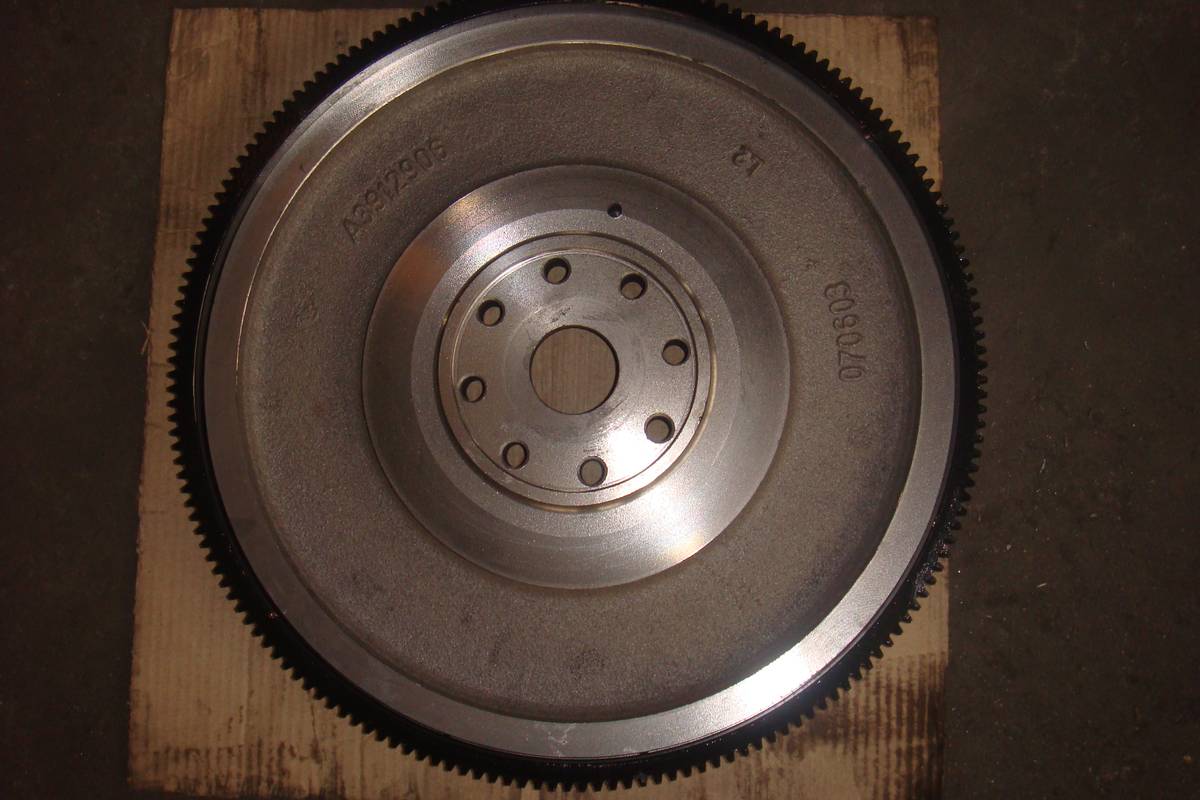
This is our own casting. The number A3912906 is cast into the web of the friction face, which is the clearest identification evidence you can get short of a data plate photograph.
4933490: SAE 1, 158 Teeth
Documented specification: SAE 1 flywheel, 158 tooth ring gear, 8/10 ring gear pitch, 8 mounting bolts to the crank, 14 inch clutch, clutch mounting diameter 438.15 mm, maximum high idle 3270 rpm.
Documented fitment: QSC 8.3, ISC 8.3 and QSL. It supersedes the older number 3909908.
Note the pattern against the previous entry. SAE 1 with 158 teeth against SAE 2 with 173 teeth. The housing size and the tooth count move together, which is why a buyer who counts teeth has already done most of the identification work.
Notice also that 4933490 is a C and L series flywheel, not a B series one. The 8.3 and 8.9 litre engines take it. If you have a 5.9 litre 6BT and someone quotes you 4933490, the clutch mounting diameter alone should tell you it is the wrong part.
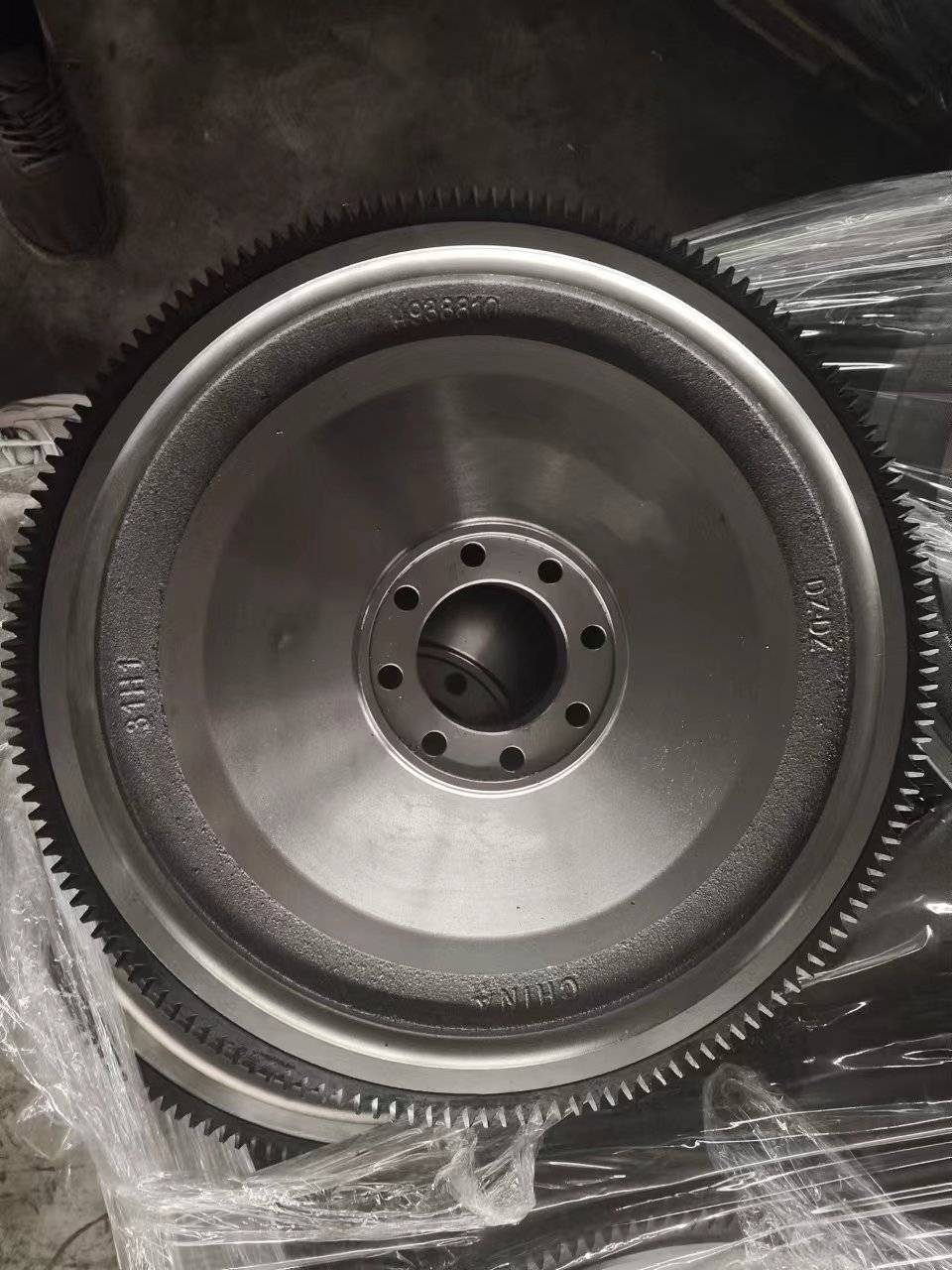
The 4933490 has a raised hub with the friction band recessed below it. It does not share the flat profile of a 6BT flywheel.
3415350: The 28 kg C and L Series Flywheel
Documented specification: 28.0 kg, option code FW9826, 8.3 to 8.9 litre C and L series fitment covering ISL9, 6C8.3, ISC8.3, QSC8.3, QSL9 and L8.9. It appears in the QSB 6.7 parts listing as a flywheel, and Chinese suppliers catalogue it as a 6CT 8.3 flywheel assembly.
The 28 kg figure is worth keeping. Flywheel mass is not cosmetic. It is the stored energy that carries the engine between firing strokes, and on a C or L series industrial engine it is part of how smoothly the machine runs under load.
The 3415350 is a heavy casting with a distinctly coarser ring gear pitch than the smaller B series flywheels.
3960448: The B and C Series Crossover
Documented fitment: 6B, 6BT and 6CT.
This one number is the cleanest argument for why a part number cannot be read as an engine family. The same flywheel is listed for the 5.9 litre B series and the 8.3 litre C series, two engines with different bore, stroke and displacement.
Whatever makes that possible, the practical effect is that a buyer with a 6BT and a buyer with a 6CT can both be quoting the same number and both be correct. What separates them is not the number. It is the clutch they are going to bolt to it.
What the Cast Marks on a Flywheel Tell You
This is where most online guides are wrong, so it is worth being precise.
Cast and stamped marks on a flywheel fall into two groups, and only one of them identifies the part.
Traceability codes. These are the ones you will find most often. On our own castings we have read marks such as 0743960A4A on a 6CT flywheel, BT632711 and 0327126 on a 3415350, and 4936810 on a 4933490. These are mould, batch and date references used by the foundry to trace a casting back to its heat. They are not part numbers, and entering one into a parts search will return nothing.
Part numbers. Occasionally the genuine number is cast or stamped into the part. The A3912906 in the photograph above is a real example, and where it appears it is the single best piece of identification evidence you can photograph.
We mention this because a buyer who reads a traceability code off a flywheel, searches it and finds nothing will often conclude the part is a counterfeit or an unmarked aftermarket casting. Neither is necessarily true. The code was never meant to be searched.
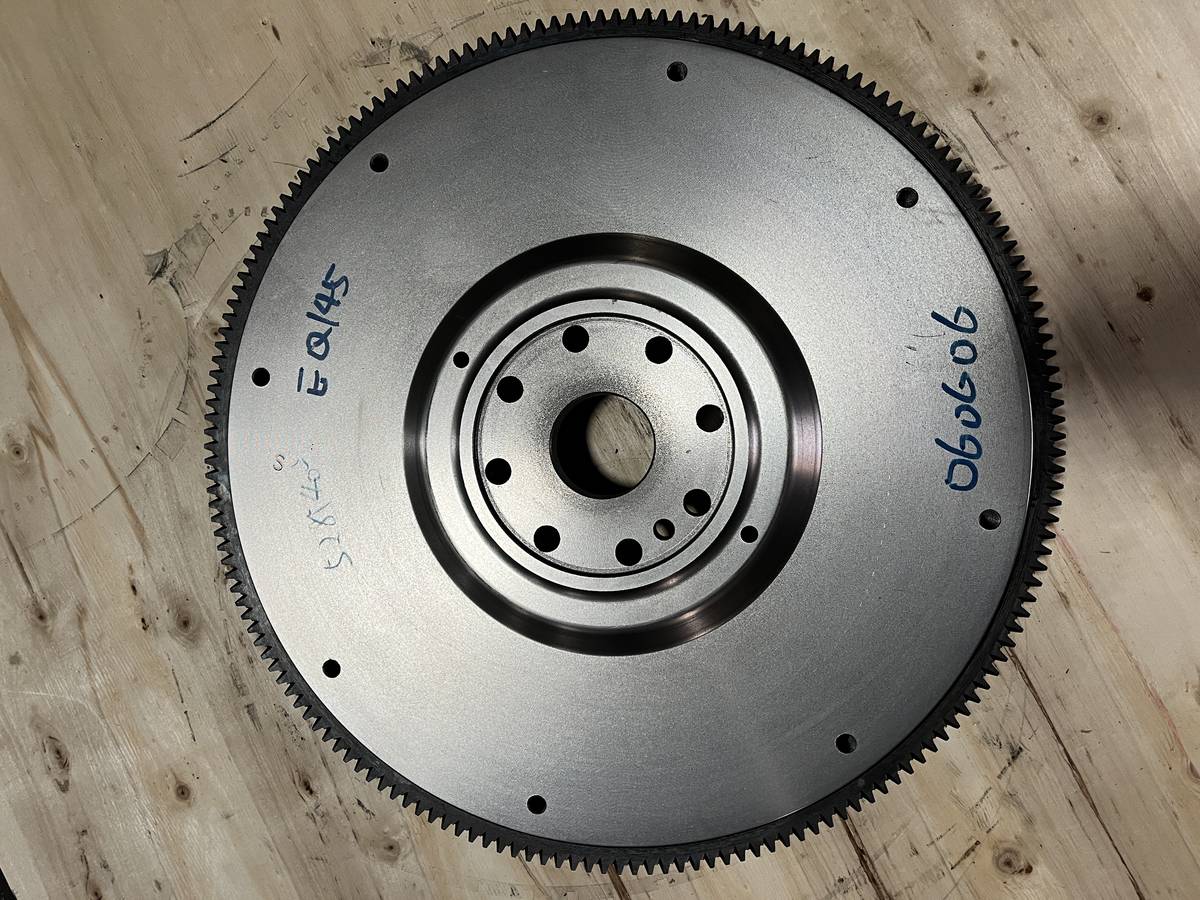
The EQ145 flywheel carries an additional ring of holes near the rim for the clutch mounting. Those holes are not part of the crank flange and cannot be used to identify the engine.
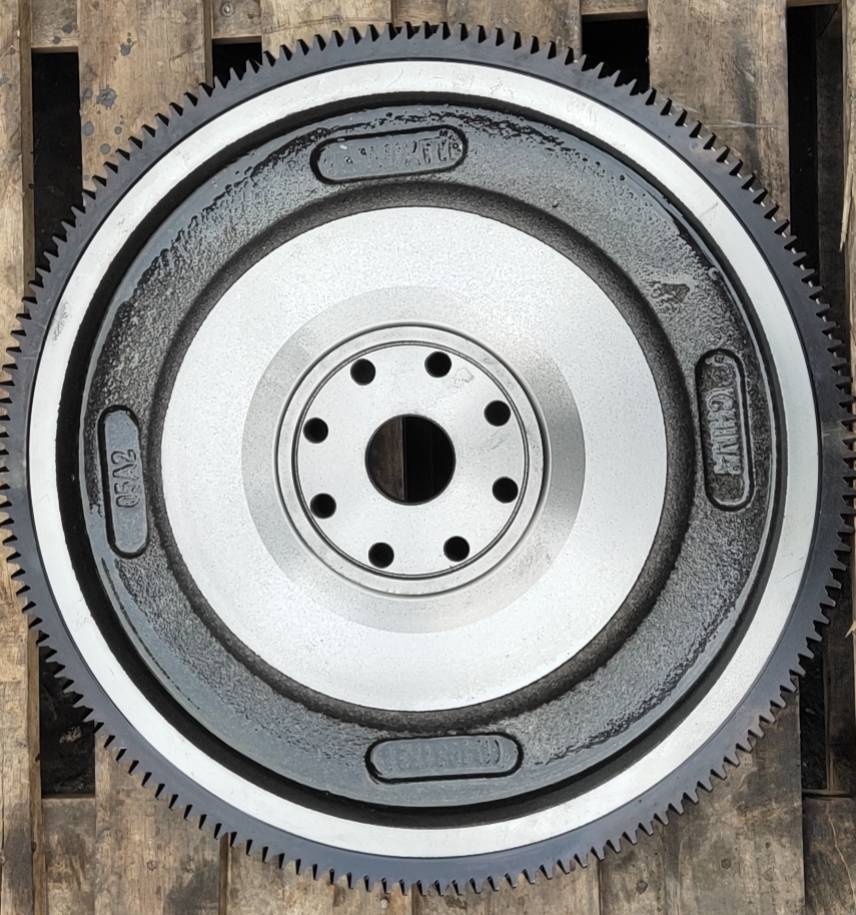
This casting shows the balance pockets machined into the web. Balancing cuts like these are a machining step, not a casting feature, and they will differ between individual flywheels of the same part number.
EQ145 and EQ153 Are Truck Models, Not Engine Families
Chinese parts catalogues group Cummins flywheels by truck. EQ145 and EQ153 are Dongfeng truck models. When a supplier says EQ153 flywheel, they mean the flywheel used on that truck, which in practice means a 6BT flywheel.
This matters when you are buying across markets. A European or North American listing will name the engine. A Chinese listing will often name the truck. Both descriptions can point to the same casting, and a buyer who treats EQ153 as though it were an engine family will end up searching for an engine that does not exist.
Our own stock list is grouped the same way, by application, which is practical for a foundry but not the same as an engine family grouping. If you are reading a supplier list and see the same part number under two different headings, that is usually why.
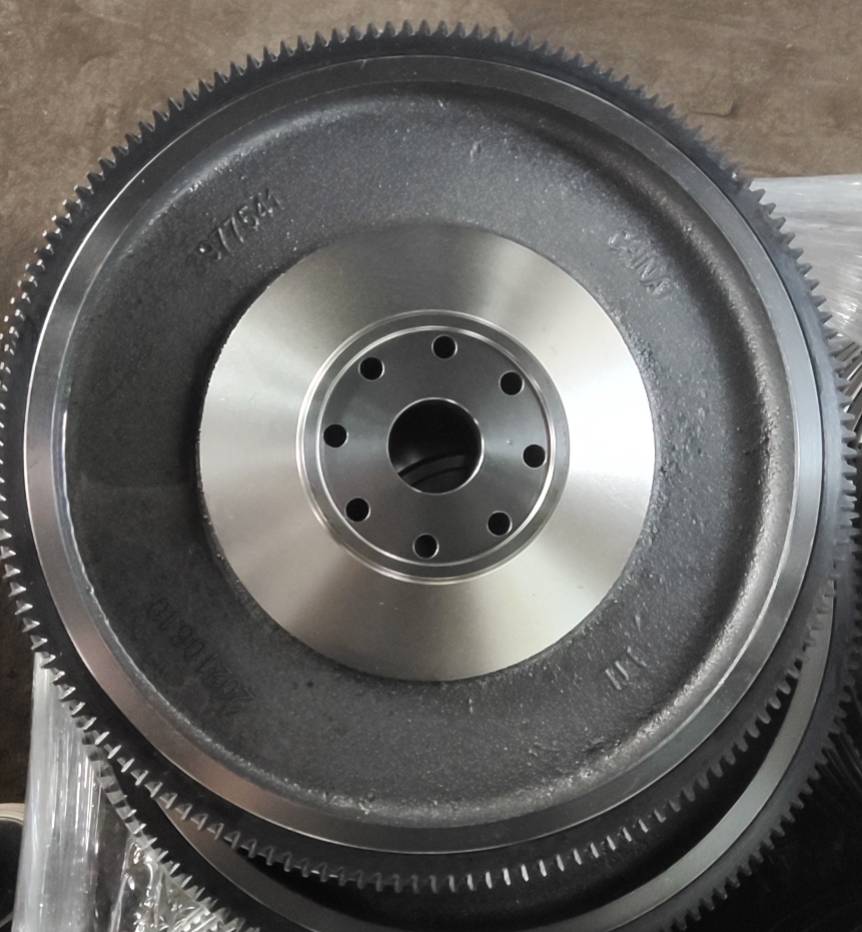
Different Cummins flywheels carry different crank flange bolt circles, different hub heights and different friction band depths. Two castings can look alike in a photograph and still not interchange.
How to Match a Flywheel Before You Order
Work through these six checks in order. Stop at the first mismatch.
One, read the engine data plate. Take the engine model, the CPL and the engine serial number. Photograph the plate rather than writing the numbers down, because serial numbers are easy to transcribe incorrectly.
Two, count the ring gear teeth. Mark the first tooth with chalk and count all the way round. This is the single most useful number on the whole part.
Three, measure the ring gear outside diameter and the overall flywheel thickness. A caliper is enough. Record the friction face diameter as well if the face is not flat.
Four, count the crank flange bolts and note the position of the dowel pin relative to them.
Five, measure the clutch mounting bolt circle and the clutch diameter.
Six, photograph the flywheel square-on from both sides, clutch face and crank face, with the ring gear teeth visible in the frame. Two clean photographs will resolve most identification questions faster than any number of measurements read out over the phone.
What to Send Us for a Quote
Send the engine model, the CPL if the plate shows one, and two photographs. If you have the old part number, include it, but do not rely on it alone.
We cast and machine Cummins replacement flywheels in house, including the numbers listed above and the wider B, C and L series range. Because we control the casting and the machining, we can work from a sample, a drawing or an OEM number, and we can match a one-off pattern as readily as a production batch.
Irene
changweiintl.com
[email protected]
+86 19953662121 (phone, WeChat, WhatsApp)
Factory: Wangke Industrial Zone, Changyi, Weifang, Shandong, China
IATF 16949 certified foundry. FOB Qingdao.
FAQ
Can I use the part number alone to order a Cummins flywheel?
No, and this is the most common cause of returns in this category. A Cummins flywheel number can cover several engine families and dozens of engine models. Use the number to shortlist, then confirm with the ring gear tooth count, the SAE housing size and the clutch mounting diameter.
Why does my flywheel not have a part number cast into it?
Most foundry marks on a flywheel are traceability codes for the casting batch, not part numbers. Marks such as 0743960A4A or BT632711 are mould and date references and will not appear in any parts catalogue. Where a genuine number is cast in, it is usually the service number with an A prefix.
What is the difference between a 6BT and a 6CT flywheel?
The 6BT is a 5.9 litre engine with a 102 x 120 mm bore and stroke. The 6CT is 8.3 litres with a 114 x 135 mm bore and stroke, and roughly 220 kg heavier. Their flywheels differ in diameter, ring gear tooth count and clutch capacity, and they do not interchange.
What does SAE No. 2 mean on a flywheel?
SAE numbers describe the flywheel housing size, and a lower number means a larger housing, so SAE 1 is larger than SAE 2. The housing size determines the flywheel outside diameter and the ring gear tooth count the starter engages. A documented SAE No. 2 Cummins flywheel in circulation uses a 173 tooth ring gear, while a documented SAE 1 uses 158 teeth.
Can a flywheel with the right number still be wrong for my engine?
Yes. Two trucks with the same Cummins engine model can carry different CPL build codes and therefore different flywheels. If the number matches but the clutch does not sit flat, or the starter does not engage cleanly, check the CPL and the thickness before assuming the supplier shipped the wrong part.
Is a heavier flywheel better?
For a given engine, not automatically. Flywheel mass is matched to the application. An industrial or generator engine often uses a heavier flywheel to smooth load changes, while a road vehicle uses a lighter one to let the engine rev more freely. Changing the mass changes how the engine behaves, so it is not an upgrade.
Why do Chinese suppliers list flywheels by truck model instead of engine?
Because that is how the domestic parts market buys them. EQ145 and EQ153 are Dongfeng truck models rather than engine families, and a supplier listing an EQ153 flywheel is naming the vehicle. The underlying part is usually a 6BT flywheel.
Get a Cummins Flywheel Quote
Send the engine model, the CPL, and photographs of both faces of the flywheel with the ring gear teeth visible. We will confirm the identification, the price and the lead time.
Irene
changweiintl.com
[email protected]
+86 19953662121 (phone, WeChat, WhatsApp)
Factory: Wangke Industrial Zone, Changyi, Weifang, Shandong, China
IATF 16949 certified foundry. FOB Qingdao.
Related reading:
– Cummins engine flywheel products
– Cummins flywheel and ring gear range
– Flywheel identification guide: same look, different part number
– HINO flywheel by engine family
– Flywheel ring gear identification guide
– Request a quote