
HINO Flywheel by Engine: J08C, J08E, E13C, K13C, EF750, P11C Fitment Guide
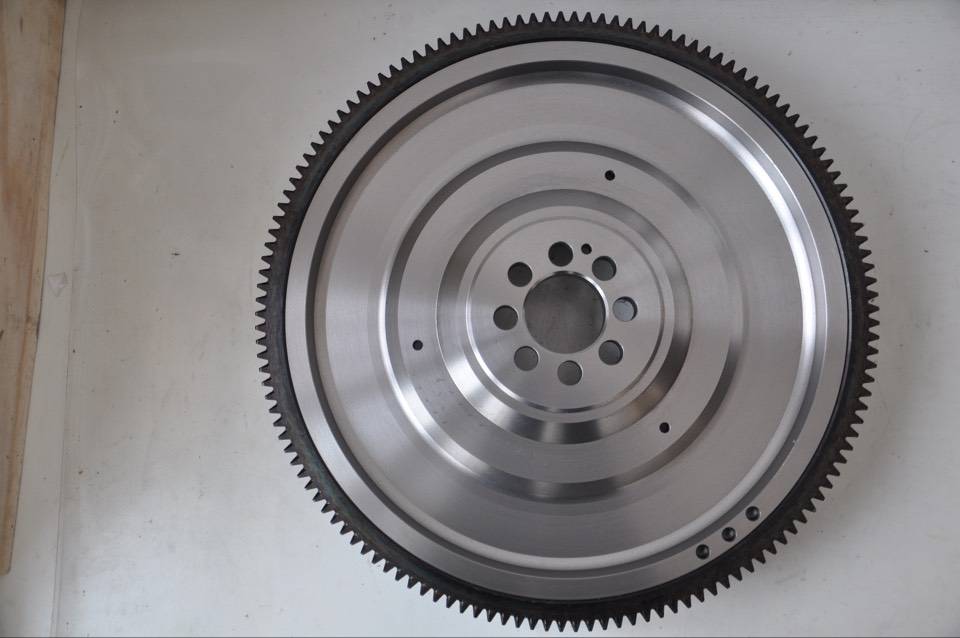
HINO Flywheel by Engine: J08C, J08E, E13C, K13C, EF750, P11C
HINO is one of the few diesel families where the same truck model year can carry flywheels from three different engine generations, all visually similar from two metres away. That is the whole problem with buying a HINO flywheel: the part looks right, it bolts up, and then the starter does not line up or the clutch does not sit flat.
This guide goes engine family by engine family. For each one, what the flywheel actually looks like, what changes between variants, and how to confirm you have the right one before it ships. All the photographs are our own parts.
Table of Contents
- Why HINO Flywheels Are Hard to Buy
- The HINO Engine Families That Use a Flywheel
- J08C: The 8.0 Litre Workhorse
- J08E: Two Flywheels Under One Engine Code
- P11C: The Counterweight Question
- E13C: The Heavy Haul Flagship
- EF750 and EP100: The Older Generation
- K13C: Heavy Duty, Different Flange
- What Changes Between HINO Flywheels
- How to Identify the Flywheel on Your Truck
- Clutch Size and Why It Drives the Flywheel Choice
- What to Send Us for a Quote
- FAQ
- Get a HINO Flywheel Quote
Why HINO Flywheels Are Hard to Buy
Four reasons, and they compound.
First, HINO reuses engine codes across generations and markets. J08E appears on trucks, buses and industrial applications with flywheels that are not interchangeable.
Second, HINO flywheels are commonly supplied and catalogued in two forms that sound identical: as a bare flywheel, and as a flywheel with the ring gear already fitted. Buyers order one and receive the other.
Third, the crank flange pattern is not unique per engine. An 8-bolt flange with one offset dowel hole appears across several HINO engines, so counting bolts does not identify the part.
Fourth, most listings give you the engine code and nothing else. Engine code plus “flywheel” is not a specification, because the same code can carry more than one flywheel.
The way out is to identify on the physical features that do change: friction face geometry, ring gear tooth pitch, hub height, and pressure plate bolt pattern.
The HINO Engine Families That Use a Flywheel
| Engine family | Configuration | Displacement | Typical application |
|---|---|---|---|
| J05C | 4-cylinder turbo | 4.0 L | Light trucks, city delivery |
| J08C | 6-cylinder turbo | 8.0 L | Medium trucks, 10-tonne class |
| J08E | 6-cylinder turbo intercooled | 7.684 L | Trucks, buses, intercity |
| P11C | 6-cylinder | 10.5–11.7 L | Heavy trucks, 49-tonne class |
| E13C | 6-cylinder in-line | 12.9 L | Flagship heavy haul, up to 60 tonnes |
| K13C | 6-cylinder | 12.9 L class | Heavy duty |
| EF750 | V8 | — | Older heavy trucks |
| EP100 | 6-cylinder | — | Older generation trucks |
The J-series covers light and medium duty. The P and E/K series cover heavy duty. The older EF750 and EP100 sit outside both and are still in service in Africa, the Middle East and Southeast Asia, which is exactly where our export customers are.
One number worth knowing up front: J08E runs a Ø430 mm clutch as the standard fitment, and that single figure already restricts which flywheel will work. We cover clutch sizing separately further down.
J08C: The 8.0 Litre Workhorse
J08C is a 6-cylinder turbo engine at 8.0 litres, found in medium trucks in the 10-tonne class. It is the engine most people mean when they say “HINO flywheel” in a generic way.
The J08C flywheel has a dished friction face with the ring gear seated on the outer diameter, an 8-bolt crank flange pattern with one smaller offset locating hole, and a separate ring of pressure plate bolt holes further out.
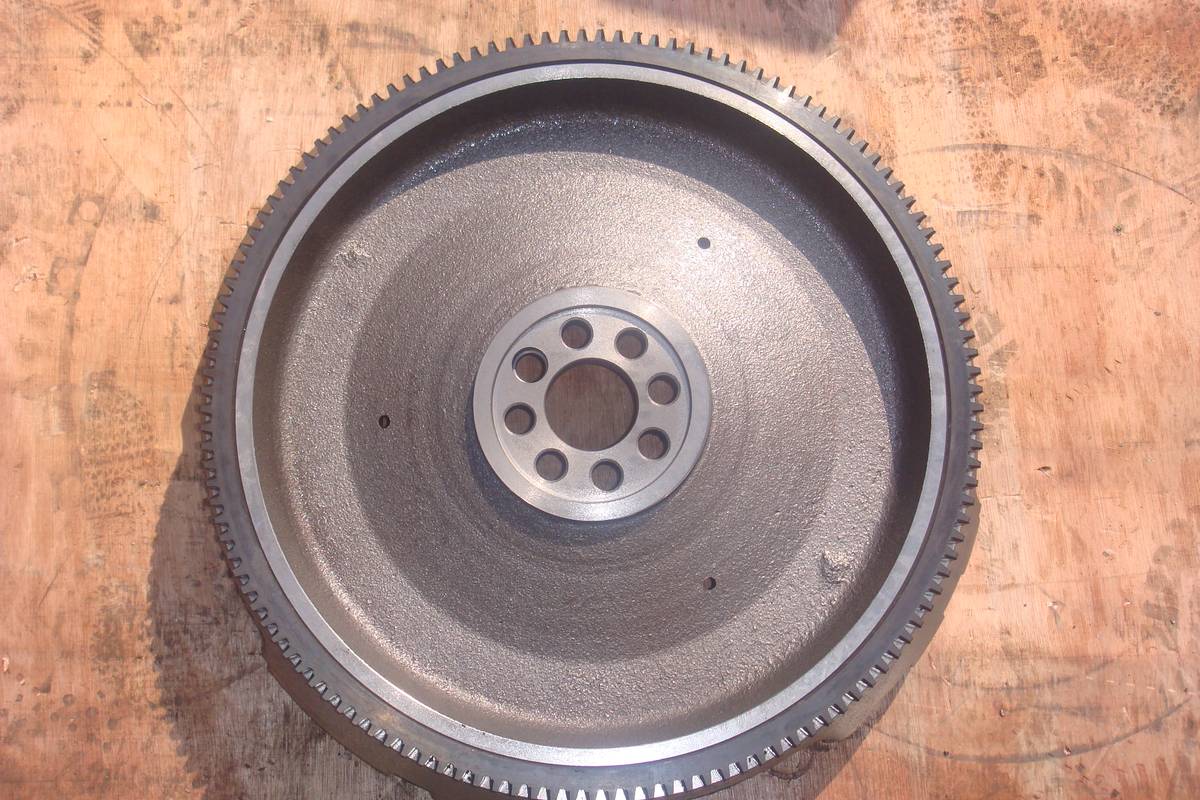
J08C flywheel, clutch side. Eight crank bolts plus one offset locating hole, ring gear seated on the outer diameter.
The rear face is where the identification usually happens, because that is where the crank flange registers and where you can see how the hub is machined.
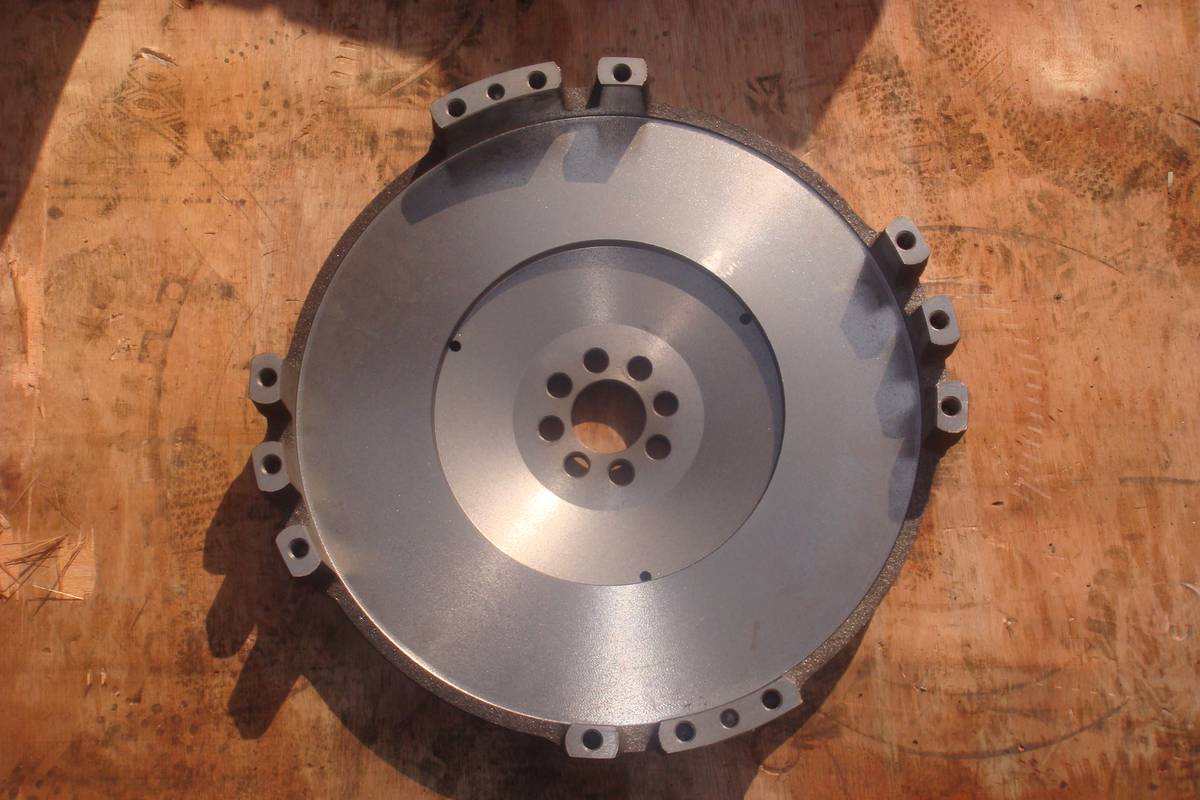
The same J08C flywheel from the crank side. The hub height here is the dimension that goes wrong when a substitute is fitted.
Two variants we hold and see regularly differ in a way that matters on assembly, both of which we label with the engine code and the distinguishing feature so the wrong one does not ship:
- The standard J08C flywheel
- A variant with one additional stepped hole in the face
That extra hole is not cosmetic. If your truck’s application uses it, a plain flywheel will fit but the mating component will not bolt up. If you are not sure, photograph the face and we will tell you which you have.
J08E: Two Flywheels Under One Engine Code
J08E is where buyers get caught most often, because the same engine code is associated with at least two clearly different flywheels. We hold both.
J08E, 17-inch form. A deeply dished friction face, with the dish noticeably deeper than the J08C and the ring gear tooth pitch finer.
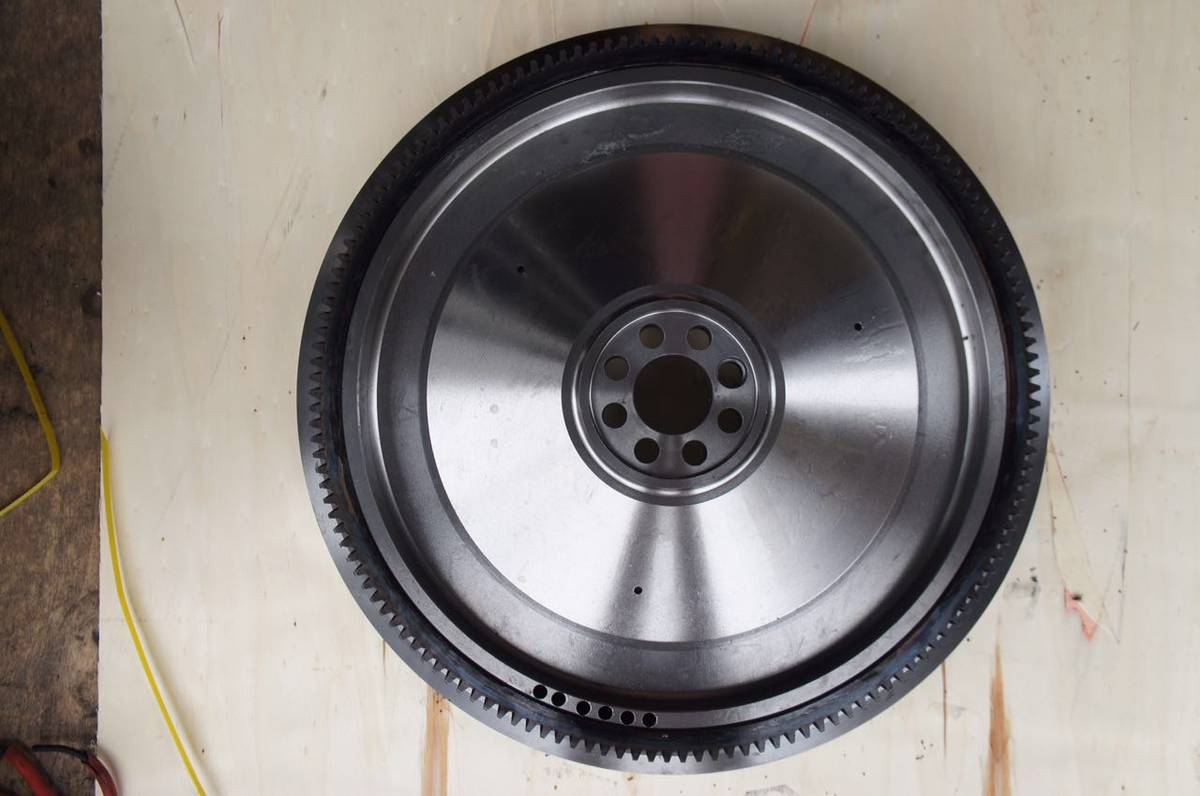
J08E, 17-inch form. Note how deep the friction face is dished compared with the J08C.
J08E, flat form. A wider, flatter friction band, with a visibly coarser ring gear tooth pitch.
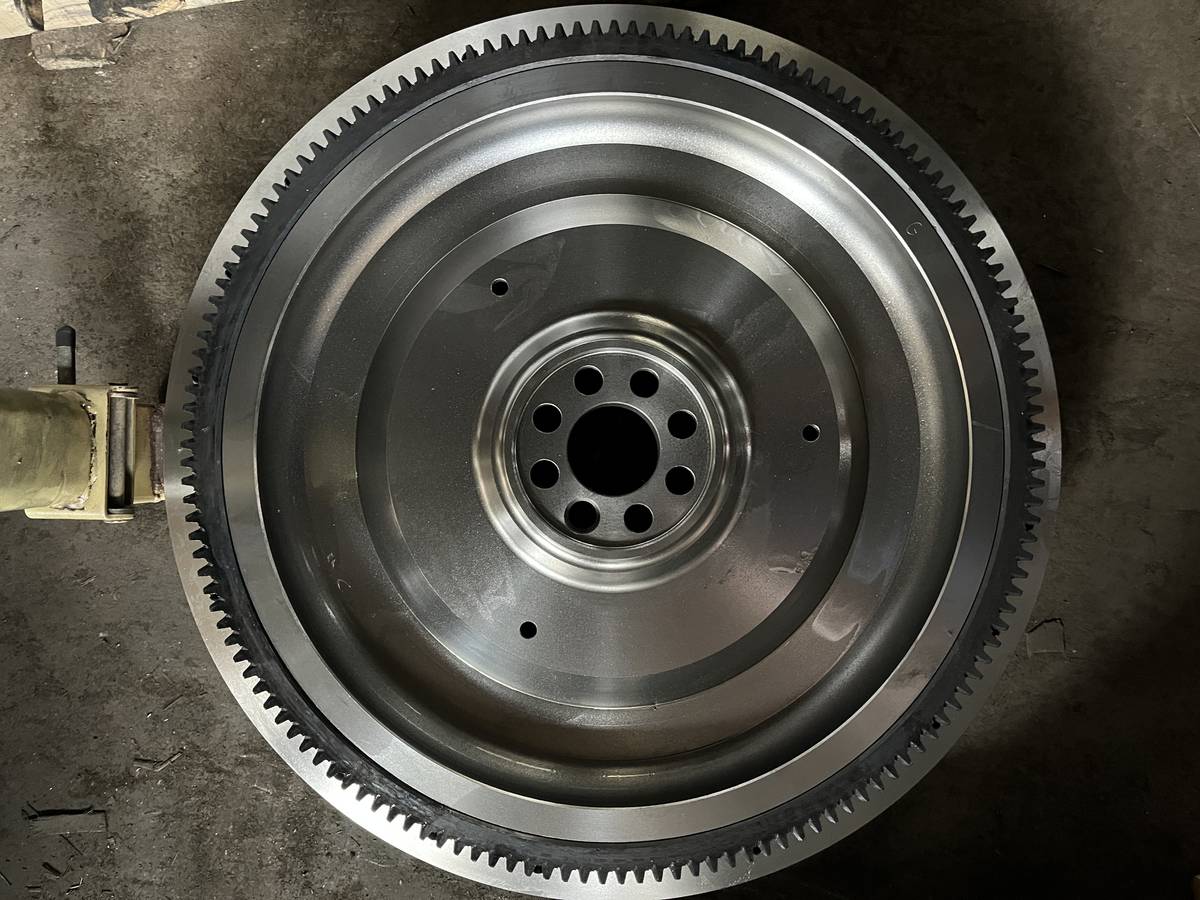
J08E, flat form. The ring gear tooth pitch is clearly coarser than the 17-inch version — the single easiest way to tell them apart in a photograph.
If you can only send one photograph, send a square-on shot with the ring gear teeth clearly visible. The tooth pitch difference between these two is obvious side by side and impossible to judge from a description.
J08E also gives us the clearest verified engine specification of the HINO range, which is useful when a customer is matching a flywheel to a repower:
| J08E parameter | Value |
|---|---|
| Configuration | 6-cylinder in-line, overhead camshaft |
| Bore × stroke | 112 × 130 mm |
| Displacement | 7.684 L |
| Aspiration | Turbocharged and intercooled |
| Fuel system | Electronically controlled common rail |
| Timing gear train | Rear mounted |
| Cylinder liner | Dry |
| Compression ratio | 17.0:1 |
| Net weight | 670 kg |
| First major overhaul | 800,000 km |
| Standard clutch | Ø430 mm |
Two of those rows matter to a flywheel buyer. Rear-mounted timing gear train means the gear train is at the back of the engine, which is relevant if you are also buying the flywheel housing or gear housing. And Ø430 mm clutch tells you the pressure plate bolt circle the flywheel has to carry.
P11C: The Counterweight Question
P11C is the heavy truck engine, 10.5 to 11.7 litres, 350 to 420 hp in the usual ratings, used in the 49-tonne class.
P11C flywheels come in two forms that are not interchangeable, and the difference is visible the moment you turn the part over.
The standard P11C flywheel has a flat-topped clutch face with a ring of pressure plate holes near the rim and a machined hub.
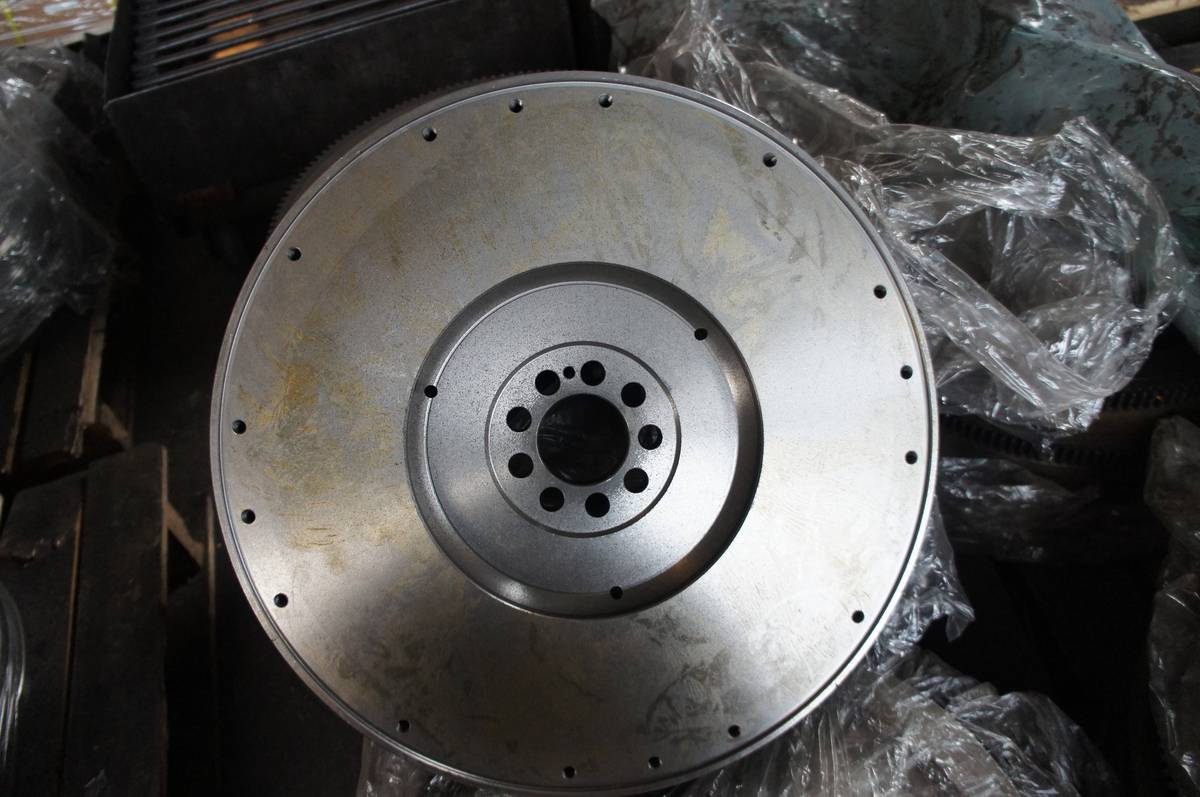
P11C, standard form. Flat-topped clutch face, no counterweight lobes. Compare the outline with the counterweight version below.
The P11C flywheel with counterweight lobes — what our workshop calls the “legs” version — carries cast counterweight lobes standing off the back of the flywheel. These are visible from the side and unmistakable.
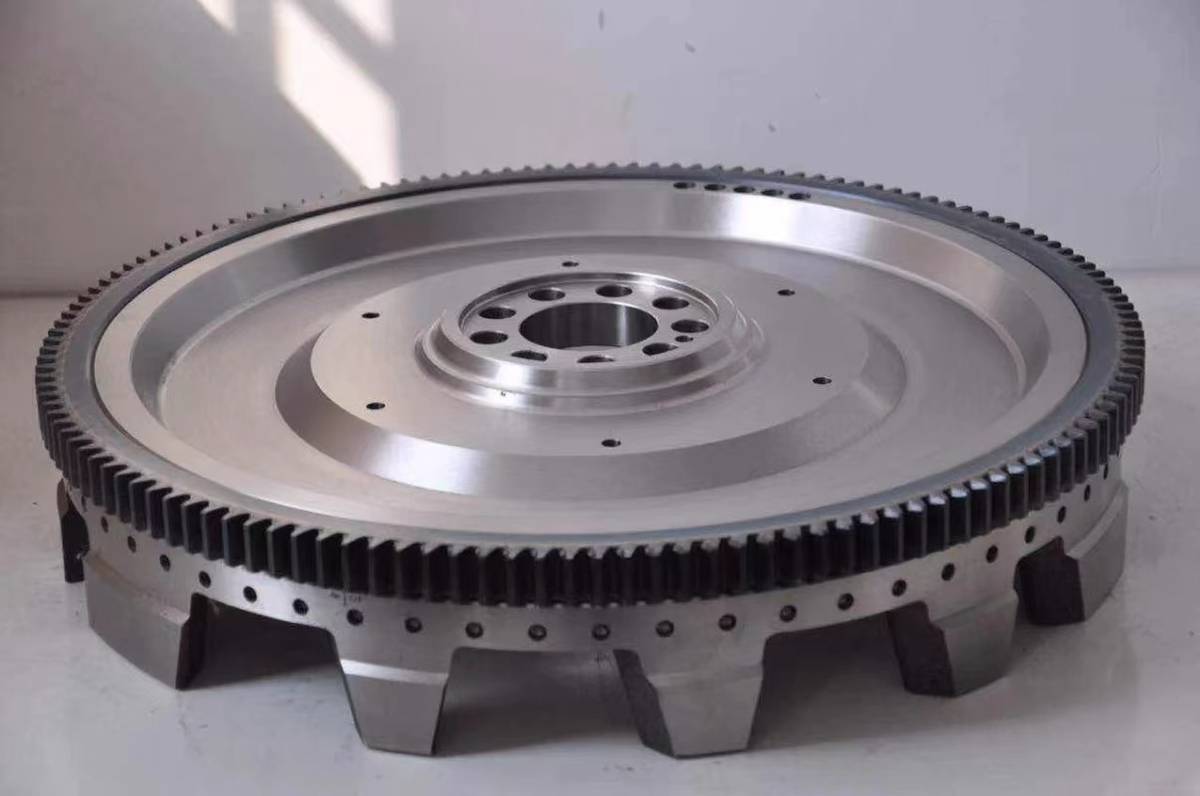
P11C with counterweight lobes. The lobes stand off the rear face and are visible the moment you look at the part from the side. This is not interchangeable with the flat version.
If you order a P11C flywheel from a listing that only says “P11C flywheel”, you have roughly a coin-flip chance of receiving the right one. Ask for a photograph of the rear face before you buy. That single request resolves it.
E13C: The Heavy Haul Flagship
E13C is the flagship, a 12.9 litre in-line six, rated around 443 hp, designed for long-haul work with an 800,000 km overhaul interval. The flywheel is correspondingly bigger and more heavily machined than the J-series parts.
E13C flywheel. The friction face is fully machined with a groove cut into it, and the ring gear tooth pitch is finer than the J08C.
What to look for on an E13C flywheel, and what separates it from a J-series part in a photo:
- A fully machined friction face rather than a partly as-cast surface
- A machined groove in the face, which is a distinctive feature of this flywheel
- A finer ring gear tooth pitch than the J08C
- A smaller relative hub diameter, because the friction face takes up more of the total area
E13C parts are also where weight matters most for freight. A flywheel for this class is a heavy item and the difference between packing it well and packing it badly is the difference between the part arriving flat and arriving bent. We crate these specifically.
EF750 and EP100: The Older Generation
EF750 and EP100 are older generation engines, and we still ship these flywheels steadily. The demand is almost entirely replacement rather than new build, because the trucks are long out of production but still working in export markets.
EF750 is a V8. Its flywheel has a correspondingly large ring gear with a noticeably coarser tooth pitch than the in-line six engines, and a deeply recessed hub with a raised boss around the crank bore.
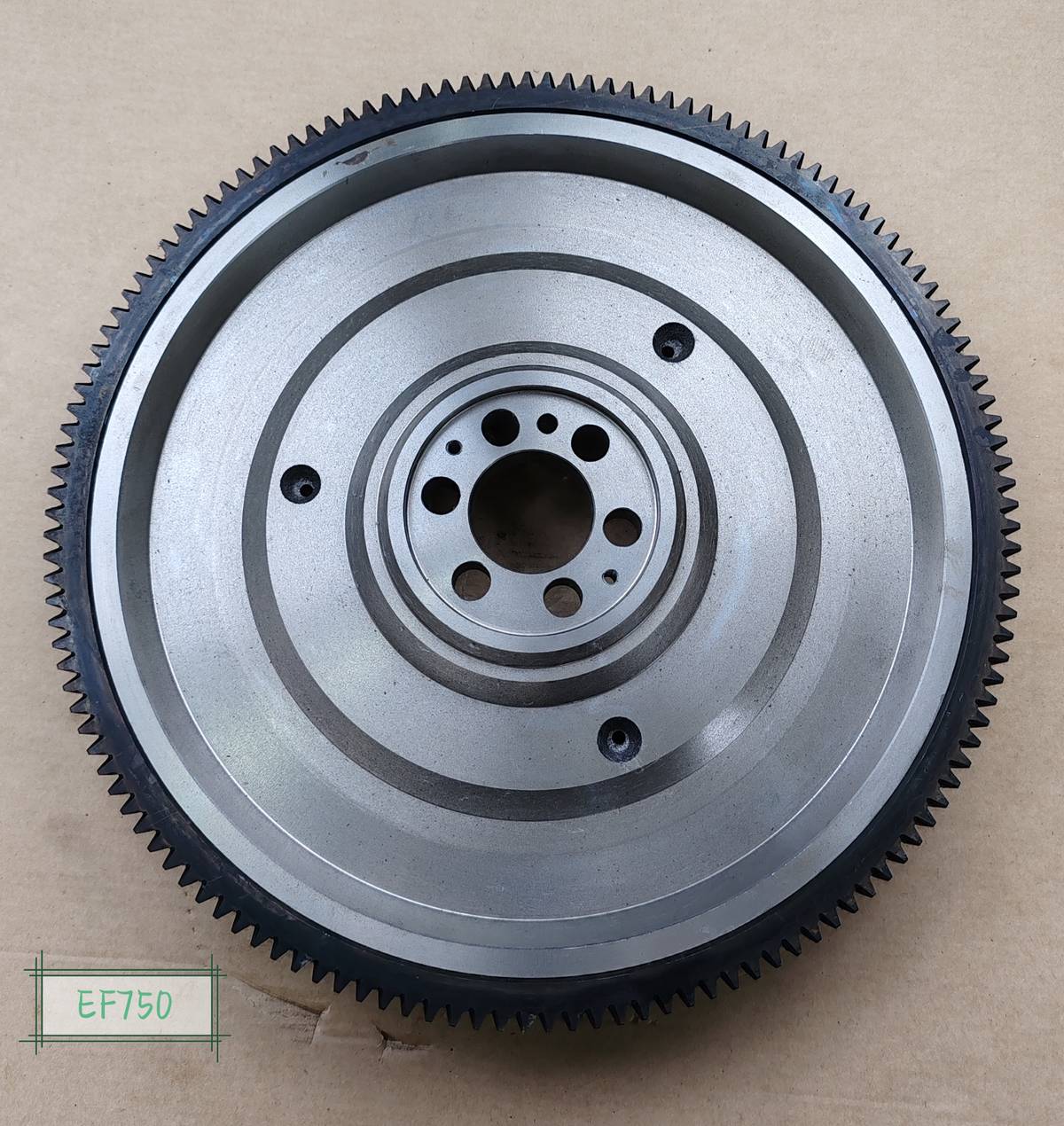
EF750 flywheel. Large diameter, coarse tooth pitch, deeply recessed hub with a raised boss around the crank bore.
EP100 flywheels come in mechanical and electronically injected versions, and these are not the same part. If your truck is a late EP100, make sure you identify which injection system it runs before ordering, because the flywheel differs.
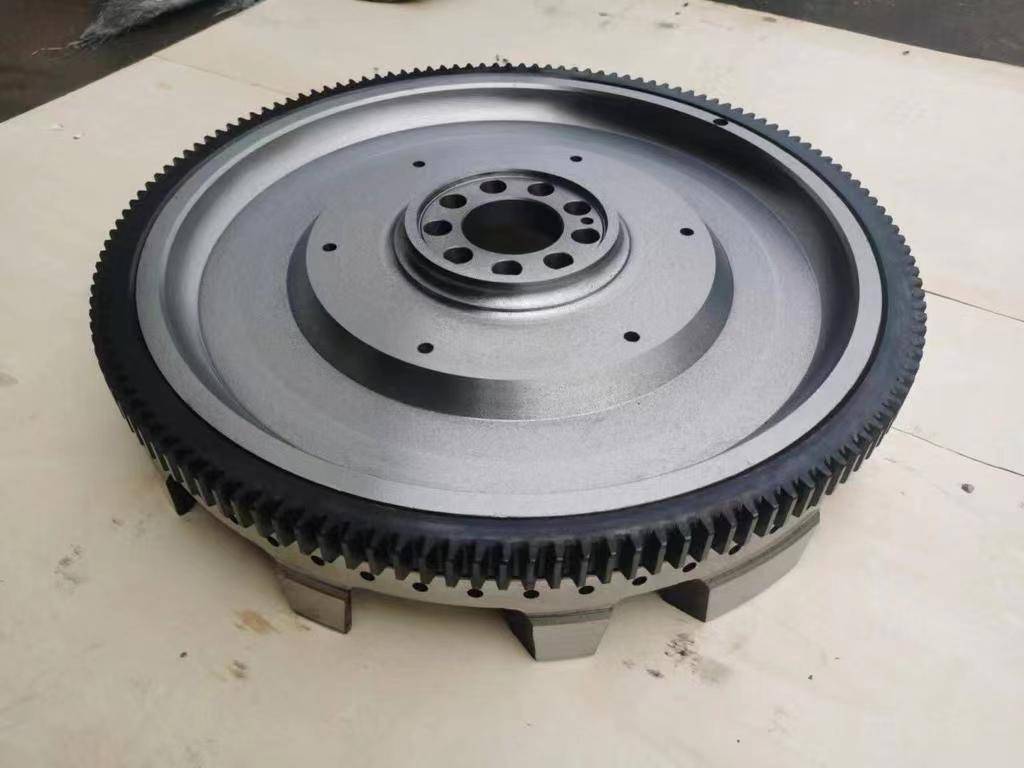
EP100 flywheel. Mechanical and electronically injected EP100 engines do not use the same flywheel.
For both of these older families, the engine plate on the truck is often the fastest way to identify the part, because aftermarket listings for EF750 and EP100 are less consistent than for the current engines.
K13C: Heavy Duty, Different Flange
K13C sits in the heavy duty class alongside E13C and uses a larger flywheel again. The friction face is fully machined and the part is noticeably heavier.
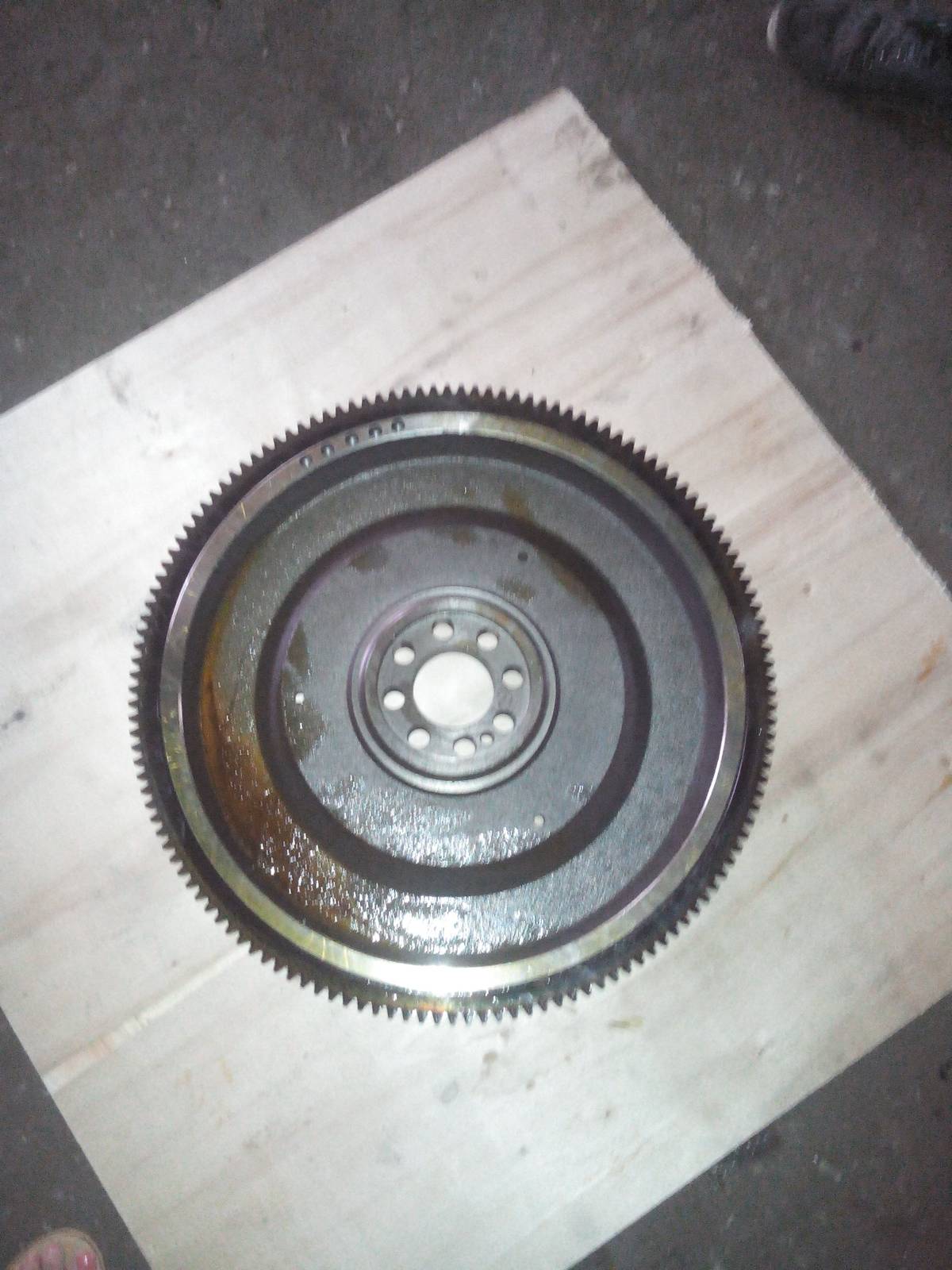
K13C flywheel, heavy duty. Larger and heavier than the J-series parts, with a fully machined face.
Do not assume K13C and E13C flywheels interchange because they are both heavy duty 13-litre class engines. They do not. Confirm on the crank flange pattern and the pressure plate bolt circle.
What Changes Between HINO Flywheels
Strip away the engine codes and there are five things that actually change. Check these five and you can identify almost any HINO flywheel.
| Feature | Why it changes | How to check |
|---|---|---|
| Friction face geometry | Clutch diameter and dish depth differ by engine | Look at how deeply dished the face is and how wide the friction band is |
| Ring gear tooth pitch | Tooth count and module differ by engine size and starter | Photograph the teeth square-on and compare |
| Ring gear fitted or loose | Some part numbers supply the flywheel only | Check whether the ring gear is present and whether it is shrink-fitted or bolted |
| Hub height and bore | Crank flange offset differs | Measure the hub and photograph the crank side |
| Pressure plate bolt pattern | Clutch size differs, e.g. Ø430 mm on J08E | Count the holes and measure the bolt circle |
Counterweight lobes are a sixth, on the P11C specifically.
How to Identify the Flywheel on Your Truck
Step 1 — Photograph the clutch side square-on. Ring gear teeth visible around the edge. This one photo answers tooth pitch and friction face shape.
Step 2 — Photograph the crank side square-on. This shows hub height, the crank flange pattern and whether counterweight lobes are present.
Step 3 — Count the crank bolts and note the offset hole. Most HINO engines use 8 bolts plus one smaller offset locating hole. Confirm your count rather than assuming.
Step 4 — Count and measure the pressure plate bolt holes. Measure the bolt circle diameter. This is what ties the flywheel to the clutch.
Step 5 — Measure the outside diameter of the flywheel and of the ring gear. Two different numbers, and both matter.
Step 6 — Measure the thickness through the friction face. Compare with the drum you are replacing.
Step 7 — Note the engine code and read the plate on the engine. Photograph the engine plate too, even if it is dirty. It resolves ambiguities that nothing else will.
If you get through steps 1, 2 and 7, we can usually identify the flywheel without further questions.
Clutch Size and Why It Drives the Flywheel Choice
The flywheel and the clutch are a matched pair, and the constraint runs from the clutch to the flywheel, not the other way round. The pressure plate bolt circle and the friction face diameter on the flywheel have to match the clutch you are using.
J08E is the cleanest example: it runs a Ø430 mm clutch, and that figure immediately narrows which J08E flywheel will work and rules out several that physically bolt up but will not carry the right pressure plate.
We have written about HINO and ISUZU clutch and flywheel pairing separately. The rule that matters here is simple: decide the clutch first, then confirm the flywheel’s pressure plate bolt circle matches.
What to Send Us for a Quote
- Engine code, and a photograph of the engine plate if possible
- Truck or bus model and year
- Photograph of the flywheel clutch side, square-on, ring gear teeth visible
- Photograph of the flywheel crank side, square-on
- Crank bolt count and whether there is an offset locating hole
- Pressure plate bolt hole count and bolt circle diameter
- Flywheel outside diameter and ring gear outside diameter
- Whether you need the flywheel alone, or with the ring gear fitted
- Whether counterweight lobes are present, for P11C
- Clutch diameter if you are replacing the clutch at the same time
Send the two photographs first. In most cases we can tell you which flywheel you need from those alone, before you take a single measurement.
FAQ
Are all HINO flywheels interchangeable?
No. Flywheels differ between J08C, J08E, P11C, E13C, K13C, EF750 and EP100, and in some cases within a single engine code. J08E and P11C each have at least two forms that are not interchangeable.
What is the difference between the two J08E flywheels?
One is the 17-inch form with a deeply dished friction face and a fine ring gear tooth pitch. The other is the flat form with a wider, flatter friction band and a coarser tooth pitch. The tooth pitch is the fastest way to tell them apart in a photograph.
Does P11C always have a counterweight flywheel?
No. There is a standard flat-bodied P11C flywheel and a version with cast counterweight lobes on the rear face. They are not interchangeable, and the lobes are visible from the side.
What clutch size does a HINO J08E use?
Ø430 mm is the standard fitment for J08E. Confirm against your specific application, because the flywheel pressure plate bolt circle has to match.
How many bolts hold a HINO flywheel to the crank?
Most HINO engines use 8 crank bolts plus one smaller offset locating hole. Verify on your own engine rather than assuming, since the pattern is shared across several engines and therefore does not identify the part on its own.
Can I fit a ring gear to a flywheel that came without one?
Sometimes, but it depends on the part. Some HINO flywheels are supplied with the ring gear shrink-fitted and cannot practically be separated without damaging it; others are supplied loose. Tell us which you need and we will confirm which applies to your number.
Do you supply EF750 and EP100 flywheels?
Yes. These older engines still have significant replacement demand in export markets, and we keep both. Note that EP100 mechanical and electronically injected versions do not share a flywheel.
How do I know if my HINO is mechanical or electronic injection?
The engine plate and the fuel system on the engine will tell you. For EP100 in particular this determines which flywheel you need, so send us a photograph of the engine plate if you are unsure.
What is MOQ and lead time?
It depends whether the part is a current production size or a special. Send the engine code and photographs and we will confirm both with the price.
Get a HINO Flywheel Quote
Send the engine code and two photographs, clutch side and crank side, square-on with the ring gear teeth visible. We will come back with the part identification, price and lead time.
Irene
changweiintl.com
[email protected]
+86 19953662121 (phone, WeChat, WhatsApp)
Factory: Wangke Industrial Zone, Changyi, Weifang, Shandong, China
IATF 16949 certified foundry. FOB Qingdao.
Related reading:
– HINO engine flywheel and ring gear products
– ISUZU 4HF1 flywheel, 138 teeth, 325 mm
– Flywheel ring gear identification guide
– All flywheel and ring gear products
– Request a quote