Cummins Generator Flywheel Selection: Built-In vs Separate Ring
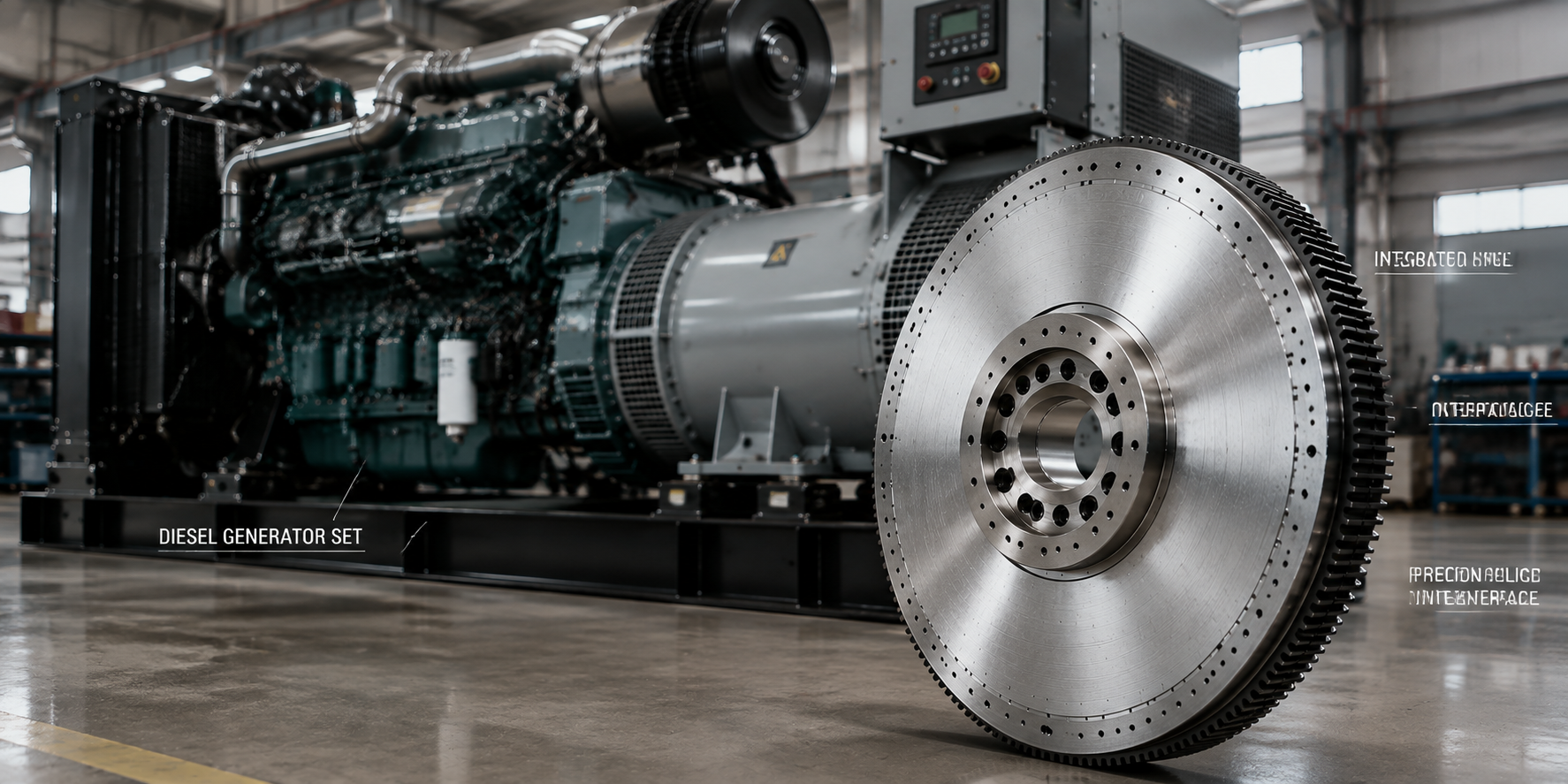
Cummins engines are among the most widely specified platforms for generator sets worldwide. From the compact 15N (13×12) and RSG series serving mid-range applications, to the high-output KTA and QSK series powering large industrial installations, Cummins covers the full spectrum of stationary power generation.
When you specify a generator set on any Cummins platform, flywheel selection is a critical engineering decision. The flywheel must mount correctly on the engine crankshaft and interface precisely with the generator coupling that drives the alternator. For Cummins generator work, that decision comes down to one question: do you use a separate flywheel plus connection ring, or a flywheel with a built-in (integrated) connection ring?
This guide provides a flywheel selection reference for Cummins generator set applications across the 15N, QSM, KTA, and QSK families — why the built-in connection ring matters, what problems it solves, and how to specify the correct flywheel for your engine and coupling combination.
The Flywheel Selection Challenge in Cummins Generator Sets
Vehicle Flywheels vs Generator Flywheels
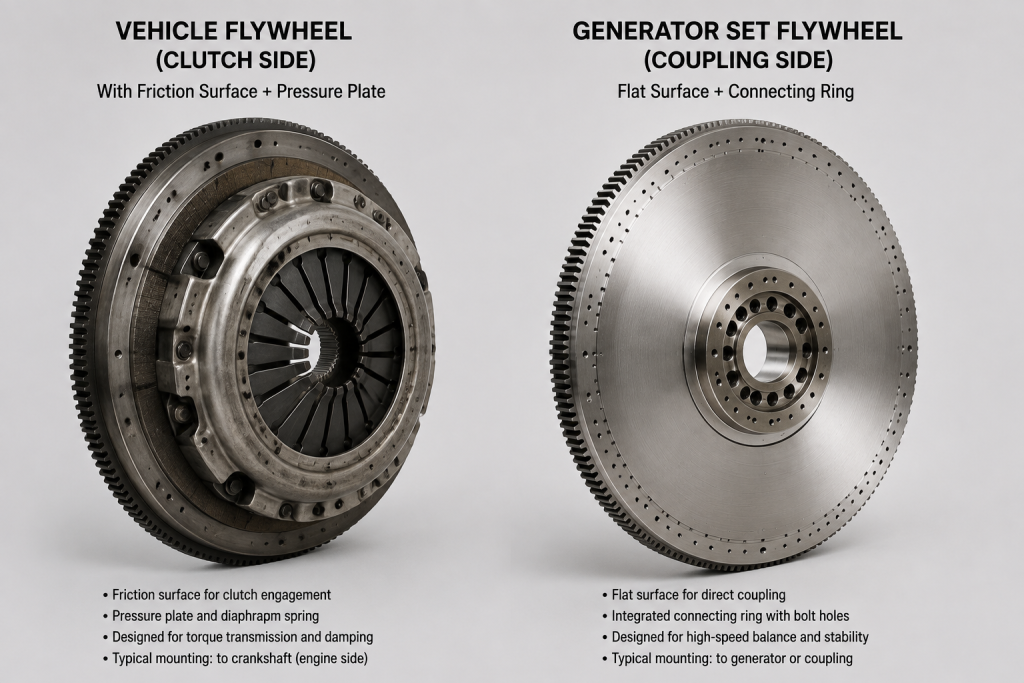
Cummins builds the same basic engine architecture — crankshaft, cylinder block, valvetrain, fuel system — for both vehicle and generator set markets. But the flywheel requirements differ significantly between the two applications.
A Cummins vehicle flywheel is designed to:
- Mount on the engine crankshaft with a specific bolt pattern and pilot bore
- Provide a clutch friction surface for engagement with the transmission
- Include a starter ring gear for engine cranking
- Operate across a variable RPM range with intermittent clutch engagement
A Cummins generator flywheel must:
- Mount on the same engine crankshaft (same bolt pattern and pilot bore)
- Provide a coupling interface for continuous connection to the generator alternator — no clutch
- Include a starter ring gear for engine cranking (same as the vehicle application)
- Operate at constant speed (typically 1500 or 1800 RPM) with continuous torque transfer
The critical difference is the outer interface: clutch friction surface versus generator coupling connection. This is where the flywheel connection ring — whether separate or built-in — becomes the defining design feature.
The Connection Ring Function
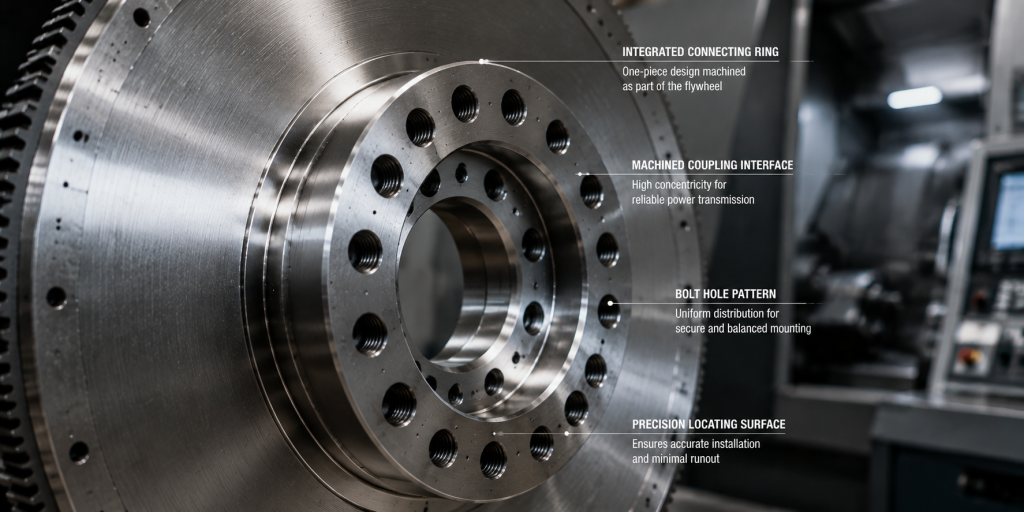
The connection ring (adapter ring) bridges the dimensional and bolt-pattern differences between the Cummins engine flywheel and the generator coupling. It provides:
- A pilot diameter that aligns the generator coupling on the flywheel centerline
- A bolt pattern matching the generator coupling specification
- A flat, machined mating surface for the coupling connection plate
- Correct depth/step dimensions to position the coupling at the proper engagement distance from the flywheel face
Without this connection function — whether provided by a separate ring or built into the flywheel — the Cummins engine cannot interface with the generator coupling. This makes the connection ring the most important distinguishing feature between a Cummins vehicle flywheel and a Cummins generator flywheel.
The Four Problems That Built-In Connection Rings Solve
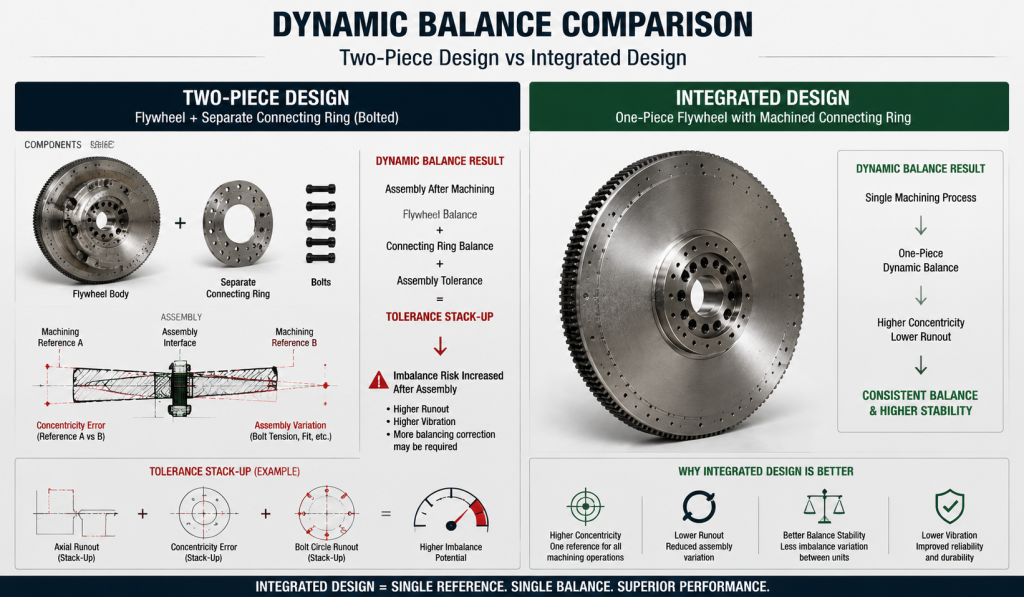
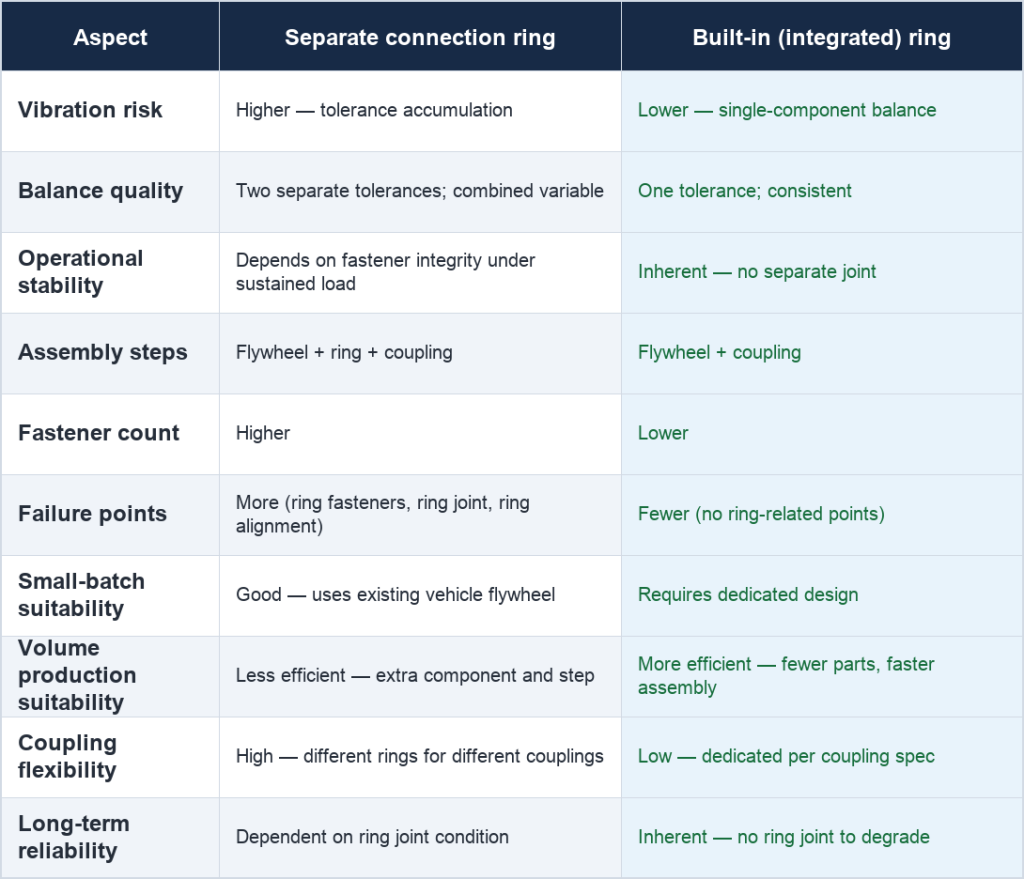
Using a separate connection ring bolted to the vehicle flywheel is a workable approach — the Cummins 15N (13×12) RSG engine has been validated running stably in this configuration. However, this two-piece approach introduces four problems that become significant in production environments and sustained generator set operation:
1. Vibration During Operation. When a separate flywheel and connection ring are bolted together, the two components each carry their own balance tolerance. The combined tolerance can produce imbalance that causes vibration under the constant-speed operation typical of generator sets. A generator set running at 1500 or 1800 RPM produces sustained vibration at a constant frequency — more damaging than the intermittent vibration of a vehicle. A built-in connection ring eliminates this problem because the entire flywheel is balanced as one component.
2. Dynamic Balance Tolerance Accumulation. Each component in a two-piece system is manufactured within its own dimensional and balance tolerance range. When bolted together, these tolerances combine. In the worst case, the combined imbalance exceeds the specification that either component alone would meet. A built-in connection ring flywheel is balanced in a single operation on the complete component — no random combination of separate tolerance vectors.
3. Operational Instability. The bolted joint between a flywheel and a separate connection ring relies on fasteners to maintain structural integrity and alignment under sustained load. Over extended service, this loading can contribute to fastener loosening, fretting at the mating surface, and misalignment. A built-in connection ring has no such joint — the coupling interface is an integral part of the flywheel itself.
4. Installation Complexity. A two-piece flywheel system requires five steps: mount the flywheel, align the connection ring, bolt it with specified fasteners and torque, verify alignment, then attach the coupling. A built-in connection ring flywheel requires only two: mount the flywheel, then attach the coupling directly. This reduces assembly time and error probability on the production line.
Separate vs Built-In Connection Ring: Comparison
Cummins Engine Series: Flywheel Selection Guide
Cummins 15N (13×12) and RSG Series
The 15N (13×12) engine and RSG series serve mid-range generator set applications. For small-batch installations, the vehicle flywheel with a separate connection ring works. For batch or volume production, specify a flywheel with built-in connection ring and verify the generator coupling specification and engine-side interface for your specific alternator model.
Cummins QSM Series
The QSM series covers mid-to-high range generator set applications, commonly running in continuous-duty configurations. The built-in connection ring approach is recommended — eliminating tolerance accumulation and vibration is important for QSM generator sets that run extended hours.
Cummins Z13 / Z14 Series
The Z13/Z14 series appears in specific generator set configurations. The built-in connection ring approach eliminates vibration, tolerance accumulation, and installation complexity. Verify the specific engine model’s crankshaft interface requirements.
Cummins KTA Series
The KTA series provides high-output power for large generator set applications — industrial facilities, data centers, hospitals. The built-in connection ring approach is strongly recommended. At these power levels, any flywheel imbalance produces significant vibration forces; eliminating tolerance accumulation through integrated design is a reliability imperative.
Cummins QSK Series
The QSK series represents Cummins’ highest-output generator set engines. The built-in connection ring approach is essential — at these power levels and operating profiles, flywheel balance and structural integrity are critical. The integrated design eliminates the weakest link: the bolted joint between flywheel and separate connection ring.
For all of these platforms, part-number discipline matters as much as the ring design. Two Cummins flywheels can look identical and even share a part-number suffix, yet carry different full part numbers for different engine platforms and coupling specs. We covered that trap in detail in our guide on why the same flywheel part number suffix can hide a different part — always read the full number, not just the last digits, before you specify.
How to Specify a Cummins Generator Flywheel
- Engine model: Confirm the exact Cummins engine model and its crankshaft interface specifications (bolt pattern, pilot bore, model-specific features).
- Coupling specification: Confirm the generator coupling type, pilot diameter, bolt pattern, and depth dimensions.
- Ring gear: Confirm the starter motor specification — tooth count, gear pitch, and pressure angle.
- Balance grade: Higher-output engines and continuous-duty applications require tighter balance specifications.
- Quality requirements: Specify material grade, surface treatments, and inspection criteria.
Quality Assurance and Manufacturing
When sourcing Cummins generator flywheels, require IATF 16949 / ISO 9001 certification, CMM inspection of both interfaces, dynamic balance verification, material certification, and first-article inspection on new designs. Producing both the engine-side and generator-side interfaces on one workpiece is what makes the integrated design work — vertical CNC lathes machine the rotational surfaces, machining centers cut the bolt patterns, and gear hobbing machines cut the ring gear, all in coordinated setups that hold positional accuracy a two-piece assembly cannot.
As an IATF 16949 certified manufacturer with CMM inspection equipment, vertical CNC lathes, machining centers, and gear hobbing machines, Changwei meets these requirements for Cummins generator flywheel production. Changwei’s flywheel line covers Cummins engine designs for both vehicle and generator set applications, including 15N/RSG, QSM, Z13/Z14, KTA, and QSK series — each matched to the specific engine model’s crankshaft interface while providing correct generator coupling connection specifications.
Conclusion
For Cummins 15N, QSM, KTA, and QSK generator set applications, flywheel selection is not merely a matter of finding a component that fits on the crankshaft. The connection interface — how the flywheel couples to the generator alternator — is equally important, and the choice between a separate connection ring and a built-in connection ring has direct implications for vibration, balance quality, operational stability, and assembly efficiency.
The built-in connection ring design is the professional specification for Cummins generator flywheels. It eliminates tolerance accumulation and vibration, removes a potential failure point (the bolted ring joint), and simplifies production assembly. For generator set manufacturers producing Cummins-powered units in volume, the integrated flywheel approach provides both engineering and production advantages.
To specify the correct Cummins generator flywheel with built-in connection ring for your application, contact Changwei with your engine model and generator coupling specifications.
About Changwei: Weifang Changwei Intelligent Equipment Co., Ltd. is an IATF 16949 certified engine flywheel manufacturer based in Weifang, China. With a 40,000 sqm production facility and 20+ years of engineering expertise, Changwei supplies flywheels, gear rings, and housing parts to customers in 20+ countries. Contact us for OEM/ODM flywheel solutions.