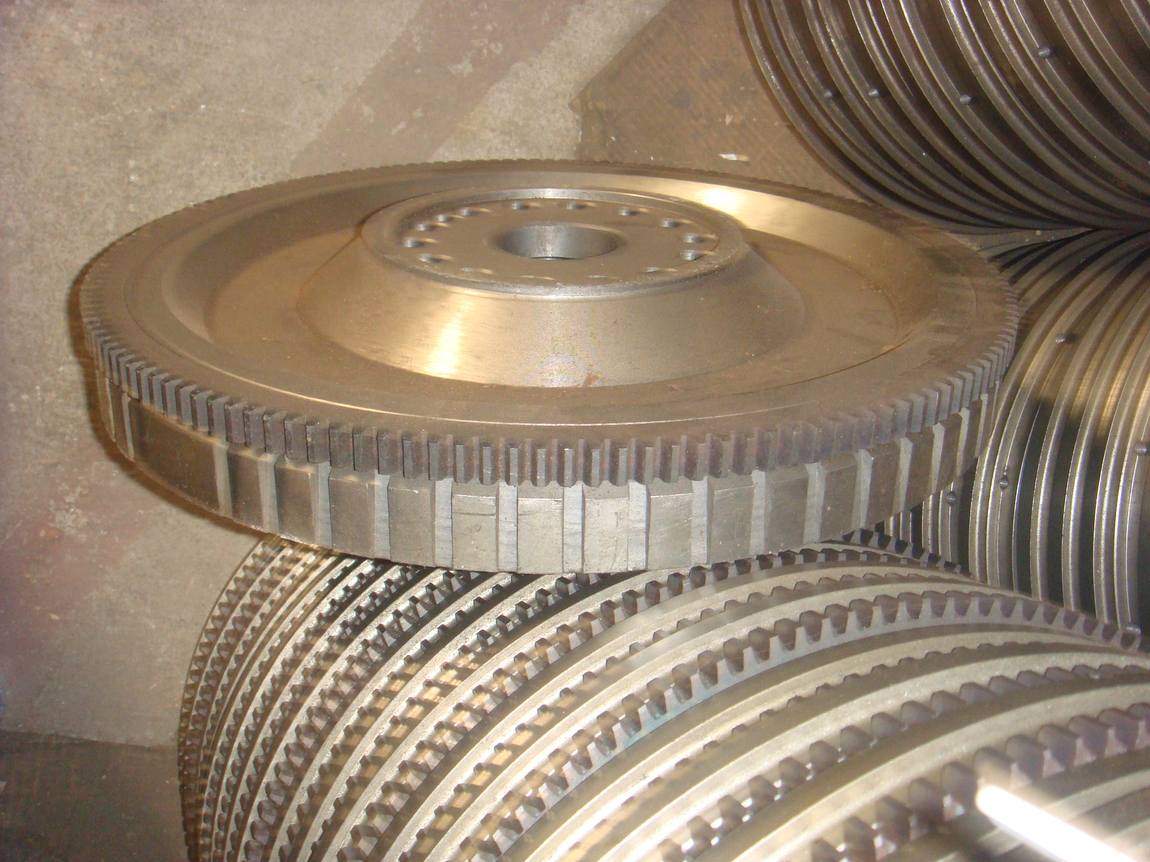
Volvo Truck Flywheel Part Numbers: 153 or 156 Teeth
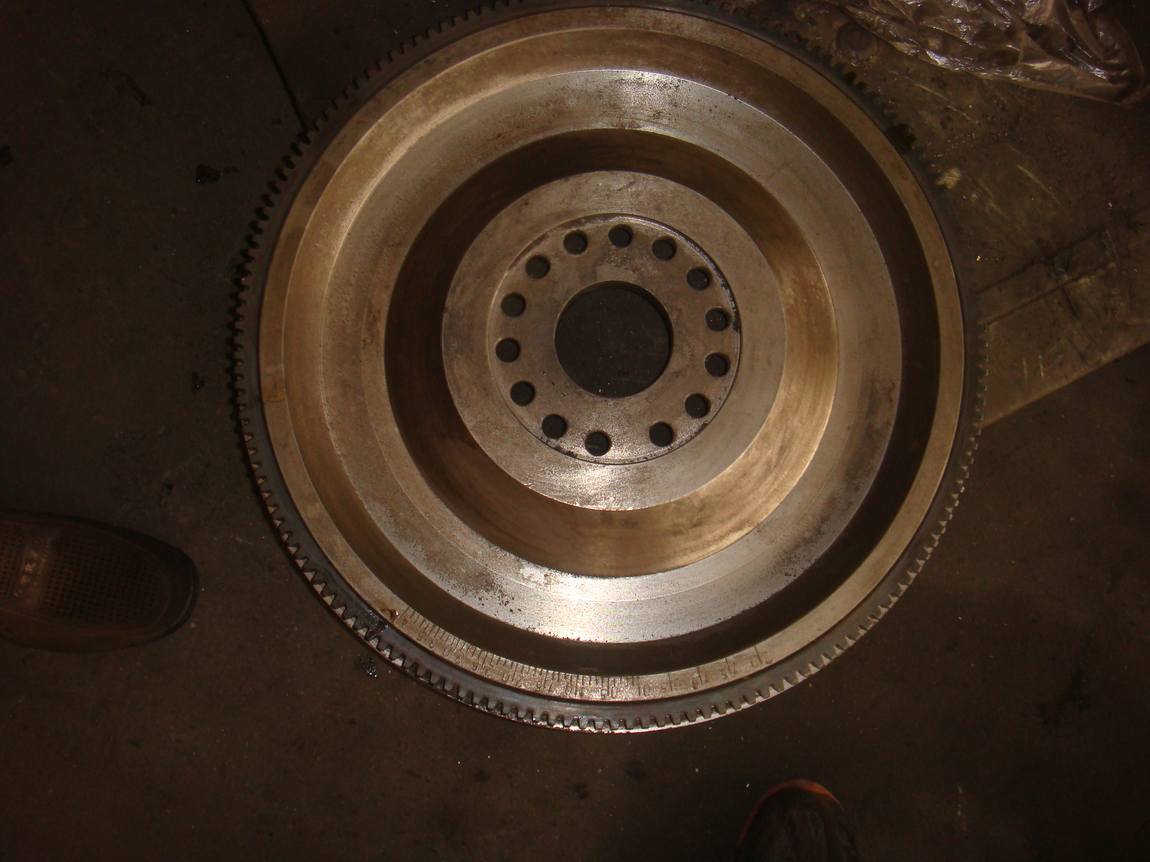
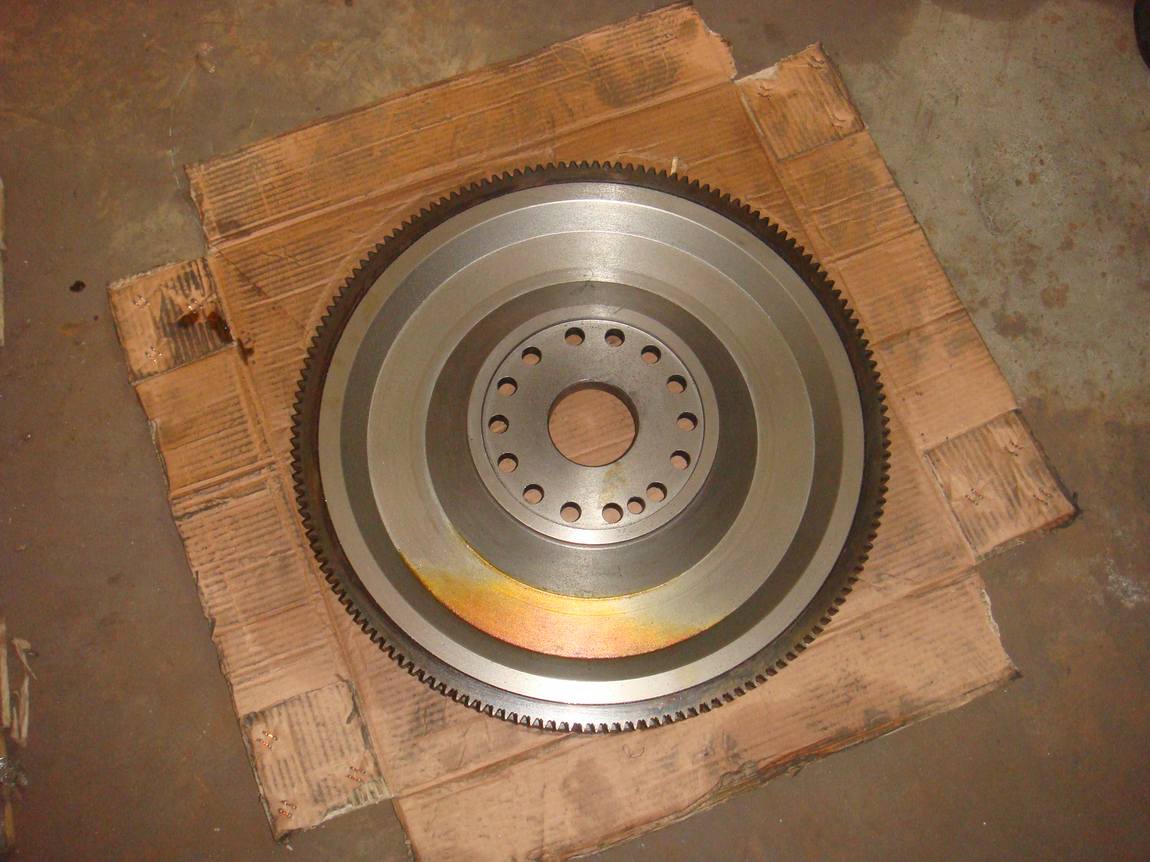
Three flywheels sit on one rack in our shop. All three are close to 430 mm across. All three carry a full ring of starter teeth. Two of them are separated by a single digit in the part number, and by six holes in the hub.
That last detail is where most Volvo flywheel orders go wrong. The trade has a habit of saying that Volvo flywheels run 153 teeth, as if the brand used one ring for everything. The catalogues do not agree with that habit, and neither do the parts on our rack.
This article puts three Volvo numbers side by side. It uses published catalogue dimensions for the figures, and our own photographs for the shapes. Where the catalogues clash, both figures are printed and neither is chosen.
Table of Contents
- Three Flywheels On One Rack
- Two Tooth Counts Not One
- The Three Numbers Side by Side
- Fourteen Holes Against Ten
- One Casting Seven Numbers
- The EDC Notch Count
- Why 430 Is Not The Outside Diameter
- What Our Photographs Show
- What A Photo Cannot Prove
- How to Order Without Guessing
- Questions Buyers Ask
- Sources and Evidence Level
- Send The Hub Photo
Three Flywheels On One Rack
A flywheel is a cast iron disc with a hardened ring of teeth pressed or shrunk onto its rim. Every part in this article answers that description. From two metres away, they are the same object.
The differences sit in three places. The bore that centres the part on the crankshaft. The circle of bolt holes around that bore. The number of teeth on the ring.
Each of those three can fail on its own. A wrong bore will not go on at all. A wrong bolt circle will go on with the wrong bolts, or not at all. A wrong tooth count will bolt up perfectly, start badly, and chew the ring within a season.
Two Tooth Counts Not One
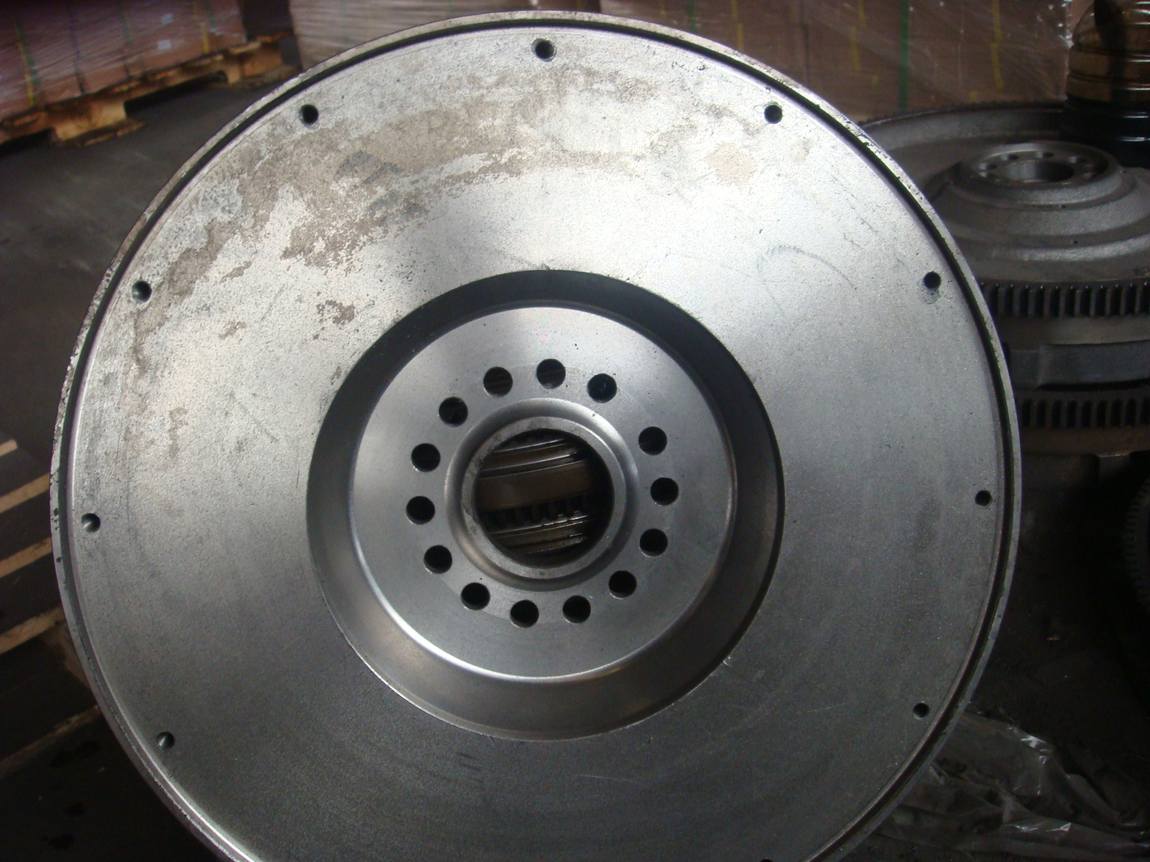
The common shorthand is that Volvo heavy truck flywheels carry 153 teeth. That is true for 8170798. It is not true for the rest of the family we handle.
Two numbers on our rack, 478931 and 479192, are listed at 156 teeth by four and two independent catalogue brands respectively. Both are 430 mm parts. Both have the same 72 mm hub bore and the same 130 mm hub bolt circle. Both weigh a little over 40 kg.
So the tooth count alone will not sort a Volvo flywheel. It splits the family into two groups, and inside the larger group there is a second, quieter split.
The Three Numbers Side by Side
The table below uses published catalogue figures. The last column names the catalogue articles, so any line can be checked against its source.
| Number | Teeth | Nominal diameter | Hub bore | Hub bolt circle | Hub bores | Clutch cover circle | Weight in catalogues | Catalogue source |
|---|---|---|---|---|---|---|---|---|
| 8170798 | 153 | 430 mm | 72 mm | 153 mm | 14 | 450 mm | 39.5 to 46.6 kg | febi 45336, PETERS ENNEPETAL 140.003-00A, DT 2.10366, SAMPA 033.197 |
| 478931 | 156 | 430 mm | 72 mm | 130 mm | 14 | 450 mm | 39.2 to 42.2 kg | febi 180274, AUGER 58441, BF 20090412201, DT 2.10362 |
| 479192 | 156 | 430 mm | 72 mm | 130 mm | 10 | not listed | 40.4 to 42.5 kg | AUGER 58443, DT 2.10360 |
Two things stand out in that table before any photo is involved.
The first is the hub bolt circle. 8170798 sits on 153 mm. The other two sit on 130 mm. A flywheel drilled for one will not sit flat on the other, and no adapter plate changes that.
The second is the hub bore count. 478931 and 479192 share a diameter, a tooth count, a bore, a bolt circle and roughly a weight. They differ in how many holes are drilled through that circle.
Fourteen Holes Against Ten
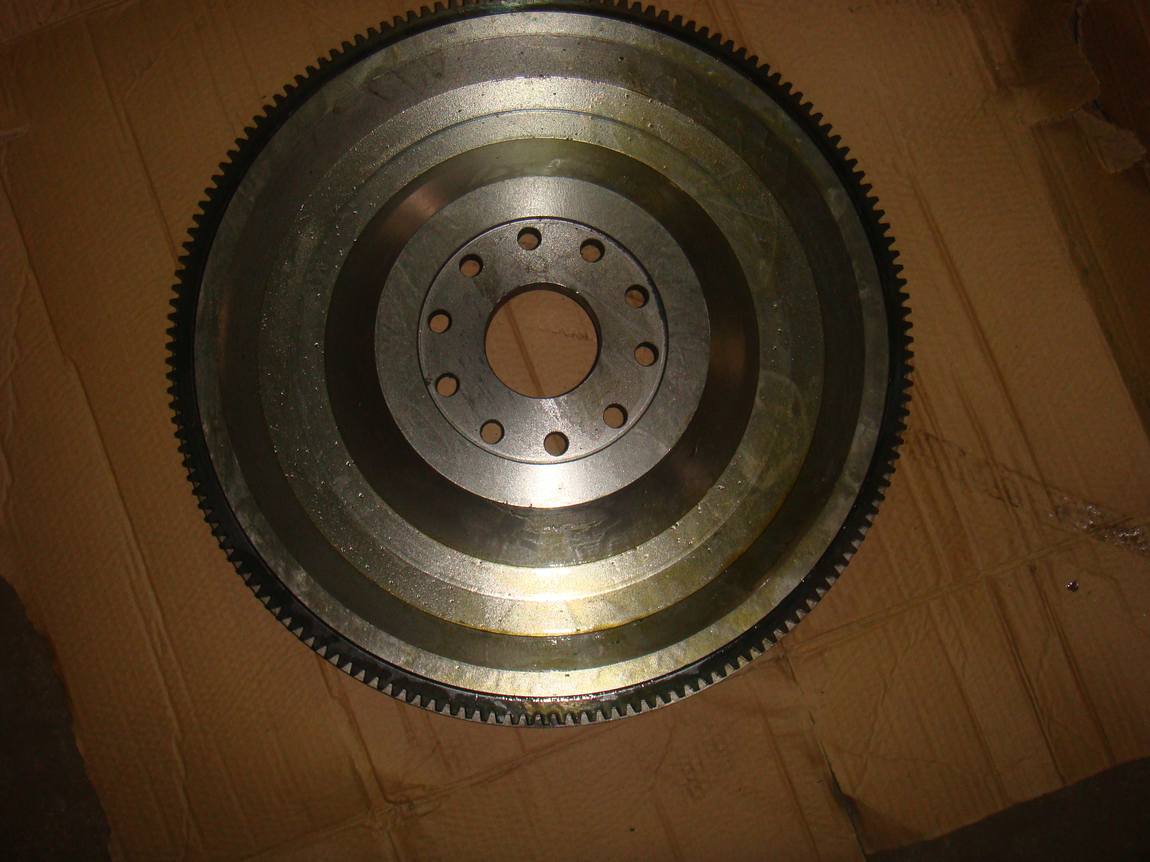
Two numbers that differ by one digit, and by the drilling in the hub. That is the whole difference a buyer can act on.
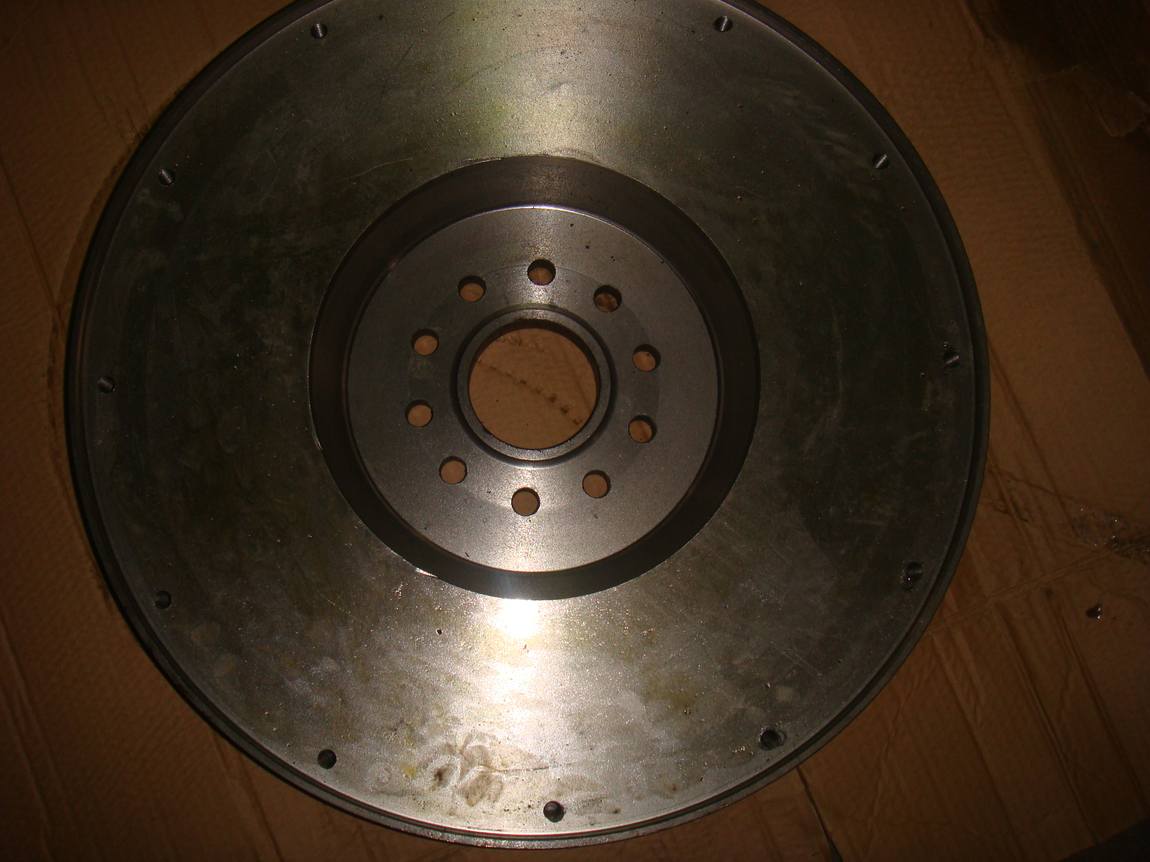
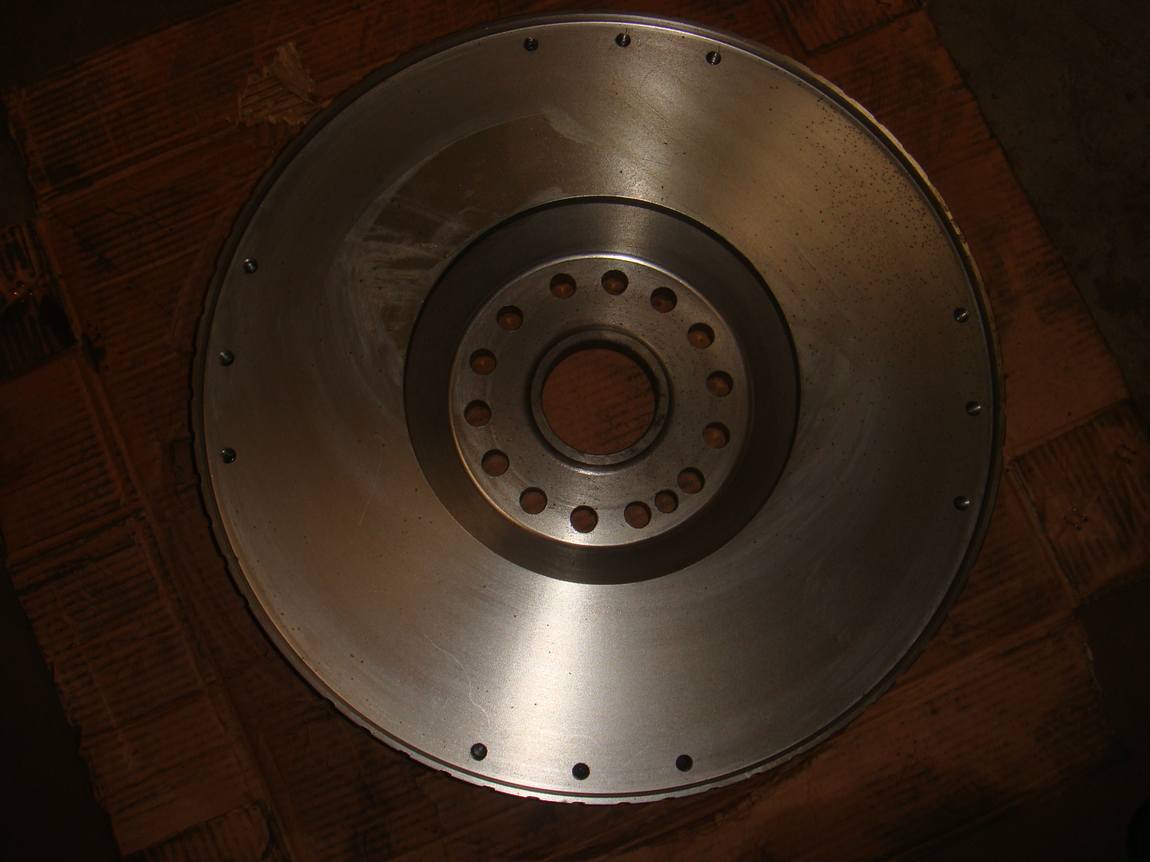
febi lists 478931 with 14 hub mounting bores and 12 clutch cover bores. AUGER lists the same number as having 16 holes, which appears to count both circles together, and does not say so. On our own core we count 14 bores on the hub circle and 12 on the cover circle, which matches the febi sheet.
For 479192, AUGER lists 10 holes, and DT lists the part without a hub bore count at all. On our own core we count 10 bores on the hub circle.
Ten against fourteen is not a tolerance. It is a different crankshaft flange. A 10-bolt crank will not take a 14-bolt flywheel, and a buyer who orders on the strength of “430 mm, 156 teeth, Volvo” has a one in two chance of being wrong.
One Casting Seven Numbers
Volvo does not sell one number. It sells a chain of supersessions, and the aftermarket adds a Renault Trucks branch on top.
The febi sheet for 45336 lists five Volvo numbers and two Renault Trucks numbers against one physical flywheel: 8170798, 21184874, 20729327, 1677033, 20441568, plus 74 20 729 327 and 74 21 184 874. PETERS ENNEPETAL lists the same part against 8170798 and 21184874. SAMPA lists 033.197 against 8170798.
| Number on the box | Brand | Status in the catalogue chain |
|---|---|---|
| 8170798 | Volvo | Base number, most widely listed |
| 21184874 | Volvo | Listed as the OE reference by febi and PETERS ENNEPETAL |
| 20729327 | Volvo | Supersession in the same febi sheet |
| 1677033 | Volvo | Supersession in the same febi sheet |
| 20441568 | Volvo | Supersession in the same febi sheet |
| 74 20 729 327 | Renault Trucks | Same casting, Renault numbering |
| 74 21 184 874 | Renault Trucks | Same casting, Renault numbering |
This is why a quote request that says only “Volvo flywheel” is not enough, and also why a buyer should not panic when the box arrives with a number that is not the one on the invoice. Five of those seven are the same disc.
The same pattern shows up on the 156 tooth pair. DT lists 478931 against 479333 as well, and lists 479192 against 479543. Whether DT is describing a supersession or a stock-keeping decision, we cannot tell from the sheet, so we print it and stop there.
The EDC Notch Count
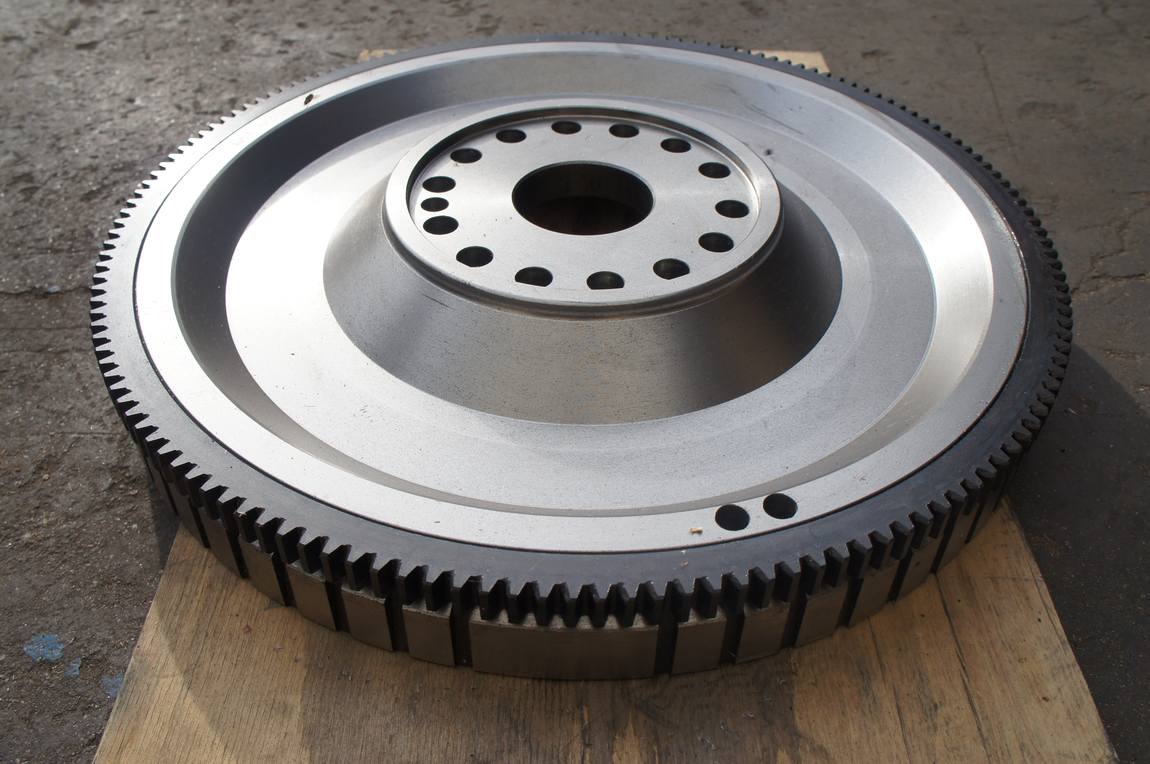
From Euro 3 onward, the engine management system needs to know where the crankshaft is. On these flywheels that job falls to a pattern of notches machined into the rim, read by a sensor in the housing.
febi is the only catalogue in our set that publishes the count for 8170798: 54 notches. No other brand in the group prints a figure. That makes it a single-source number in this article, and we treat it as one.
What matters for a buyer is simpler than the exact count. A flywheel with no notch pattern cannot feed that signal. A flywheel with a different pattern feeds a wrong one. Both bolt on. Neither shows up as a fitting problem until the engine is cranked.
If your core has notches, count them, photograph them, and send the photo. Do not order on the strength of a tooth count alone.
Why 430 Is Not The Outside Diameter
The same part is quoted at 430 mm, at 486 mm and at 492 mm, and all three figures are correct. They describe different circles.
The 430 mm figure is the nominal clutch size. The 486 mm figure is the outside diameter over the tooth tips. The 492 and 450 pair from DT describes the largest diameter and the running surface. A buyer who measures across the teeth and gets 486 has not found a wrong part.
The same trap runs through the 156 tooth pair. AUGER lists 478931 at 430 mm and BF lists the same number at 486 mm. DT prints 474 and 440 for the same part. None of them is lying. They are measuring three different features on one casting.
Measure the running surface, not the tooth tips, when you compare against a clutch specification.
What Our Photographs Show
The photographs in this article come from our own stock. They are useful for shape, hole pattern and marking practice. They are not a substitute for measuring your core.
Two of the shots are worth a second look.
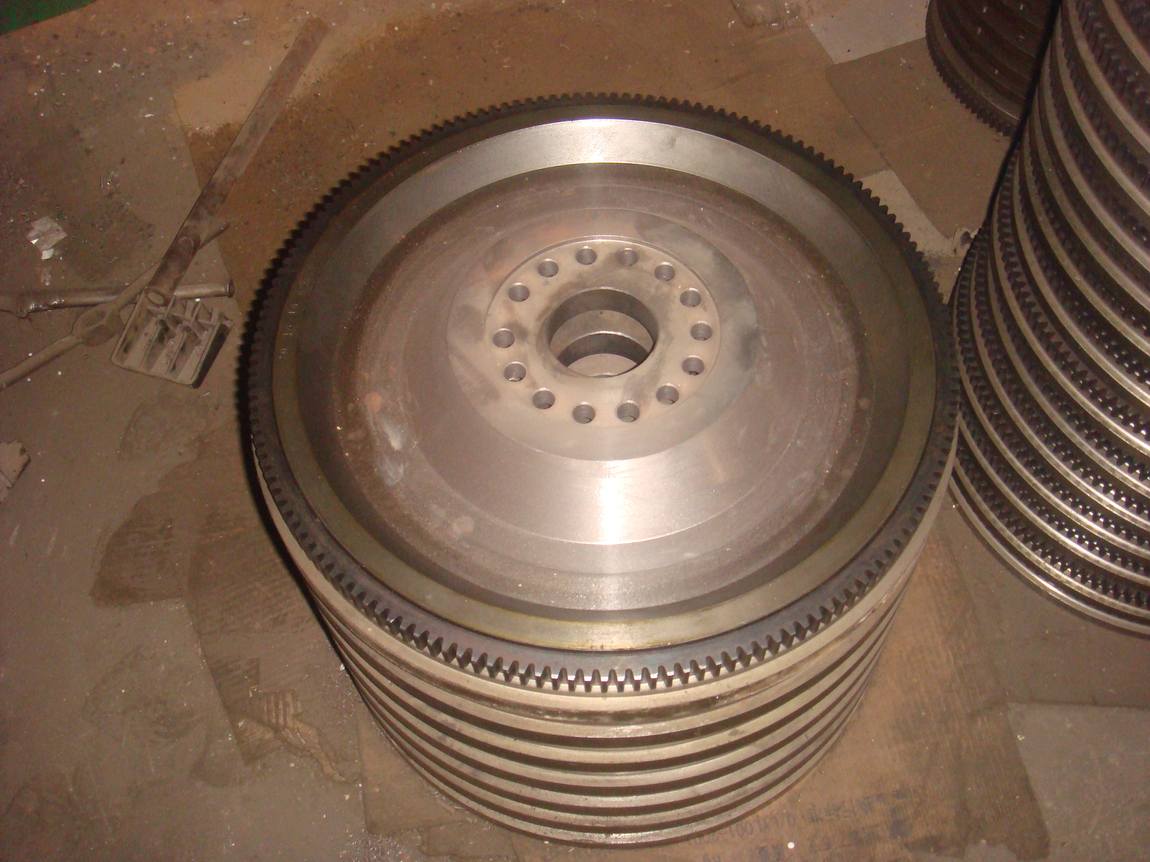
The first shows a stack of finished flywheels on the shop floor, all the same number, all with the ring gear already shrunk on. This is what a production run looks like before it is packed, and it is the reason we can talk about ring gear fitment from experience rather than from a catalogue.
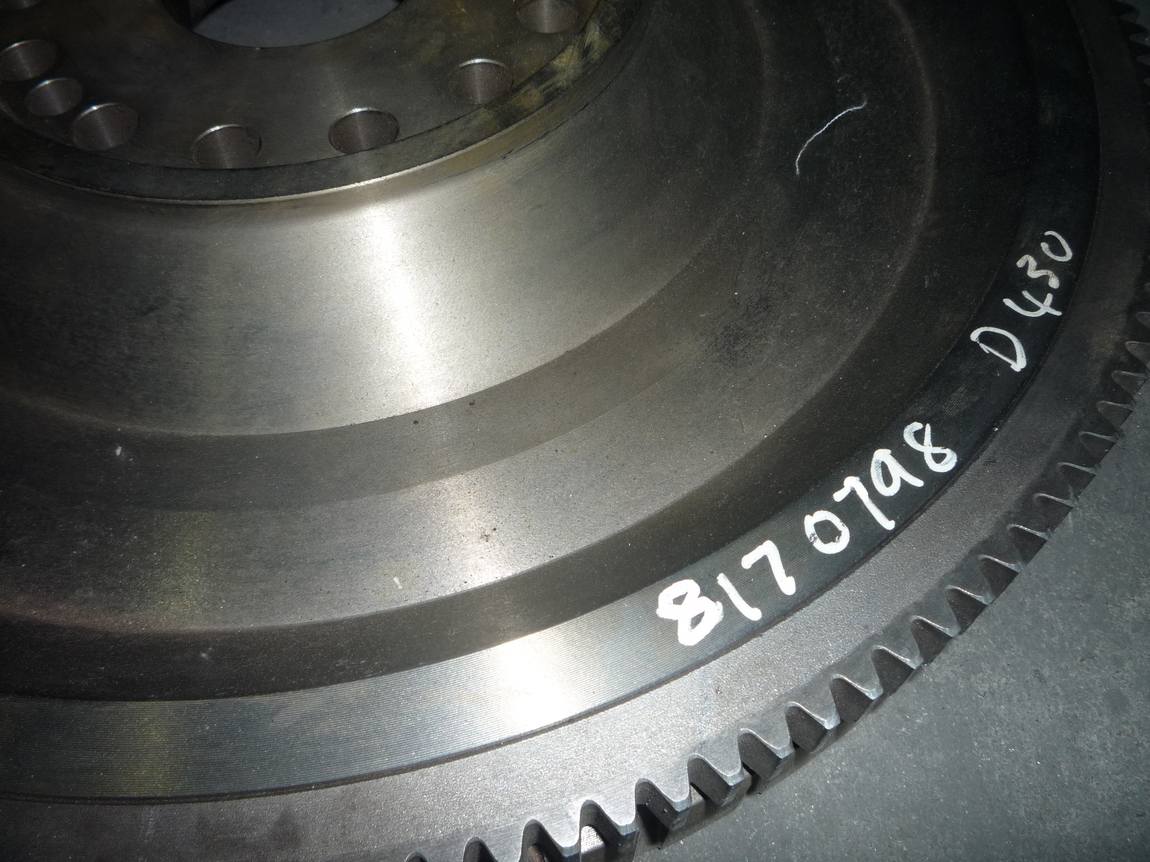
The second shows a rim band with a white paint marker on it. The marker reads 8170798 and D430. The number is a warehouse reference written by hand. The D430 is the clutch size, not a part number. Neither marking is an OEM stamp.
What A Photo Cannot Prove
This is the part of the article that most suppliers leave out.
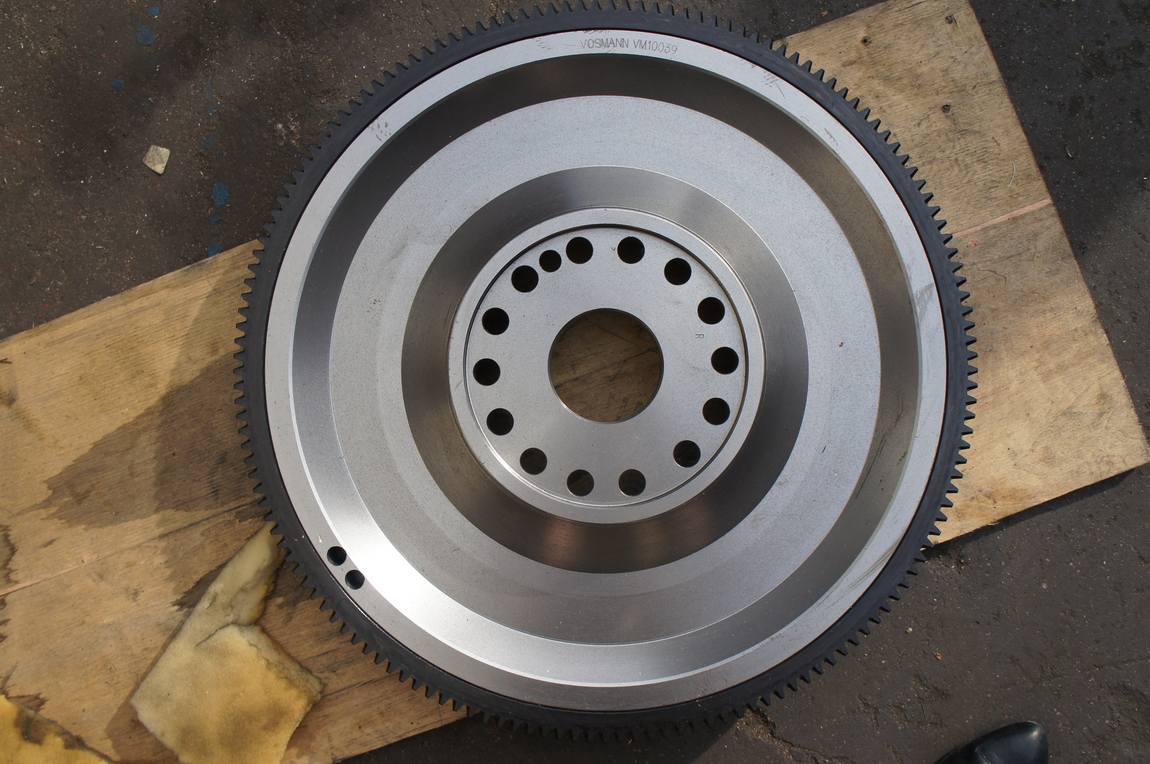
One rim in our own rack carries an etch that reads VOSMANN VM10039. It is a clean, machine-cut etch in the machined band between the teeth and the friction face. It is not a Volvo number. Nothing else on that rim looks like a Volvo number either.
We do not sell that part as 8170798, as 8710798, or as any other Volvo number, because we cannot prove what it is. A rim etch can be a supplier code, a batch reference or a customer mark. Only the OEM stamp, or a catalogue that names the casting, settles identity.
The lesson is worth more than the part. If a photo shows a number, ask who put it there. If nobody can answer, the number is a lead, not a fact.
How to Order Without Guessing
Five measurements settle almost every case, and none of them needs the part to be removed from the truck if the gearbox is already out.
- Count the teeth on the ring. Write the number down. Do not estimate from the diameter.
- Count the bores on the hub circle. Ten and fourteen are both current, and they are not interchangeable.
- Measure the hub bolt circle across the bores, centre to centre. 130 mm and 153 mm both exist in this family.
- Measure the bore that centres the part on the crank. 72 mm covers all three numbers above, so a match here proves little.
- Look for notches in the rim and photograph them. If they exist, their pattern is part of the part number.
Send those five, plus one photo of the hub face and one of the rim, and a quotation can be checked against the right number instead of the nearest one.
Questions Buyers Ask
Do 478931 and 479192 interchange?
No. They share a diameter, a tooth count and a hub bore, but the hub is drilled 14 against 10. A 10-bolt crankshaft flange will not take the 14-bolt part.
Is 8170798 the same as 21184874?
febi and PETERS ENNEPETAL both list 21184874 as an OE reference against the same flywheel as 8170798. That is catalogue evidence of one casting under two numbers, not a Volvo statement, and it is the strongest evidence available to us.
Does 8170798 have EDC notches?
febi lists 54 notches for 45336, the article that carries 8170798. No other brand in our set publishes a count, so treat 54 as a single-source figure.
Can I fit a 156 tooth flywheel where a 153 tooth part came off?
Only if the starter pinion and the housing position match the new ring. Tooth count changes the pitch, and a starter set for one ring will not mesh correctly with the other.
Sources and Evidence Level
Every figure in this article is traceable. Nothing is rounded up to look precise.
| Claim | Figures used | Evidence level |
|---|---|---|
| 8170798 is 153 teeth, 430 mm, hub 72 mm, hub circle 153 mm, 14 hub bores, 12 cover bores | febi 45336, PETERS ENNEPETAL 140.003-00A, SAMPA 033.197, DT 2.10366 | Multi-source, four independent brands |
| 478931 is 156 teeth, 430 mm, hub 72 mm, hub circle 130 mm, 14 hub bores, 12 cover bores | febi 180274, AUGER 58441, BF 20090412201, DT 2.10362 | Multi-source on teeth and bore; hub bore count from febi, confirmed by our own count |
| 479192 is 156 teeth, 430 mm, hub 72 mm, hub circle 130 mm, 10 hub bores | AUGER 58443, DT 2.10360 | Two-source on teeth and bore; hub bore count from AUGER, confirmed by our own count |
| 8170798 carries five Volvo numbers and two Renault Trucks numbers | febi 45336, PETERS ENNEPETAL, SAMPA | Multi-source, three independent brands |
| 8170798 has 54 EDC notches | febi 45336 only | Single-source, printed as such |
| 478931 relates to 479333, 479192 relates to 479543 | DT sheets only | Single-source, relationship not explained by the sheet |
| Weight of 8170798 sits between 39.5 and 46.6 kg | DT, PETERS ENNEPETAL, SAMPA | Spread of 7.1 kg across catalogues, quoted as a range |
| The VOSMANN VM10039 etch is not an OEM number | Our own photograph | Observation, no catalogue confirms the part |
Two figures are deliberately missing. No catalogue in our set publishes a clutch cover circle for 479192, so that cell stays empty. No source publishes a tooth count for the VOSMANN etched part, so it is described only by what the photo shows.
Send The Hub Photo
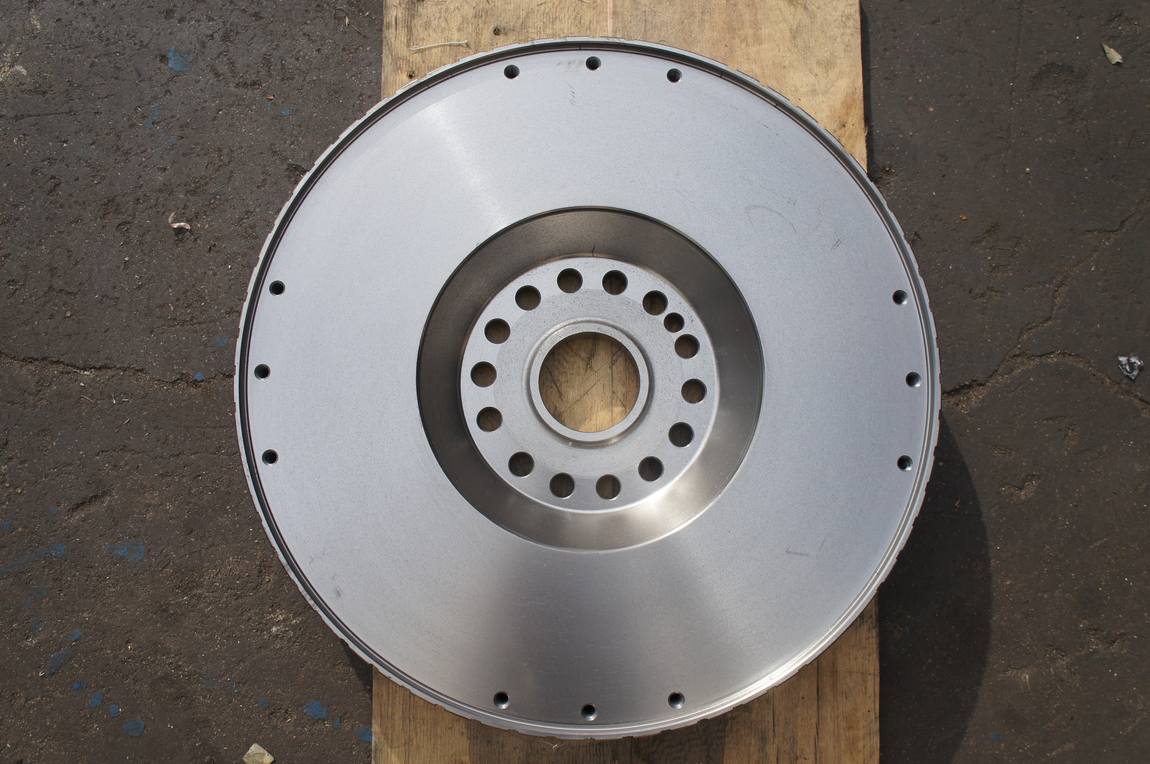
If you are holding a Volvo flywheel and are not sure which number it is, the fastest route is a photo of the hub face taken straight on, plus the tooth count.
We cast and machine flywheels, ring gears, flywheel housings, timing gear housings and cylinder heads in our own foundry in Changyi, Weifang, Shandong. We quote against drawings and against OEM numbers, and we will tell you when a number cannot be confirmed rather than ship a guess.
Email Irene at [email protected] or send a message to +86 199 5366 2121. Photos of the hub, the rim and the ring gear are enough to start.