
Hard-Connection PTO Flywheel: Why It’s Virtually Maintenance-Free
Key takeaways:
- A hard-connection power take-off flywheel replaces the friction clutch with a rigid bolted link — no clutch disc, no release bearing, no friction surface
- An entire category of maintenance disappears: no inspections, no adjustments, no disc replacement, no resurfacing
- Construction equipment benefits most, because high torque, frequent cycles, dust and long hours are exactly what kills friction clutches fastest
- Over a 10-year machine life, the savings show up in parts, labor, downtime, spare-parts inventory and admin overhead
The Maintenance Cost Nobody Talks About
When fleet managers calculate operating costs, they focus on fuel, hydraulic fluid, tracks and tires, and major overhauls. These are the visible, predictable costs.
But one category often goes unexamined: the flywheel-clutch system. In equipment with a friction clutch between the flywheel and transmission, that burden includes periodic clutch disc inspections, friction surface measurements, clutch adjustments, eventual disc replacement, and potential flywheel resurfacing. Over a machine’s life these costs accumulate — in parts and labor, but also in downtime and scheduling disruption.
Now consider a flywheel configuration that eliminates this entire category. No clutch. No friction components. No wear items. This is not hypothetical — it describes the hard-connection power take-off flywheel used in certain Weichai-equipped construction machinery.
What Is a Hard-Connection Power Take-Off Flywheel?
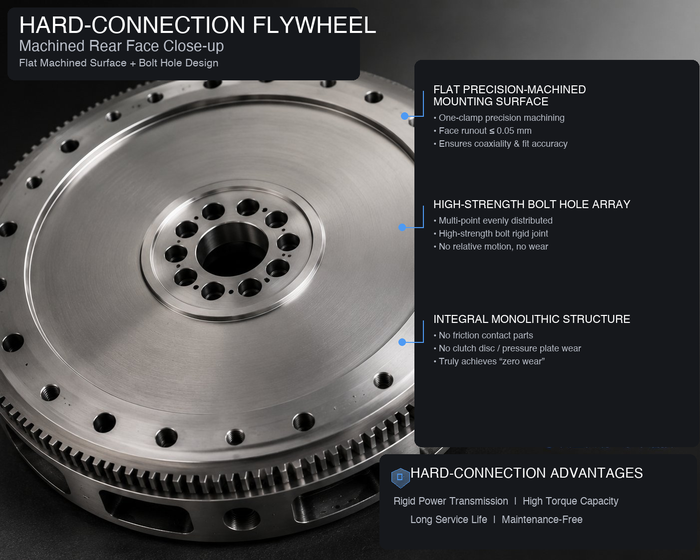
A hard-connection power take-off replaces the conventional friction clutch with a direct, rigid mechanical link between the flywheel and the downstream drivetrain. The flywheel bolts to a connecting plate — a solid component that transmits torque straight to the transmission or power take-off shaft.
In a friction clutch, torque is transmitted through contact pressure between a clutch disc and the flywheel’s friction surface. The clutch can slip, engage, and disengage — providing torque modulation but introducing wear. In a hard connection, torque flows through bolted or splined joints that cannot slip. There is no engagement cycle. The connection is permanent and rigid.
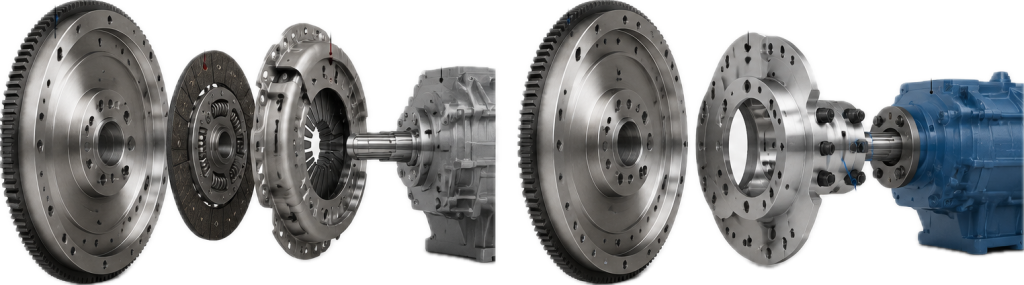
In this configuration, the flywheel serves only its two original functions:
- Energy storage — rotational inertia smooths power delivery and damps torsional vibration
- Power output — it transmits engine torque to the connecting plate and onward
The friction clutch interface — an add-on function in most automotive applications — is simply absent. And with it, an entire category of maintenance disappears.
Which Maintenance Tasks Disappear?
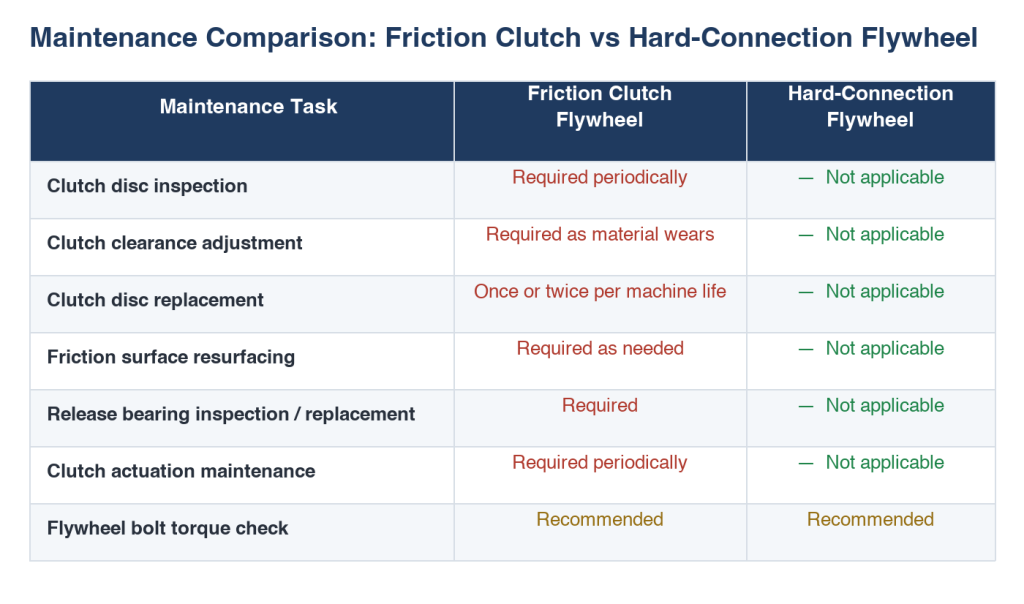
Clutch disc inspection and replacement. Friction material wears with every engagement cycle. That means periodic thickness measurements, clearance adjustments as material thins, and eventually pulling the transmission to replace the disc. None of this exists in a hard-connection system.
Friction surface maintenance. A clutch flywheel’s rear face develops heat checks, scoring, warping, and glazing over time — each of which may require removal and resurfacing. The hard-connection flywheel’s rear face is fully machined but never sees sliding contact. It touches a connecting plate, not a clutch disc. No heat, no scoring, no wear, no resurfacing.
Release bearing and actuation system. Friction clutch systems need a throwout bearing plus a mechanical, hydraulic, or pneumatic actuation system — both with their own failure modes and service schedules. The hard connection has neither.
Friction Clutch vs Hard-Connection Flywheel: Maintenance Comparison Table
How Much Does Clutch Maintenance Actually Cost?
Direct costs. For construction equipment, a single clutch replacement runs thousands of dollars in parts and labor, plus one to three days of downtime — and most machines need it once or twice over a 10-year life, often with resurfacing and a release bearing on top.
Downtime — usually the bigger bill. A wheel loader out of service isn’t generating revenue. Add project delays, rental replacements, and mobilization costs, and the downtime cost frequently exceeds the parts cost.
Inventory and admin. Fleets stock clutch discs and bearings as insurance — capital sitting on shelves. Every maintenance event also carries scheduling, ordering, and documentation overhead. Eliminate the task category, and both shrink.
Why Construction Equipment Benefits Most
Construction machinery is uniquely brutal on friction clutches:
- High torque loads — digging and pushing demand maximum torque transfer at high contact pressure
- Frequent engagement cycles — constant start-stop-reverse operation racks up cycles far faster than highway driving
- Contaminated environments — dust and moisture infiltrate clutch housings and accelerate wear
- Long hours — 8–12 operating hours per day compounds everything above
The harsher the duty cycle, the more a clutch costs to keep alive — and the more a hard connection saves.
There’s a performance argument too. Under peak loads, a worn or contaminated clutch can slip — generating heat and robbing the drivetrain of power. A hard connection cannot slip. And since construction machinery handles torque modulation downstream — through torque converters or power-shift transmissions — the flywheel interface doesn’t need modulation capability in the first place.
The Fully Machined Rear Face: Built to Stay Flat
The hard-connection flywheel’s rear face is fully machined, providing a precision interface for the connecting plate:
- No surface degradation — without sliding contact, the machined surface never wears, heat-checks, or warps
- Consistent alignment — flatness and perpendicularity hold for the component’s life, keeping the connecting plate properly aligned
- No resurfacing, ever — a task that friction-surface flywheels may require repeatedly simply doesn’t exist
How to Choose a Hard-Connection Flywheel Supplier
The design is inherently low-maintenance — but only if the flywheel is manufactured to spec. A poorly made flywheel fails regardless of the design’s theoretical durability. Key qualifications:
- IATF 16949 certification — automotive-grade quality management
- Precision machining — vertical CNC lathes and machining centers capable of the flatness, perpendicularity and surface-finish tolerances the machined rear face demands
- CMM inspection — coordinate measuring machine verification of critical dimensions
- Engine application expertise — knowledge of the specific engine configurations and flywheel parameters for hard-connection applications
- Material and heat treatment control — correct strength, hardness and microstructure
Changwei meets these requirements with IATF 16949 certification and a 40,000 sqm facility running 20 vertical CNC lathes, 30 machining centers, 20 gear hobbing machines, and CMM inspection. The company supplies flywheels for Weichai and other engine platforms used in construction machinery, backed by 20+ years of engineering experience and exports to 20+ countries.
FAQ
What is a hard-connection power take-off flywheel?
It’s a flywheel that connects to the drivetrain through a rigid bolted connecting plate instead of a friction clutch. Torque flows through mechanical joints that cannot slip, so there are no friction components and no wear items at the flywheel interface.
Why doesn’t a hard-connection flywheel wear out?
Because nothing slides against it. The rear face is fully machined but contacts a connecting plate, not a clutch disc — so there’s no friction, no heat, and no wear mechanism. The surface holds its flatness for the life of the component.
Can construction equipment operate without a clutch at the flywheel?
Yes — most construction machinery handles torque modulation downstream through torque converters, hydraulic transmissions, or power-shift transmissions. The flywheel interface doesn’t need to modulate torque, so a rigid connection works and eliminates clutch maintenance entirely.
How much does clutch maintenance cost over a machine’s life?
A single clutch replacement typically costs thousands of dollars in parts and labor plus 1–3 days of downtime, and most machines need it once or twice over a 10-year life — often with flywheel resurfacing and a release bearing on top. Downtime cost frequently exceeds the repair itself.
Conclusion
If the application doesn’t require torque modulation at the flywheel interface — and many construction machinery applications don’t — the hard-connection flywheel offers a clear economic advantage. No clutch inspections. No replacements. No resurfacing. No release bearing failures. Just a precision-machined flywheel that stores energy, transmits power, and stays in service for the life of the engine.
Over a 10-year equipment life, across a fleet of machines, the savings are real and measurable. Contact Changwei to discuss hard-connection flywheel solutions for your construction equipment.
About Changwei: Weifang Changwei Intelligent Equipment Co., Ltd. is an IATF 16949 certified engine flywheel manufacturer based in Weifang, China. With a 40,000 sqm production facility and 20+ years of engineering expertise, Changwei supplies flywheels, ring gears, and housing parts to customers in 20+ countries. Contact us for OEM/ODM flywheel solutions.