
Cummins M11 Flywheel 4974576: Read the Pads Before You Order
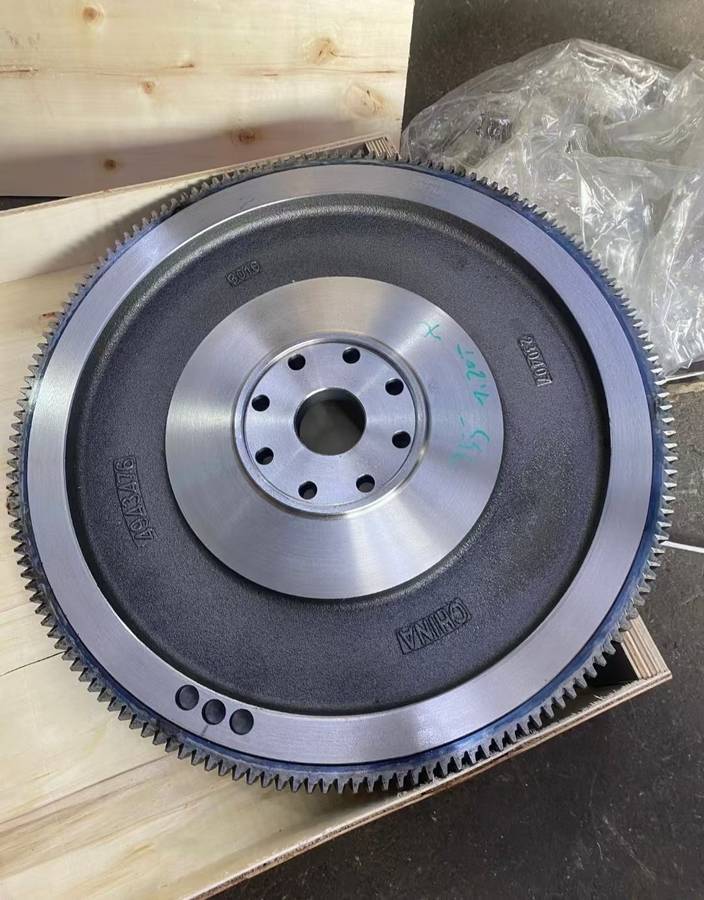
Table of Contents
- Two Numbers, One Engine Family
- What the Four Pads on the Casting Are
- The Ring Gear Carries Its Own Number
- Three Small Holes Near the Rim
- Machined Face or Cast Face
- A Photo Checklist for a Correct Quote
- Frequently Asked Questions
- Send Us the Casting and Pad Numbers
A buyer sends a photo of a flywheel and asks for a price on a Cummins M11 unit. The photo shows a clean casting and a readable number. The quote comes back wrong anyway. Nine times out of ten the number on the pad was read as something else.
This page is about that gap. We photograph our own stock, so every image below is a real part from our floor, not a catalog render.
Two Numbers, One Engine Family
Parts sellers list both 4974576 and 4974334 as flywheel assemblies for the M11, ISM11 and QSM11 family. Listings often show them as cross-references of each other. Some list 4974333 in the same group.
That is useful, and it is not proof. A catalog cross-reference means a seller believes the parts interchange. It does not mean the factory confirmed it for your engine serial number. We treat it as a lead, not a fact.
The safe order of checks is short. Read the number on your old flywheel. Confirm it against your engine serial number at a Cummins dealer. Then compare that result with the seller’s listing.
If the seller cannot tell you where the cross-reference came from, slow down. A 48 kg part that ships by sea is expensive to return.
What the Four Pads on the Casting Are
Turn our M11 flywheel over and the machined side shows four small pads. Each pad carries a different kind of information.
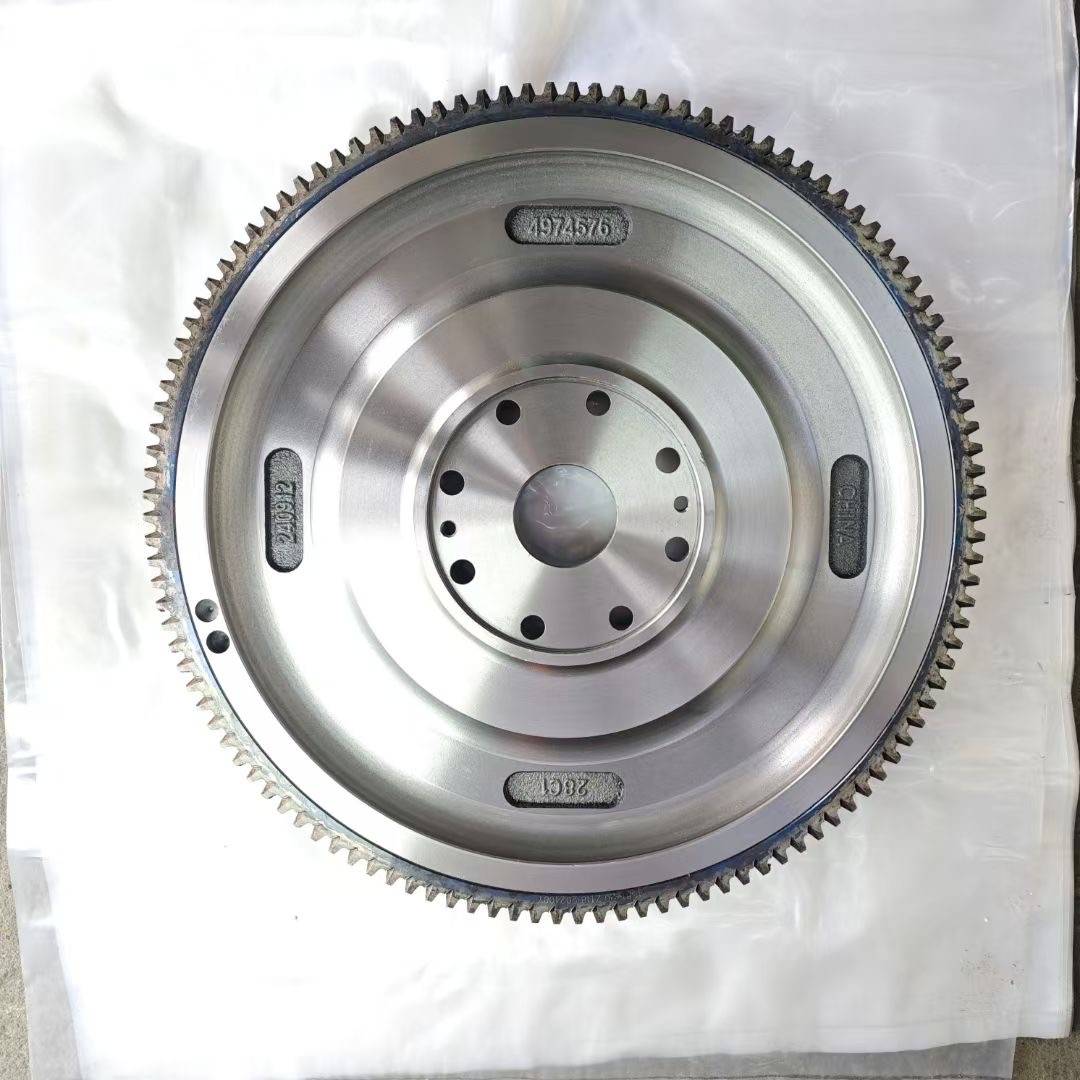
The top pad reads 4974576. That is the part number, and it is the only number on the part that you should quote.
The right pad reads CHINA. That is a country of origin mark, not a specification. It tells you where the casting was poured.
The bottom pad reads 2061. Four digits like this are a mould, cavity or batch code. They help the foundry trace a heat of iron. They do not identify the part.
The left pad carries a second number. In our photograph it does not resolve cleanly at the edges, so we log it as a casting code and leave it alone. A casting code describes the tooling, not the finished part.
This is why two M11 flywheels can show four different numbers and still be the same item. Quote the part number pad, and send a photo of the others.
The Ring Gear Carries Its Own Number
On the M11 and ISM11 the starter ring is a separate part. It is listed on its own, commonly as ring gear 4851. The flywheel is the disc. The ring gear is the toothed band shrunk onto it.
Our photos show the joint clearly. The toothed band sits over a machined shoulder, and the edge often shows a blue tint. That tint is heat from the shrink fit, not a fault.
Ring gears are fitted by heating the band and dropping it onto the disc. When it cools, the interference holds it. That is why a ring gear that spins by hand is a fit problem, not a paint problem.
If you need the ring separately, see our ring gear range. If you want the mechanics of the fit, read how the shrink fit is calculated.
Three Small Holes Near the Rim
Look at the lower left of the same face. Three small holes sit close together near the rim, outside the friction ring. They are balance drillings.
The factory drills metal away to correct imbalance after machining. A rebuilt flywheel often shows fresh holes for the same reason. That is normal and it is not damage.
Two rules follow. Do not plug them, and do not weld them shut. Either one removes the correction and puts the imbalance back.
If a used flywheel arrives with a cluster of deep holes and a resurfaced face, ask how much was machined off. Balance and thickness are linked. Our guide to resurfacing limits covers the measurement.
Machined Face or Cast Face
On the clutch side, the friction ring is machined bright. The area outside it keeps the rough cast skin. Both are correct. Confusing the two is common.
The cast skin is not a defect and it is not a sign of a cheap part. It is the surface the mould produced. Only the friction ring and the mounting faces need machining.
What matters on a used unit is different. Check the friction face for heat cracks and score marks. Check the bolt holes for elongation. Check the ring gear teeth for a step where the starter pinion lands.
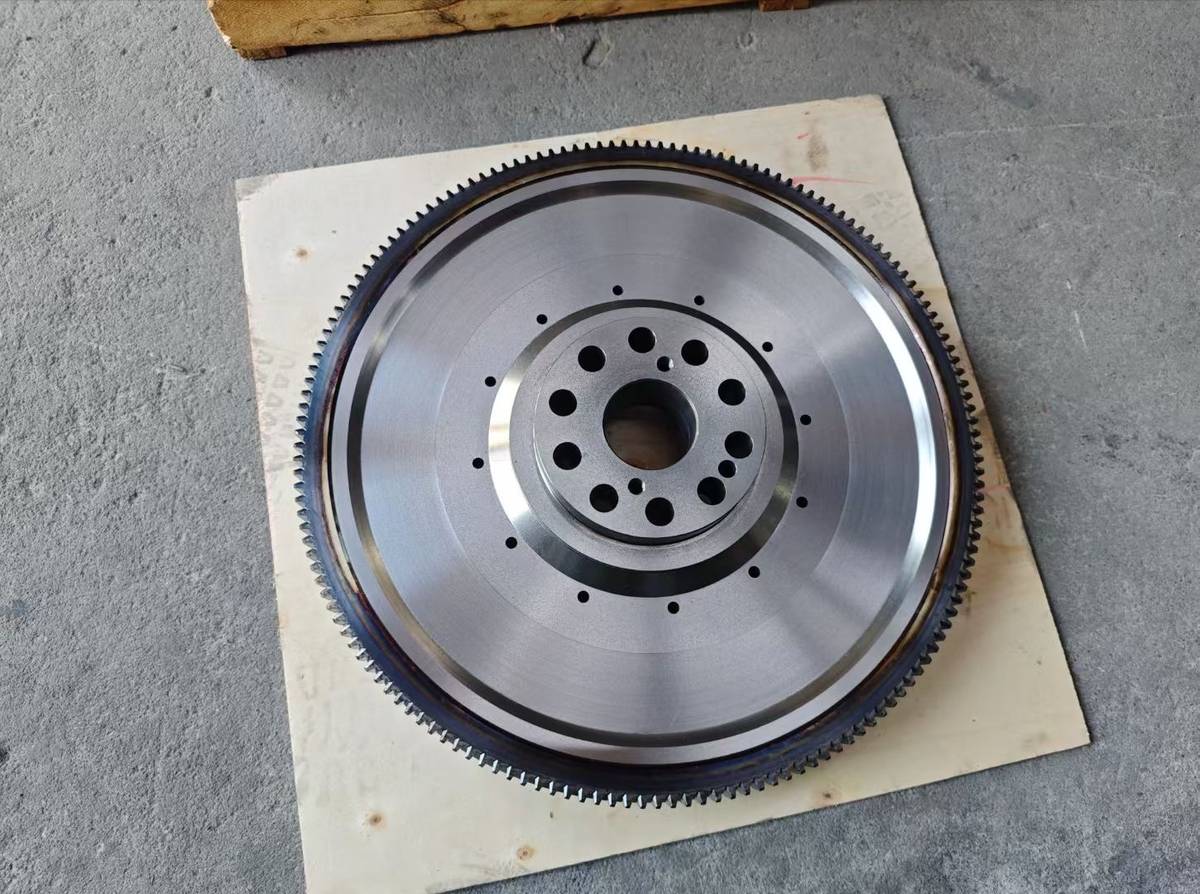
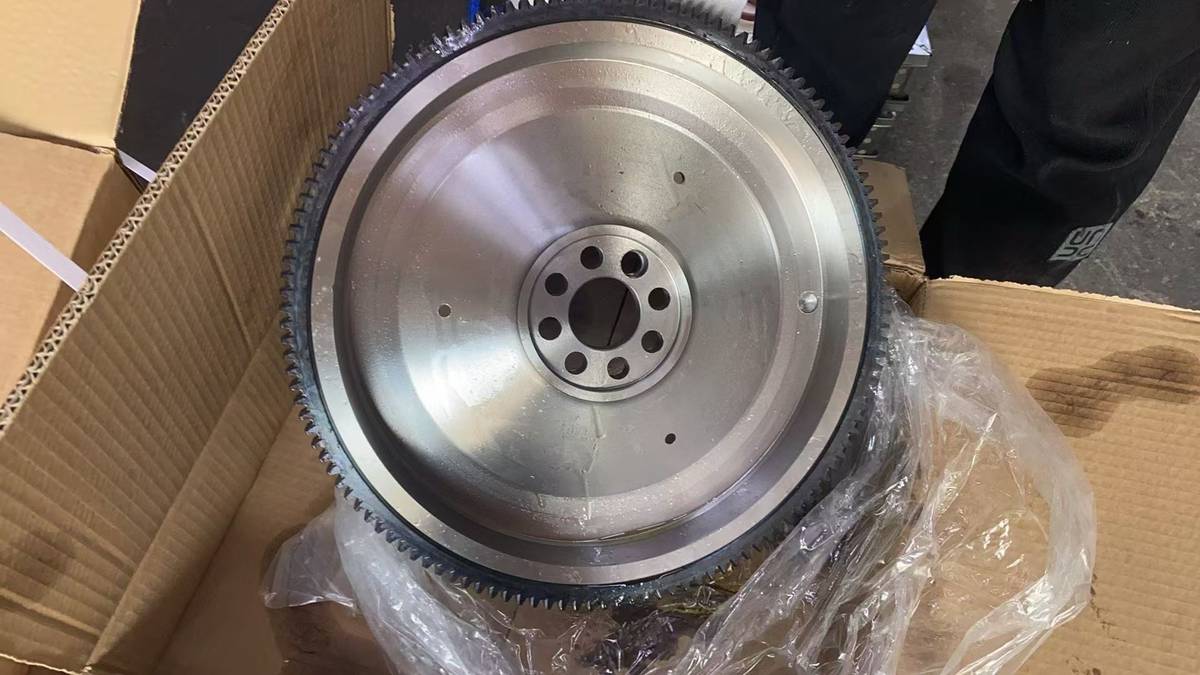
A ribbed back face is a separate design choice. Heavier commercial flywheels often carry radial ribs between hub and rim.
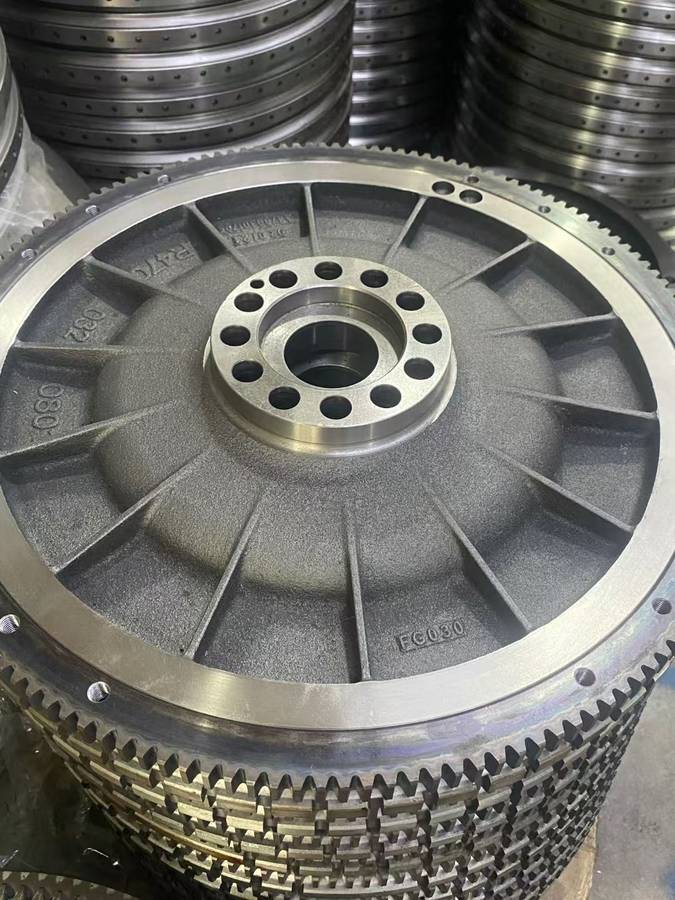
Ribs add stiffness without adding a solid disc of iron. They also trap grit, so clean them before you inspect for cracks.
A Photo Checklist for a Correct Quote
Most wrong shipments start with a bad photo set. Six images settle almost every question.
- The whole unit, flat, filling the frame.
- The pad close-up, in focus, light across the numbers.
- Every other pad on the part.
- The ring gear edge, close enough to count teeth.
- The centre bore and the bolt holes.
- The packaging, if the part is already crated.
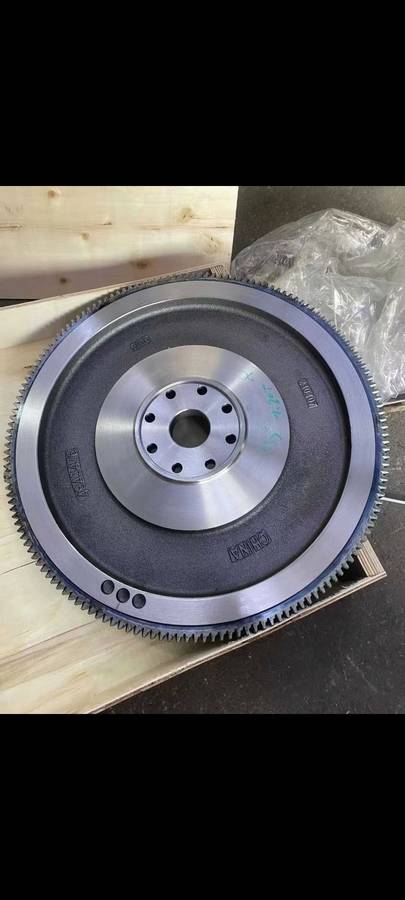
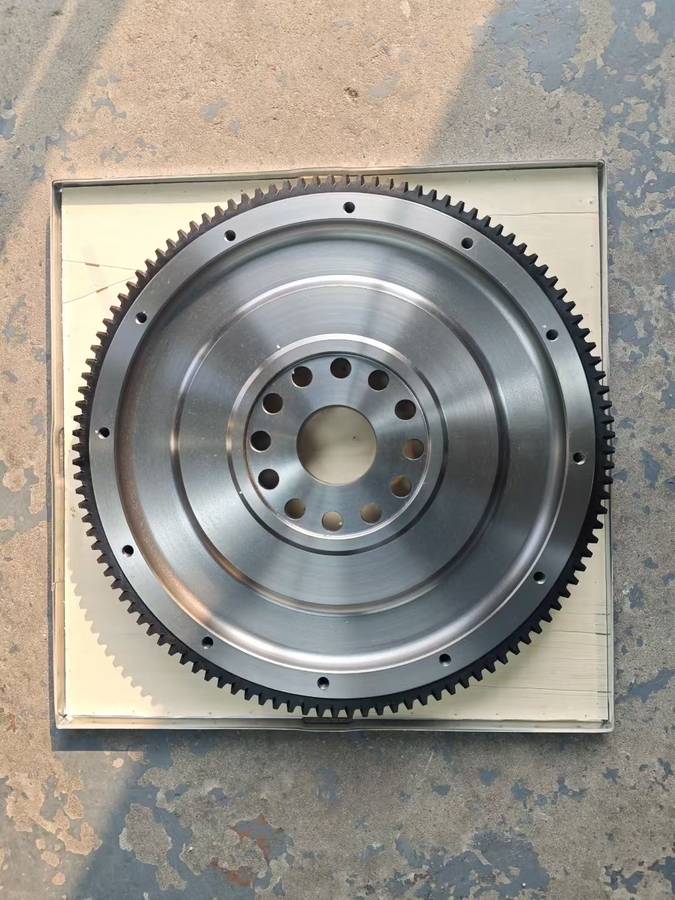
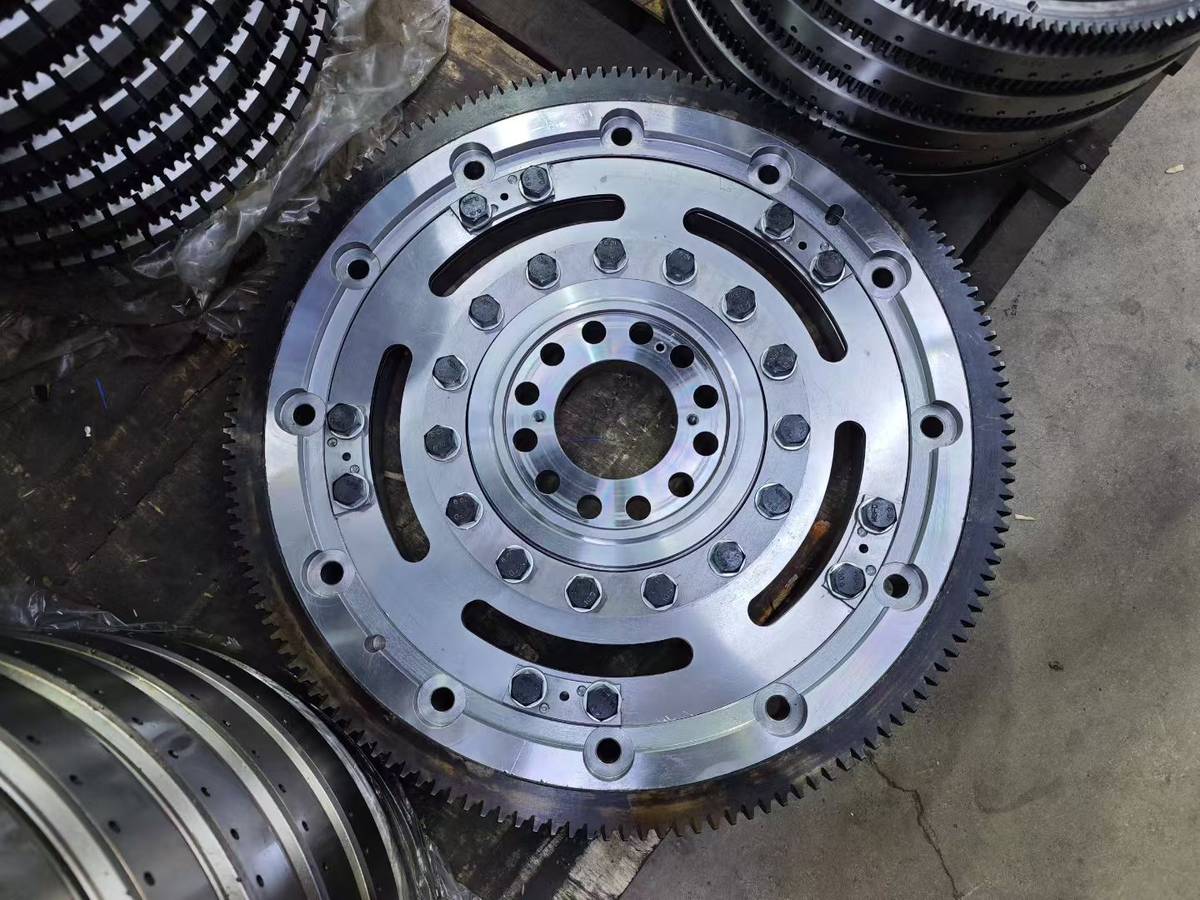
We weigh and photograph each unit before packing. A batch goes onto the stand for a visual pass first.
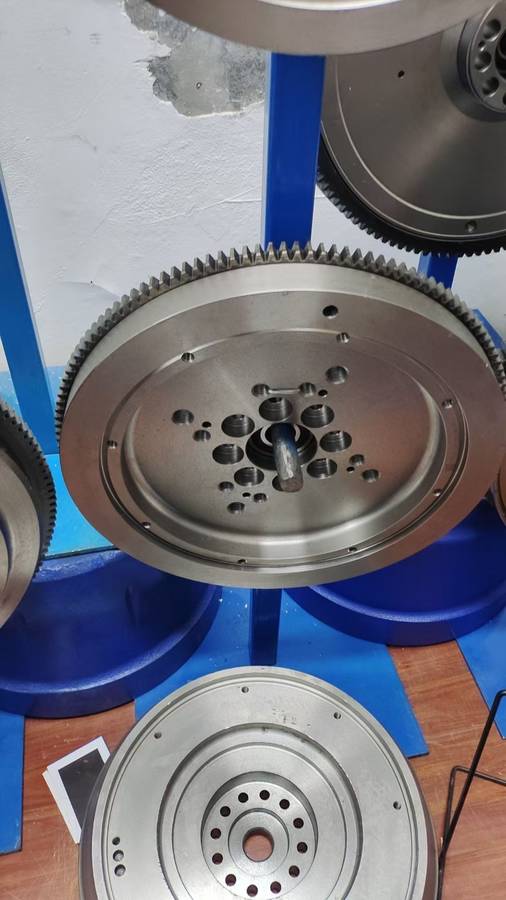
Stacked units get the same check. Faces are kept apart so the machined rings do not touch.
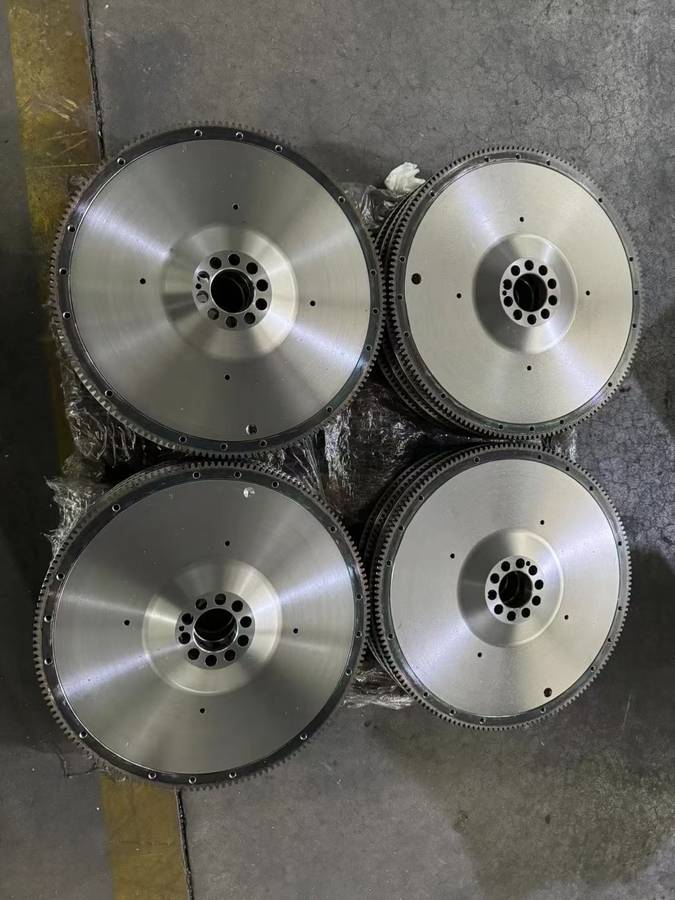
Finished stock is stored the same way, ring gear up, so the teeth are visible without lifting the part.
Parts leave in cartons with foam or in plywood cases, depending on weight and route.
Frequently Asked Questions
Is 4974576 the same as 4974334?
Sellers list them as interchangeable for M11 and ISM11 engines. We do not treat that as factory confirmation. Confirm by engine serial number before you order either one.
What does the 2061 on the flywheel mean?
It is a short batch or mould code, four digits in our photo. It traces the casting, not the part. Never quote it as a part number.
How many teeth does the ring gear have?
We do not publish a tooth count from a photograph. Teeth are countable, and a wrong count is a returned shipment. Count the teeth on your own ring gear, or send us a clear edge photo and we will count yours.
Can I reuse the old ring gear?
Sometimes. If the teeth are worn into a step where the pinion engages, replace the ring. If the ring turns on the disc, replace the assembly or have it refitted.
Why is the edge of the ring gear blue?
That is heat tint from the shrink fit. The ring was heated to expand it. Blue is expected on that joint.
Do you supply the flywheel with the ring gear fitted?
Yes, as an assembly. We also supply ring gears on their own for workshops that press their own.
Send Us the Casting and Pad Numbers
Send the part number pad, the casting pad and one flat photo of the whole unit. We will confirm the family and quote from stock.
Email [email protected] or use the quote form. Phone and WhatsApp: +86 19953662121. We ship FOB Qingdao from Changyi, Weifang, Shandong.
Related Reading