
What is a Flywheel? Complete Guide for Commercial Vehicle Buyers
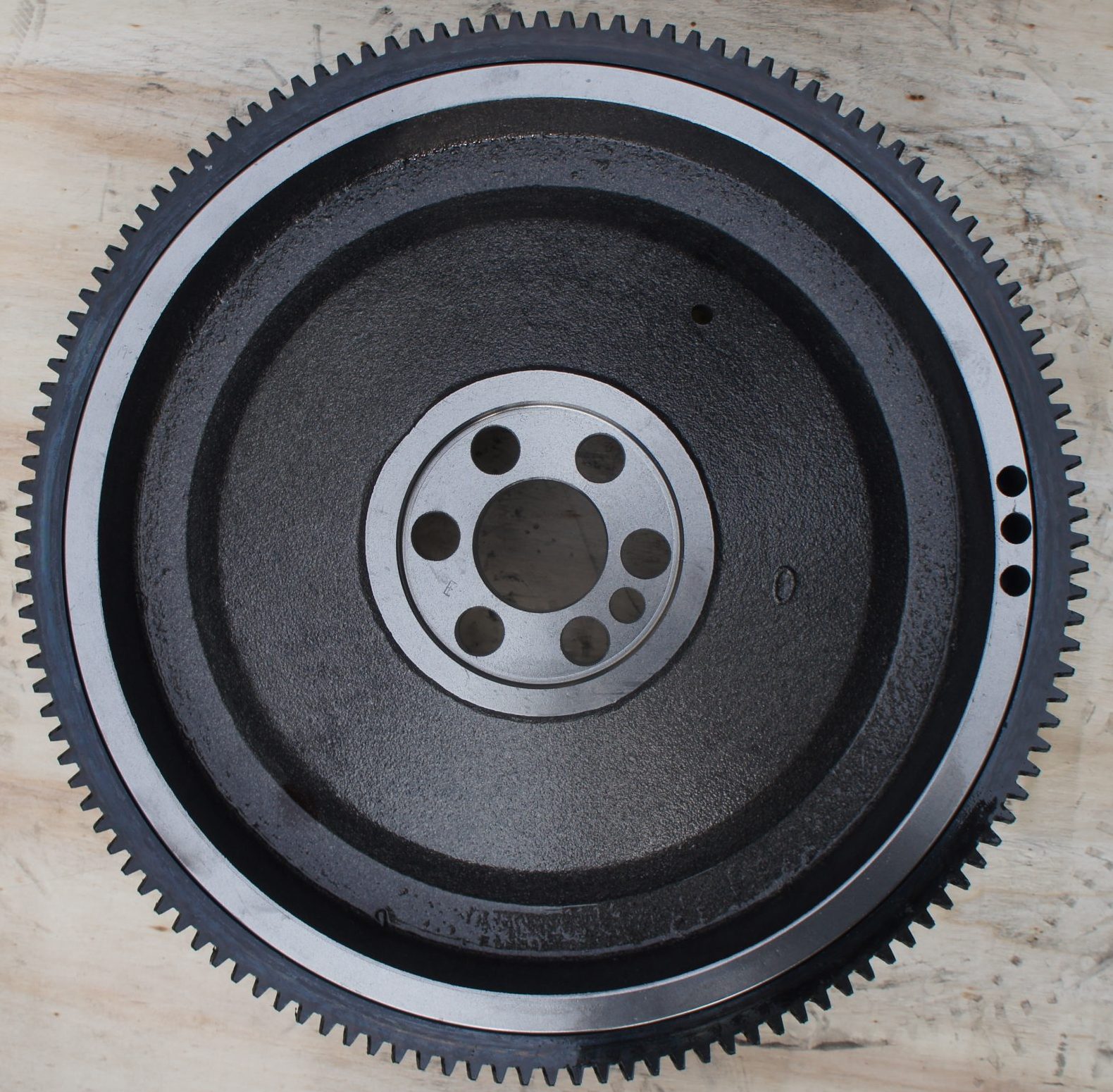
Table of Contents
- What is a Flywheel? — The Simple Definition
- How Does a Flywheel Work in an Engine?
- Key Functions of an Engine Flywheel
- Types of Flywheels Used in Commercial Vehicles
- Flywheel Materials: Cast Iron vs. Steel
- Ring Gear and Flywheel Housing: The Two Essential Companions
- Common Signs Your Flywheel Needs Replacement
- How to Choose the Right Replacement Flywheel
- OEM vs. Aftermarket: Which Should You Buy?
- FAQ: Frequently Asked Questions About Engine Flywheels
1. What is a Flywheel? — The Simple Definition
A flywheel is a heavy mechanical disc or wheel mounted on the crankshaft of an internal combustion engine. Its primary job is to store rotational energy and smooth out the power delivery from the engine’s pistons.
In simple terms: every time a piston fires, it delivers a burst of power. The flywheel acts like a rotational battery — it absorbs that energy during the power stroke and releases it smoothly during the other three strokes (compression, exhaust, intake). This keeps the engine running steadily instead of jerking or stalling.
For commercial vehicles — trucks, buses, agricultural machinery — the flywheel is even more critical because these engines operate under heavy loads for long hours. A quality flywheel directly affects fuel efficiency, drivability, and component lifespan.
Figure 1: Cast iron flywheel for HINO E13C heavy-duty truck engine. Note the ring gear teeth around the outer circumference — this meshes with the starter motor to crank the engine.
2. How Does a Flywheel Work in an Engine?
The flywheel is bolted to the rear end of the crankshaft, between the engine and the transmission (or clutch assembly). Here’s the step-by-step process:
During Engine Starting
- The starter motor engages the ring gear teeth on the flywheel’s outer edge
- The starter rotates the flywheel, which turns the crankshaft
- Once the engine fires and reaches idle speed, the starter disengages
During Engine Operation
- Power stroke: The combustion force pushes the piston down, rotating the crankshaft and accelerating the flywheel
- Non-power strokes: The flywheel’s stored momentum of inertia carries the crankshaft through compression, exhaust, and intake strokes
- Clutch engagement: In manual transmission vehicles, the clutch disc presses against the flywheel’s friction surface to transfer power to the transmission
This cycle repeats thousands of times per minute. In a diesel truck engine running at 2,000 RPM, each flywheel completes over 30 revolutions per second — which is why material quality and precision balancing are absolutely critical.
3. Key Functions of an Engine Flywheel
A flywheel serves five essential functions in a commercial vehicle engine:
| Function | Why It Matters for Commercial Vehicles |
|---|---|
| Energy Storage / Smoothing | Prevents engine vibration and ensures smooth power delivery under varying loads |
| Starting Aid | Ring gear provides the interface for the starter motor |
| Clutch Friction Surface | The flat face of the flywheel serves as one half of the clutch system |
| Torsional Dampening | Reduces twisting forces on the crankshaft, extending engine life |
| Balance Weight | Helps counterbalance reciprocating mass from pistons and connecting rods |
For fleet operators and parts buyers, understanding these functions helps you evaluate whether a low-cost aftermarket flywheel will actually perform reliably in real-world conditions.
4. Types of Flywheels Used in Commercial Vehicles
Not all flywheels are created equal. The design varies significantly based on engine type, vehicle application, and regional manufacturing standards.
4.1 By Vehicle Origin / Design Standard
Japanese Flywheels
- Used in HINO, ISUZU, FUSO (Mitsubishi Fuso), NISSAN Diesel (UD) commercial vehicles
- Typically feature a single-mass design with integrated ring gear
- Size range: 300mm – 430mm diameter
- Known for precise dimensional tolerances and long service life
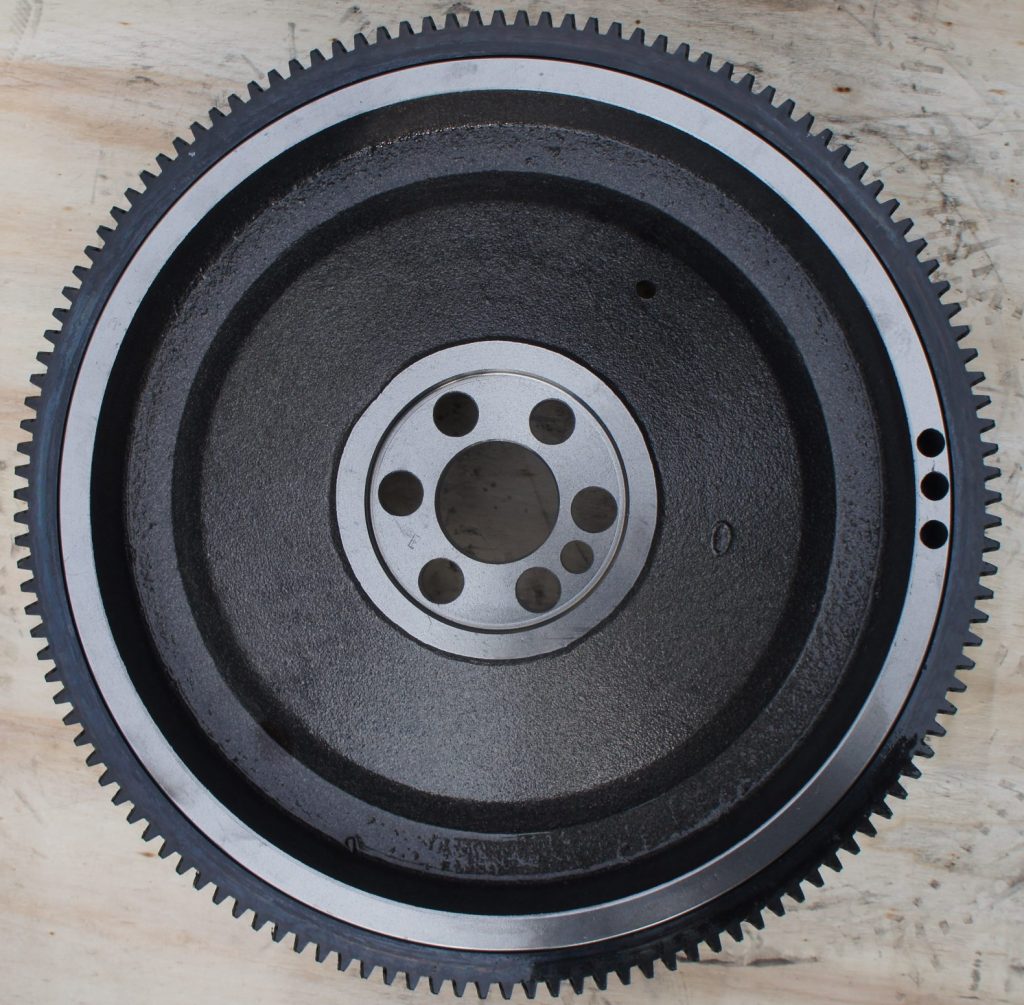
Figure 2: Cast iron flywheel for ISUZU 6BG1 engine. The machined center surface provides the clutch friction face, while the outer ring gear engages the starter motor.
European Flywheels
- Used in SCANIA, VOLVO, MAN, MERCEDES-BENZ, DAF trucks
- Often feature dual-mass flywheel (DMF) designs in modern applications
- More complex due to integrated dampening mechanisms
Chinese Domestic Flywheels
- Used in WEICHAI, CUMMINS China, YUCHAI, SHANGCHAI engines
- High volume, cost-competitive, widely used in domestic fleets and export markets
4.2 By Construction Type
| Type | Description | Typical Application |
|---|---|---|
| Single-Mass Flywheel (SMF) | One-piece solid casting, simple and durable | Heavy-duty trucks, agricultural machinery |
| Dual-Mass Flywheel (DMF) | Two masses connected by springs/dampers | Light-duty trucks, passenger vehicles with focus on NVH reduction |
| Flexible Flywheel | Incorporates flexible coupling elements | Special industrial applications |
For most commercial truck and bus applications, single-mass cast iron flywheels remain the industry standard due to their durability, lower cost, and ease of maintenance.
5. Flywheel Materials: Cast Iron vs. Steel
The vast majority of commercial vehicle flywheels are made from cast iron (foundry iron) — specifically gray cast iron or ductile iron. Here’s why:
Why Cast Iron Dominates
- Excellent damping capacity: Cast iron naturally absorbs vibrations, reducing noise and wear on other components
- Cost-effective: Casting allows complex shapes (like the curved friction surface and integrated ring gear seat) to be produced economically at scale
- Machinability: Easy to machine to precise tolerances for the clutch surface and crankshaft mounting
- Thermal stability: Maintains dimensional integrity across the wide temperature range of diesel engine operation
When Steel Is Used
Some high-performance or specialized applications use steel forgings for the flywheel body, typically when:
- Extreme weight reduction is required (racing or specialty vehicles)
- Higher RPM operation demands superior tensile strength
- The application involves shock loading beyond cast iron’s limits
For 95%+ of commercial vehicle replacement needs, high-quality cast iron is the correct and economical choice.
At Changwei, all our flywheels are manufactured from premium foundry iron using lost foam casting, clay sand casting, or resin sand casting processes — each selected based on the specific product’s requirements for density, surface finish, and dimensional accuracy.
6. Ring Gear and Flywheel Housing: The Two Essential Companions
A flywheel never works alone. Two companion components are equally important:
Ring Gear (Flywheel Ring Gear)
The ring gear is a steel gear ring press-fitted or shrink-fitted onto the outer diameter of the flywheel. Its teeth mesh with the pinion gear of the electric starter motor.
Key points for buyers:
- Ring gears can be replaced separately if worn (though many mechanics replace the entire flywheel assembly)
- Tooth count and pitch must exactly match the starter motor specification
- Common failure mode: worn or stripped teeth from repeated starting attempts or starter misalignment
Flywheel Housing (Bell Housing)
The flywheel housing (also called bell housing or clutch housing) encloses the flywheel and connects the engine block to the transmission.
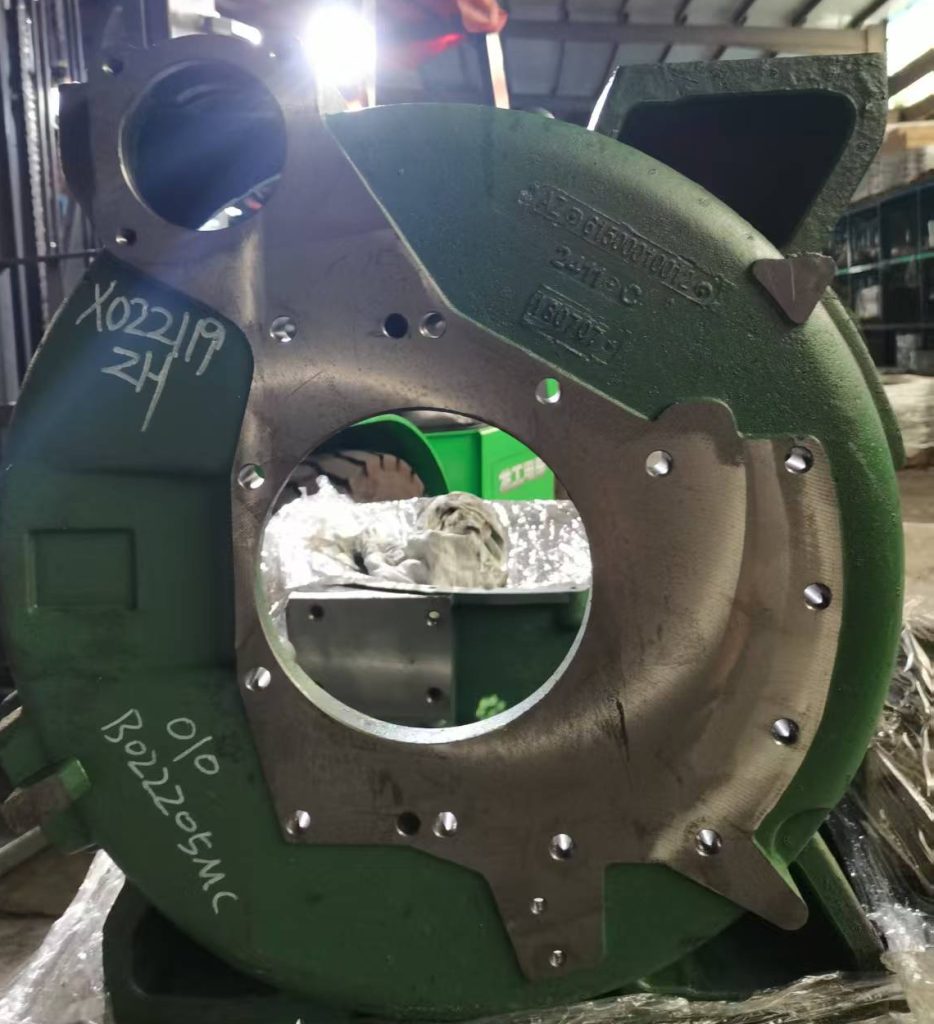
Figure 3: Cast iron flywheel housing (bell housing). This component encloses the flywheel, provides the clutch release bearing bore, and mates the engine to the transmission.
Key functions of the flywheel housing:
- Provides structural rigidity between engine and transmission
- Houses the clutch release mechanism (release bearing, fork, etc.)
- Contains the rear main seal area to prevent oil leakage
- Provides mounting points for the starter motor
When replacing a flywheel, always inspect both the ring gear condition and the flywheel housing mating surface for wear, cracks, or warping.
7. Common Signs Your Flywheel Needs Replacement
For fleet managers and parts buyers, knowing when to replace a flywheel prevents costly breakdowns. Watch for these warning signs:
| Symptom | Possible Cause | Action Required |
|---|---|---|
| Grinding noise when starting | Worn/stripped ring gear teeth | Inspect ring gear; may need full flywheel replacement |
| Clutch chatter or shudder | Warped or scored flywheel friction surface | Resurface or replace flywheel |
| Engine vibration at idle | Imbalanced or cracked flywheel | Replace immediately — safety risk |
| Burning smell from clutch area | Overheated clutch/flywheel from slipping | Inspect both clutch disc and flywheel surface |
| Difficulty shifting gears | Worn flywheel pilot bearing or damaged mounting surface | Full inspection recommended |
| Visible cracks (during maintenance) | Fatigue failure from stress cycles | Immediate replacement required |
Pro tip: When performing clutch replacement, always have the flywheel resurfaced or replaced. Installing a new clutch on a worn flywheel dramatically shortens the new clutch’s lifespan — a mistake that costs far more than the flywheel itself.
8. How to Choose the Right Replacement Flywheel
When sourcing a replacement flywheel for your commercial vehicle fleet, follow this checklist:
Step 1: Identify the Exact Part
- OEM part number (stamped or cast into the original flywheel)
- Engine model (e.g., HINO E13C, ISUZU 6BG1, FUSO 6D22)
- Vehicle model and year
- Dimensions: outer diameter, thickness, bolt circle diameter, pilot bore size
Step 2: Verify Material and Manufacturing Quality
- Confirm cast iron grade (gray iron vs. ductile iron requirements)
- Check for TS16949 / IATF 16949 certification of the manufacturer
- Ask about dynamic balancing — every flywheel should be balanced before shipment
- Request material test reports if buying in bulk
Step 3: Evaluate the Supplier
- Years of experience in engine component manufacturing
- Export track record and customer references
- Quality control process (incoming inspection, in-process checks, final inspection)
- Warranty terms and after-sales support
Step 4: Consider Total Cost, Not Just Unit Price
A cheap flywheel that fails after 50,000 km costs more than a quality unit that lasts 200,000+ km when you factor in:
- Downtime (vehicle off-road)
- Labor cost for repeat installation
- Potential damage to clutch, starter motor, or crankshaft from debris
9. OEM vs. Aftermarket: Which Should You Buy?
This is one of the most common questions from commercial vehicle parts buyers. Here’s an honest comparison:
| Factor | OEM (Original Equipment) | Quality Aftermarket (e.g., Changwei) |
|---|---|---|
| Price | Premium (20-40% higher) | Competitive (15-30% savings) |
| Quality | Consistent, guaranteed | Can match or exceed OEM when properly manufactured |
| Availability | May have long lead times | Often faster, especially from stock |
| Customization | Fixed specifications only | OEM/ODM customization available |
| Certification | Factory-certified | TS16949 / IATF 16949 certified manufacturers meet same standards |
| Minimum Order | Usually no MOQ | Varies by supplier (some accept small orders) |
Bottom line: For standard replacement parts, a quality aftermarket supplier with proper certifications can deliver OEM-equivalent performance at a better price. For specialized or warranty-sensitive applications, OEM may still be preferred.
Changwei supplies OEM-quality flywheels for Japanese, European, and Chinese engine platforms, with full IATF 16949 certification and custom OEM/ODM capabilities.
10. FAQ: Frequently Asked Questions About Engine Flywheels
Q1: How long does a typical commercial vehicle flywheel last?
A well-manufactured cast iron flywheel in normal commercial service should last 200,000–400,000 km (125,000–250,000 miles). Factors that reduce lifespan include aggressive driving, frequent stop-start cycles, poor clutch adjustment, and low-quality manufacturing.
Q2: Can a cracked flywheel be repaired?
No. A cracked flywheel must always be replaced. The risk of catastrophic failure (the flywheel disintegrating at high RPM) poses extreme safety hazards. Never attempt to weld or repair a cracked flywheel.
Q3: What is dynamic balancing, and why does it matter?
Dynamic balancing ensures the flywheel’s mass is evenly distributed around its axis of rotation. An unbalanced flywheel causes engine vibration, accelerated bearing wear, and potential crankshaft damage. Every quality flywheel should be dynamically balanced to ISO 1940 G6.3 or better before leaving the factory.
Q4: What’s the difference between a flywheel and a flexplate?
A flexplate is used with automatic transmissions — it’s a thin steel plate that connects the engine to the torque converter. A flywheel is the heavy cast iron disc used with manual transmissions (and some heavy-duty automatic setups). They serve similar energy-storage functions but are designed differently.
Q5: How do I know if a flywheel fits my engine without the OEM number?
If the OEM number is unreadable, provide your supplier with:
- Clear photos of the flywheel (both sides)
- Precise measurements: OD, ID (pilot), thickness, bolt circle PCD, tooth count on ring gear
- Engine serial number and vehicle VIN
- Photos of any casting numbers or markings
A reputable manufacturer can cross-reference these details to identify the correct replacement.
Q6: What is the typical lead time for custom/OEM flywheel orders?
For custom or OEM flywheel projects:
- Sample development: 15–25 days (including pattern/tooling if needed)
- Mass production: 25–45 days after sample approval
- Standard products from stock: 7–15 days
Always confirm lead times with your supplier before placing orders, especially for time-critical fleet maintenance.
Conclusion: Choosing a Reliable Flywheel Supplier
The flywheel may seem like a simple component — a round piece of cast iron with gear teeth. But its role in engine performance, reliability, and safety is anything but simple.
When sourcing replacement flywheels for your commercial vehicle fleet, prioritize:
- Material quality (premium cast iron, not recycled scrap)
- Manufacturing precision (dimensional tolerance, dynamic balancing)
- Supplier certification (IATF 16949 is the gold standard for automotive components)
- Traceability (batch records, material certificates, test reports)
Looking for a reliable flywheel supplier?
Changwei Intelligent Equipment manufactures engine flywheels, ring gears, flywheel housings, and related cast iron components for HINO, ISUZU, FUSO, NISSAN, WEICHAI, CUMMINS, and 20+ other engine platforms.
📧 Email: [email protected] | 📞 Tel: +86-19953662121
🏭 Certified: IATF 16949 | 20+ Years Experience | 100+ Countries Served