
One Belt, Five Components: The Elegant Simplicity of Modern Engine Front-End Design
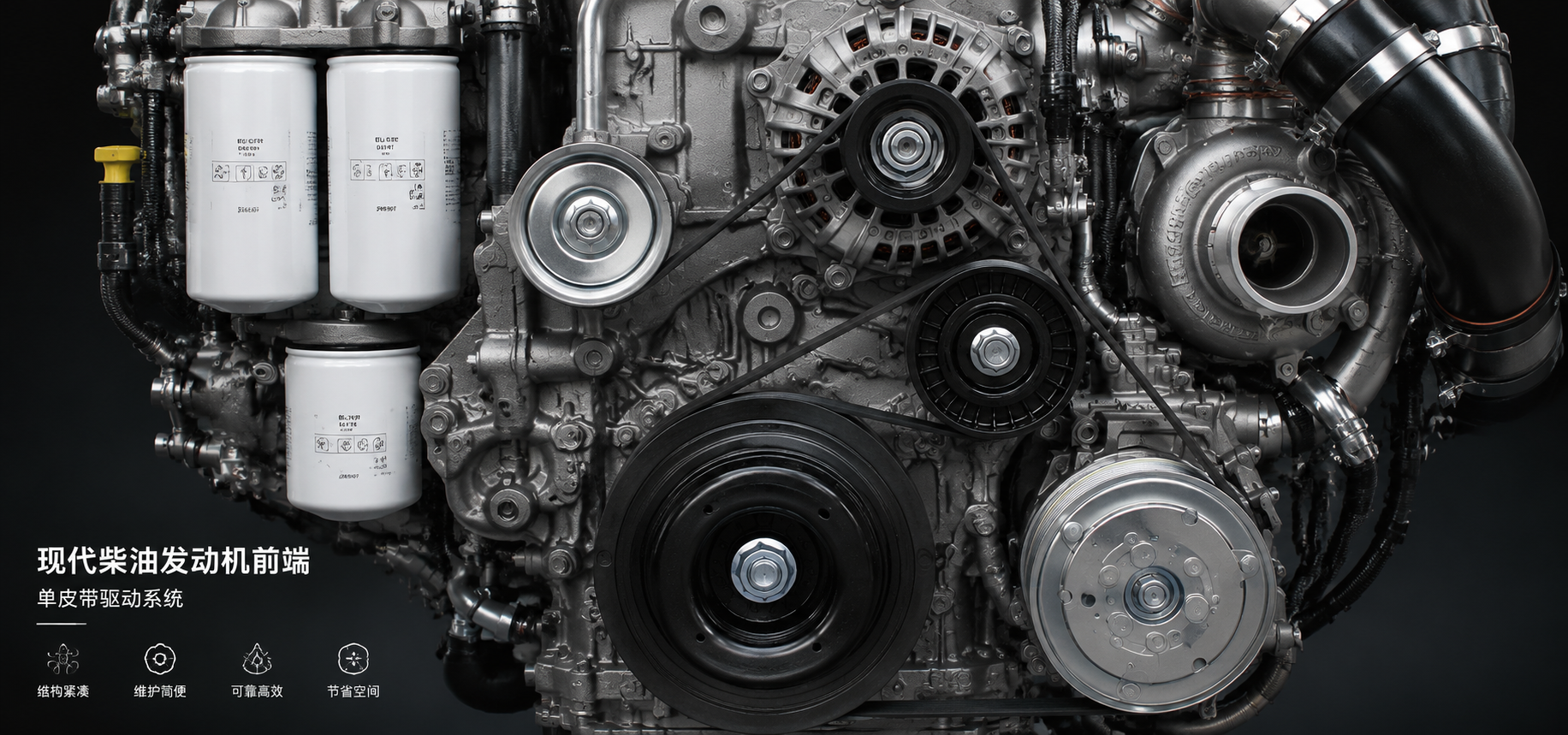
The Beauty of a Clean Engine Front End
When you look at the front end of a well-designed modern diesel engine, the first thing you may notice is what is not there. No tangle of multiple belts. No clutter of brackets and tensioners supporting a web of auxiliary drives. No labyrinth of pulleys and idlers that seems to exist primarily to complicate maintenance. Instead, the layout is clean, organized, and immediately comprehensible.
In one representative example of modern engine front-end design, a single belt connects and drives five major components: the compressor, alternator, fan, crankshaft, and water pump. On this side of the engine, apart from three oil filter elements and a turbocharger, the layout is remarkably uncluttered. This is not an accident. It is the result of deliberate engineering choices that prioritize functionality, serviceability, and reliability.
This article examines the principles behind clean engine front-end design and explains why simplicity at the front of the engine translates into tangible benefits for equipment operators and maintenance teams.
The Single-Belt Drive System: How It Works
One Belt, Five Components
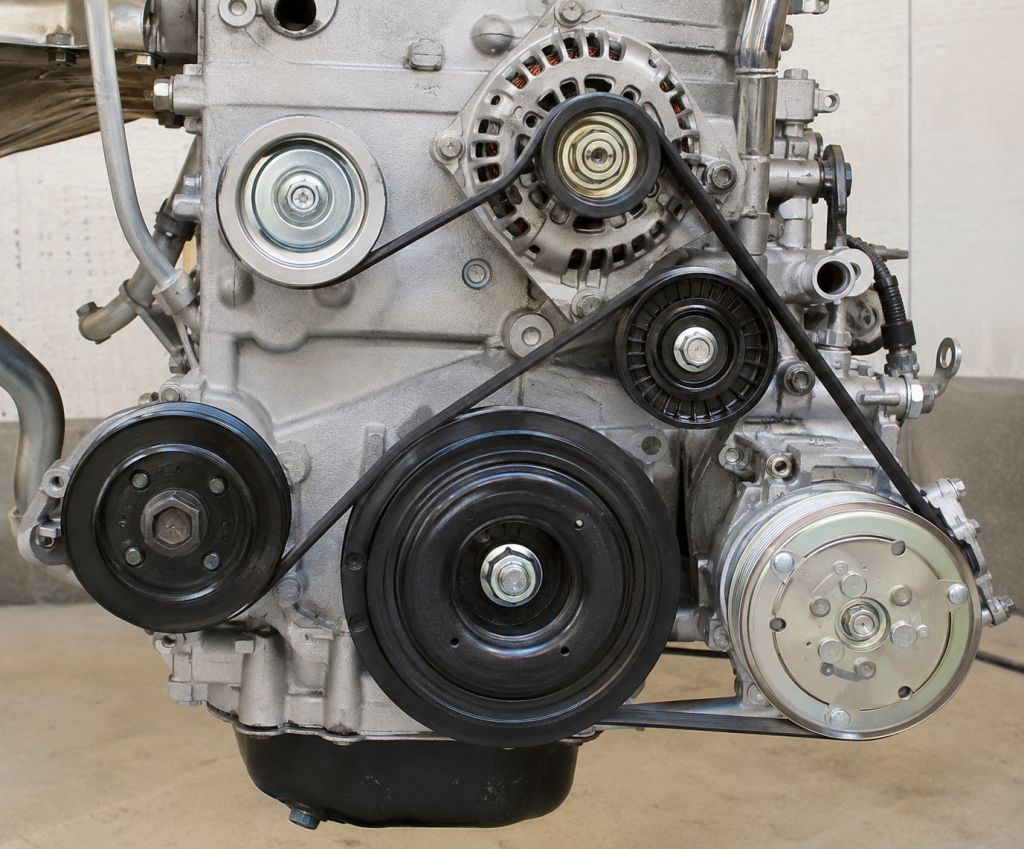
The front-end accessory drive system on a modern diesel engine typically needs to power several auxiliary components:
- Compressor: Provides compressed air for brake systems (in commercial vehicles) or pneumatic systems (in construction equipment)
- Alternator: Generates electrical power to charge the battery and supply the vehicle’s electrical systems
- Fan: Drives the engine cooling fan to maintain operating temperature
- Water pump: Circulates coolant through the engine block and radiator
- Crankshaft: Serves as the drive source for the belt system, transferring engine power to the accessories
In older or less sophisticated engine designs, these components might be driven by multiple belts — one for the alternator, another for the water pump and fan, yet another for the compressor. Each belt requires its own tensioner, its own set of pulleys, and its own maintenance schedule. Multiple belts mean multiple potential failure points and a more complex routing path that can be difficult to service.
The single-belt approach — typically using a serpentine belt or a multi-rib belt — replaces this complexity with one continuous belt that routes around all five component pulleys in a specific path. A single automatic tensioner maintains proper belt tension throughout the belt’s service life.
The Engineering Behind Single-Belt Integration
Making a single-belt system work requires careful engineering. The belt must be capable of transmitting sufficient torque to drive all five components simultaneously, including the high-load compressor during its compression cycle and the alternator under peak electrical demand. The belt’s cross-section, material composition, and rib profile must be selected to handle the combined load without slipping, excessive wear, or premature failure.
The routing path must be designed so that the belt has adequate wrap angle around each pulley. The wrap angle — the portion of the pulley circumference that the belt contacts — determines how much torque can be transmitted without slipping. Components with high torque demands, such as the compressor, require a larger wrap angle than lightly loaded components.
The tensioner must be positioned to maintain consistent tension across all operating conditions, including engine speed changes, temperature variations, and belt stretch over time. An improperly positioned or specified tensioner can result in belt slip, noise, or accelerated wear.
Why Simplicity at the Front End Matters
Fewer Components, Fewer Failure Points
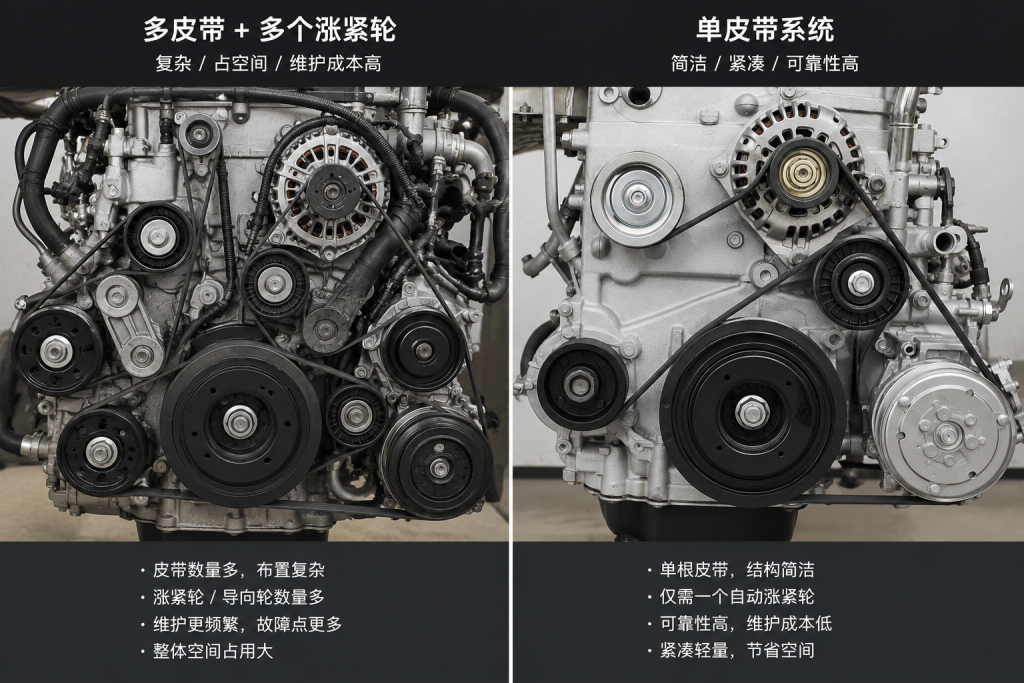
Every component in an engine system represents a potential failure point. Every belt, every tensioner, every pulley bearing, every bracket is a part that can wear, loosen, break, or fall out of adjustment. When you reduce the number of components, you reduce the number of ways the system can fail.
A single-belt system with five driven components and one tensioner has significantly fewer failure points than a three-belt system driving the same five components. The single-belt system has:
- One belt instead of three
- One tensioner instead of three
- Fewer idler pulleys
- A simpler bracket structure
This reduction in part count translates directly into improved reliability. The probability of a belt-related failure in any given operating period is lower with one belt than with three, simply because there are fewer belts to fail.
Maintenance Accessibility
A clean front-end layout is easier to service. With a single belt, maintenance personnel can:
- Inspect the belt visually: One belt is easy to examine for cracks, fraying, glazing, or contamination
- Replace the belt quickly: A single belt can be removed and installed in a fraction of the time required for a multi-belt system
- Tension the belt automatically: The automatic tensioner eliminates the need for manual tension adjustment, removing a source of maintenance error
- Access other components: With fewer brackets and pulleys in the way, the compressor, alternator, and water pump are more accessible for inspection or replacement
In construction machinery and commercial vehicle applications, where maintenance downtime directly affects productivity, this accessibility has real economic value. An engine that can be serviced quickly returns to operation sooner.
System-Level Reliability
The single-belt system’s reliability benefit extends beyond the belt itself. Consider the accessories it drives:
- The water pump is critical for engine cooling. If the water pump drive fails, the engine will overheat rapidly, potentially causing severe damage.
- The alternator is critical for electrical system function. If the alternator drive fails, the battery will discharge and the engine will eventually stop.
- The compressor is critical for brake systems in commercial vehicles and pneumatic systems in construction equipment. If the compressor drive fails, the vehicle or machine may become unsafe to operate.
- The fan is critical for cooling, particularly in construction machinery that operates at low speeds or in high-temperature environments.
A drive system that is simple, well-designed, and reliable ensures that these critical accessories continue to function. The single-belt approach, when properly engineered, provides this reliability through a straightforward, proven mechanism.
The Rest of the Front End: Clean and Functional
Oil Filter Elements
Beyond the belt drive system, the front end of the engine in this example houses three oil filter elements. The placement of the filters on the front of the engine is intentional — it provides easy access for routine filter changes, one of the most frequent maintenance tasks on any diesel engine.
Having the filters grouped together on the front face, in an uncluttered area, means that a technician can perform an oil and filter change quickly and without navigating around other components. The three-filter configuration (typically a full-flow oil filter, a bypass filter, and possibly a fuel filter) provides comprehensive filtration to protect the engine’s lubrication system.
Turbocharger
The turbocharger, also mounted on the front end in this layout, is the engine’s forced-induction component. It uses exhaust gas energy to compress intake air, increasing the mass of air entering the cylinders and allowing the engine to burn more fuel per cycle, thereby producing more power from a given displacement.
The turbocharger’s placement on the front end, alongside the belt drive and filters, represents a packaging decision that balances several factors: exhaust routing from the manifold, intake air path to the cylinders, cooling considerations, and service accessibility. A clean layout ensures that the turbocharger’s compressor inlet and outlet connections are accessible for inspection and that the turbocharger itself can be removed for service if needed.
What Is Not There
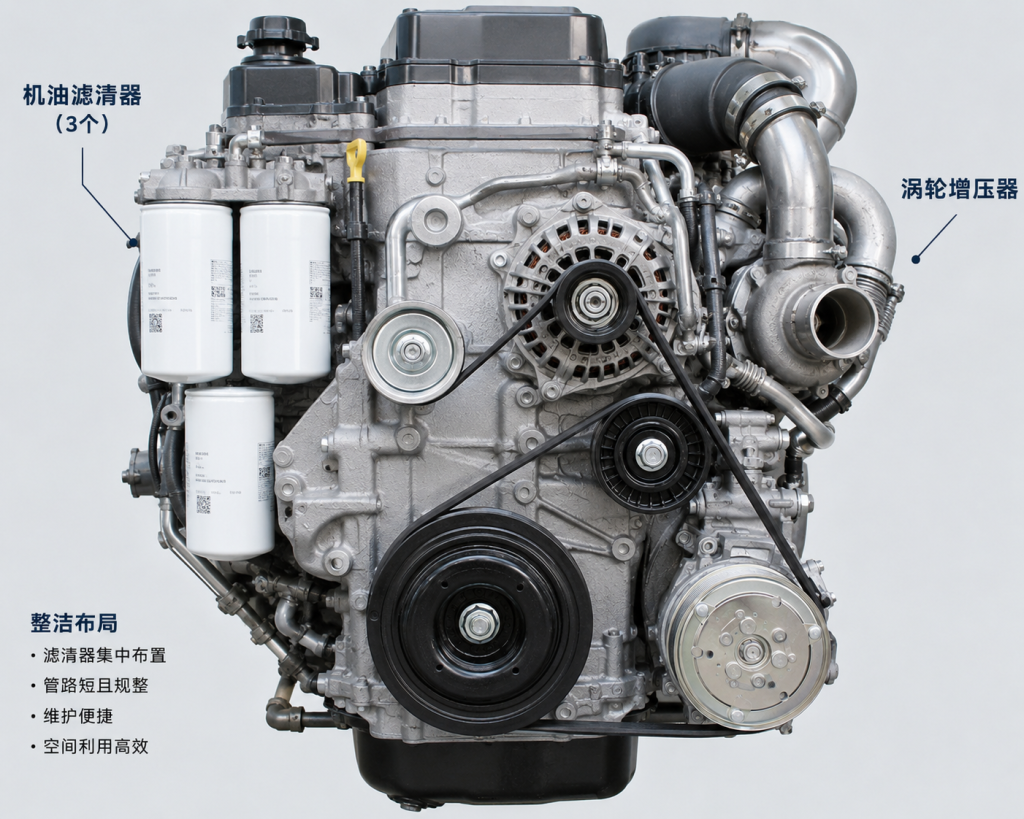
The clean appearance of this engine’s front end is partly defined by what is absent. There is no clutter of redundant brackets. No secondary belt system. No awkwardly positioned components that require special tools or contortionist maneuvers to access. The layout reflects a design philosophy that treats serviceability as a first-tier engineering requirement, not an afterthought.
The Design Philosophy: Functionality Through Simplicity
Intentional Minimalism
The single-belt, five-component layout is an example of what engineers call elegant simplicity — achieving the required functionality with the minimum necessary complexity. Every component in the system serves a defined purpose. There are no redundant parts, no unnecessary brackets, and no overly complex routing paths.
This approach stands in contrast to designs that accumulate complexity over time — where each new requirement results in an additional bracket, an additional pulley, or an additional belt. The clean front-end design starts from a system-level perspective: what components need to be driven, what is the most efficient way to drive them, and how can the layout be optimized for both function and service?
Fewer Failure Points, Better Reliability
The relationship between component count and reliability is well established in engineering. This principle, sometimes expressed as “the simplest solution is usually the best,” is not about cutting corners or reducing capability. It is about designing systems where every component earns its place.
On the engine front end, each eliminated component:
- Removes a potential failure point
- Eliminates a maintenance task
- Reduces parts inventory requirements
- Simplifies the overall system architecture
Easier Maintenance Access
A clean front-end layout means that maintenance personnel can see and reach the components they need to service. This is not just about convenience. Poor maintenance access leads to:
- Deferred maintenance: If a component is difficult to access, maintenance may be postponed, increasing the risk of failure
- Incomplete inspections: If components are hidden behind brackets and pulleys, visual inspections may miss developing problems
- Longer service times: Each additional minute spent navigating around obstructions is a minute of lost productivity
The clean layout eliminates these issues. Every component is visible, accessible, and serviceable without unnecessary disassembly.
How Front-End Design Reflects Overall Engine Quality
The front end of an engine is, in many ways, a window into the manufacturer’s engineering philosophy. A cluttered, over-complex front end suggests a design process that added components without integrating them into a coherent system. A clean, well-organized front end suggests a design team that understood the system as a whole and optimized each element’s role within it.
For engine component manufacturers like Changwei, understanding front-end design is part of understanding the engine as a complete system. A flywheel, a gear ring, or a flywheel housing does not exist in isolation — it is part of an integrated powertrain where every component affects and is affected by the others. Learn more about Changwei’s engineering capabilities and how a system-level understanding of engine design informs every component the company manufactures.
Conclusion
The single-belt, five-component front-end design represents a principle that extends far beyond engine accessories: simplicity is a feature, not a compromise. By driving the compressor, alternator, fan, crankshaft, and water pump with one belt — and by keeping the surrounding layout clean and uncluttered — the design achieves reliability, serviceability, and functional elegance simultaneously.
This is the kind of engineering thinking that distinguishes a well-designed engine from a merely functional one. It is also the kind of thinking that should inform the selection of every component in the powertrain, from the front-end belt system to the flywheel at the rear. When simplicity, functionality, and reliability are designed in from the start, the result is an engine — and a machine — that performs consistently and can be maintained efficiently throughout its service life.
For more technical insights on engine design and component engineering, visit the Changwei blog.
About Changwei: Weifang Changwei Intelligent Equipment Co., Ltd. is an IATF 16949 certified engine flywheel manufacturer based in Weifang, China. With 40,000 sqm production facility and 20+ years of engineering expertise, Changwei supplies flywheels, gear rings, and housing parts to customers in 20+ countries. Contact us for OEM/ODM flywheel solutions.