
Cast Iron vs Steel Flywheels: Which Should You Choose?
Cast Iron vs Steel Flywheels: Which Should You Choose?
When buyers spec a flywheel, the material question comes up fast: cast iron or steel? Both are real options, and neither is universally “better.” The right answer follows what the engine does — its speed, its duty cycle, and how much weight and cost the application can carry. We are an IATF 16949 certified iron foundry, so cast iron is our home ground, but we work with customers who run steel flywheels too. This article lays out the trade-offs plainly so you can choose without guessing.
Table of Contents
- What a Flywheel Must Do
- Cast Iron Flywheels
- Steel Flywheels
- Head-to-Head Comparison
- When to Choose Cast Iron
- When to Choose Steel
- How Casting Quality Affects Flywheel Life
- Material and Price Reference
- Selection Tips for Buyers
- FAQ
- Talk to Our Engineering Team
What a Flywheel Must Do
A flywheel stores rotational energy between power strokes, smooths the torque pulses of a reciprocating engine, carries the ring gear for the starter, and often carries the clutch friction surface on manual transmissions. Two of those jobs — smoothing pulses and absorbing vibration — favor a material that damps vibration well. The other jobs — carrying load and resisting impact — favor strength. Material choice is the balance between those needs.
Cast Iron Flywheels
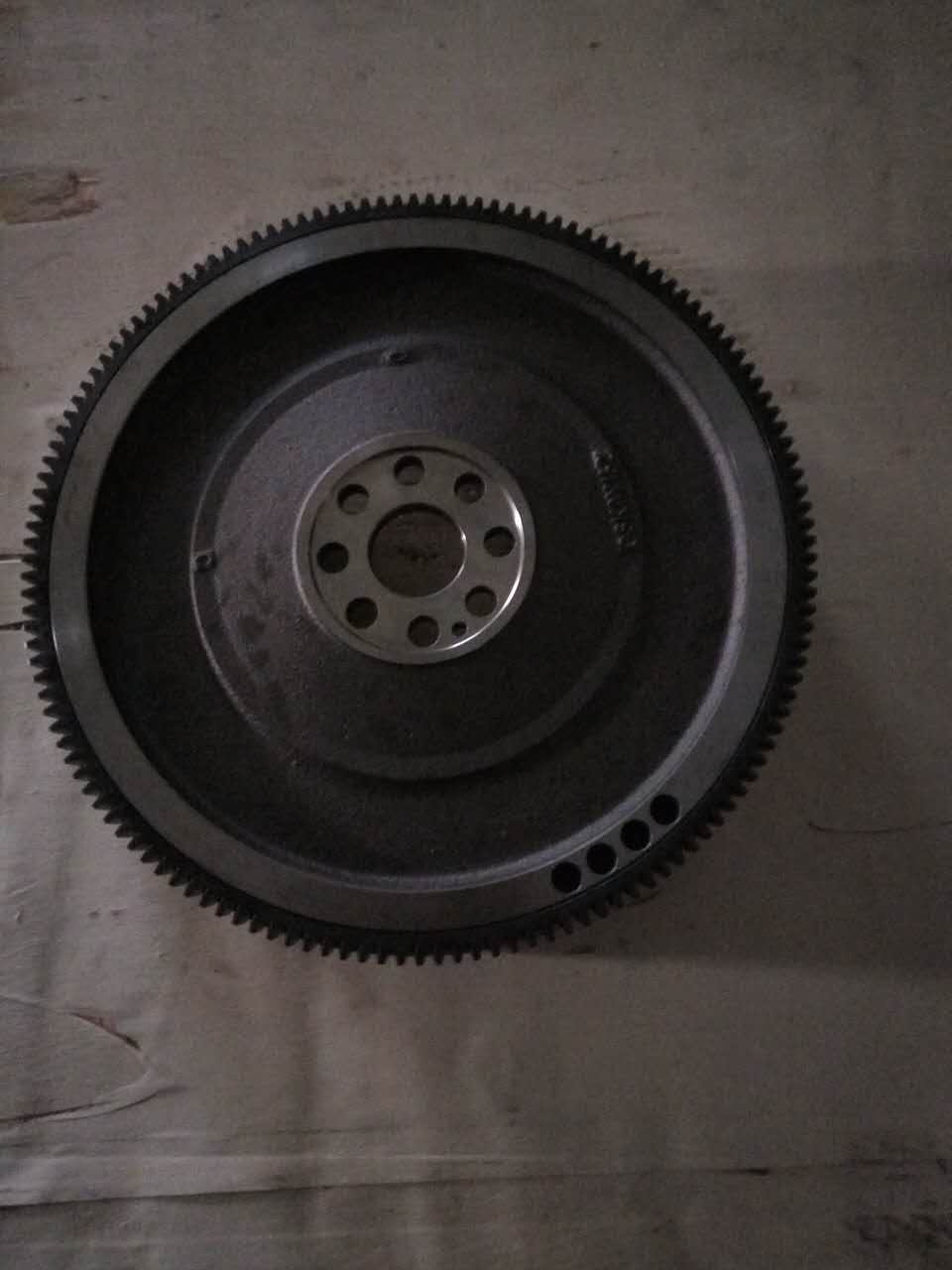
Most flywheels in the world are cast iron. The two common grades are gray iron (such as GG25 / HT250) and ductile (spheroidal graphite) iron (such as QT500 / QT600). Gray iron is the default for the bulk of commercial and industrial flywheels because it is cheap, easy to cast into a complex shape in one shot, and naturally damps vibration. Ductile iron is used where the flywheel also sees bending or impact loads, because its graphite structure gives it much higher toughness than gray iron.
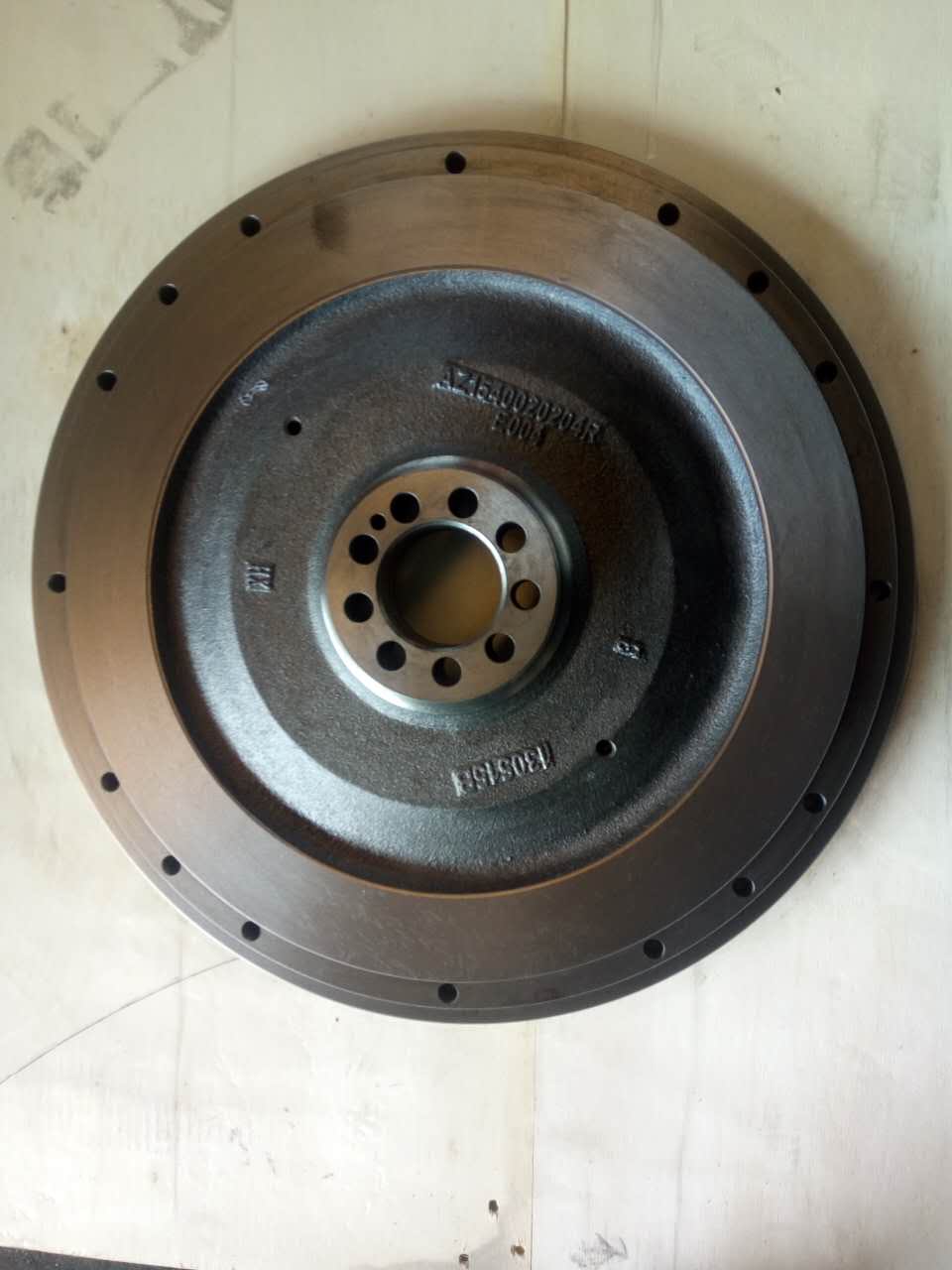
For a typical truck, agricultural, or generator-set engine, a cast iron flywheel is the pragmatic choice. It is quiet in operation, stable under the steady pulsation of a diesel, and inexpensive enough to keep the whole powertrain affordable.
Steel Flywheels
Steel flywheels come in two forms: stamped-and-welded (a thin steel disc with a welded ring gear, common in passenger cars) and forged (a solid billet, used in performance and racing). Steel’s advantage is strength-to-weight: for the same energy storage you can make a steel flywheel lighter, or for the same weight make it stronger. That matters when engine speed is high or when every kilogram of rotating mass hurts acceleration.
The cost is real, though. Steel flywheels cost more to make, weld, and machine, and a stamped steel disc damps vibration poorly compared with cast iron, so it leans on the clutch and driveline to absorb what the iron flywheel would have soaked up.
Head-to-Head Comparison
| Property | Cast iron (gray / ductile) | Steel (stamped / forged) |
|---|---|---|
| Vibration damping | Excellent (gray iron best) | Poor to moderate |
| Cost | Low | Higher (welding / forging) |
| Strength-to-weight | Moderate | High |
| Complex shape in one piece | Easy (casting) | Harder (welded assemblies) |
| Machinability | Very good | Good |
| Typical use | Truck, bus, tractor, genset, marine | Passenger car, performance, racing |
| Service temperature | Stable for normal duty | Better for very high RPM |
When to Choose Cast Iron
- Commercial vehicles, buses, and heavy trucks — the dominant flywheel market.
- Agricultural and construction equipment running at moderate speed.
- Diesel generator sets, where low noise and low cost matter more than shaving weight.
- Engines where the flywheel also needs integral features (pilot bearing boss, clutch bosses) cast in one piece.
When to Choose Steel
- High-RPM gasoline performance engines where rotating mass hurts response.
- Racing and motorsport where every kilogram is budgeted.
- Applications where a very thin, light disc is required by packaging.
- Cases where the flywheel must double as a flexplate in an automatic transmission.
How Casting Quality Affects Flywheel Life
A cast iron flywheel lives or dies on foundry discipline. Three things decide service life:
- Balance — an unbalanced flywheel shakes the whole driveline. We balance every finished flywheel to a specified grade and mark the light spot.
- Hardness and microstructure — the friction face and ring gear seat need a consistent hardness; a soft or inconsistent spot wears fast.
- Porosity and inclusions — a void near the bolt circle or pilot bore is a crack waiting to start. We control this with gating design, melting practice, and inspection.
This is where certification matters. An IATF 16949 foundry runs controlled melting, periodic metallography, and documented inspection, so the material you spec is the material you get — batch after batch.
Material and Price Reference
Flywheel price tracks diameter, weight, material grade, and machining. Market reference ranges:
- Cast iron flywheel (light, under 5 kg, single-cylinder / micro-tiller): USD 14–30 per piece
- Cast iron flywheel (medium, 10–30 kg, truck / industrial): USD 30–150 per piece
- Cast iron flywheel (heavy, 30–150 kg, industrial / marine): USD 150–600 per piece
- Steel stamped flywheel (passenger car): roughly USD 20–80 per piece
- Steel forged flywheel (performance): typically USD 150–400+ per piece
These are market reference prices, not our quotation. Final FOB Qingdao price depends on grade, balance grade, machining, certification, and volume. MOQ is typically 20 pieces. Send us your drawing or sample for a real number.
Selection Tips for Buyers
- State the engine application and redline RPM before discussing material.
- For trucks, gensets, and farm equipment, start from cast iron — it is almost always right.
- Only move to steel when weight or very high RPM is a hard constraint.
- Specify the balance grade and the required hardness band in writing.
- Ask for material certification and a first-article report on a new flywheel.
- Confirm the ring gear is supplied with the flywheel, and to what hardness.
FAQ
Is cast iron strong enough for a truck flywheel?
Yes. Gray and ductile iron flywheels have carried trucks, buses, and generators for decades. For engines where the flywheel also sees impact or bending, ductile iron is specified instead of gray iron for its toughness.
Why are steel flywheels more expensive?
Stamped-and-welded or forged steel takes more processing than a single iron casting, and the material itself costs more. You pay for the strength-to-weight advantage, not for a longer service life in normal duty.
Can a cast iron flywheel be used on a performance engine?
It can, but a performance engine that revs very high or needs minimum rotating mass usually benefits from a lighter steel or billet flywheel. For street and moderate-performance use, a well-made cast iron flywheel is fine.
Which damps vibration better?
Cast iron, especially gray iron, damps vibration far better than steel. That is why diesel commercial engines almost universally use cast iron flywheels — they run smoother and put less stress on the clutch and driveline.
Do you make both cast iron and steel flywheels?
We specialize in cast iron flywheels (gray and ductile) and the matching ring gears, supplied to drawing or sample. For steel flywheel sourcing we can advise on specification and help you qualify a supplier.
What is the usual MOQ and lead time?
MOQ is typically 20 pieces for standard items and higher for fully custom profiles. Lead time depends on whether a pattern or tool already exists; send the drawing for a firm date.
How do you guarantee the cast iron grade?
We melt to a controlled chemistry, run spectrometer checks per heat, perform periodic metallography, and issue material certificates. As an IATF 16949 foundry, these controls are part of our system, not a one-off.
Talk to Our Engineering Team
Need a Cast Iron Flywheel Quote?
Send us your drawing, sample, or OEM number and we will return a matched quote with material grade, balance grade, and inspection plan. We are an IATF 16949 certified iron foundry, FOB Qingdao.
- Email: [email protected]
- Phone / WeChat / WhatsApp: +86 19953662121
- Factory: Changyi Wangke Industrial Zone, Weifang, Shandong, China
- Request a quote online
Related reading: Flywheel product page · Ring Gear product page