
Diesel Generator Set Cast Iron Parts: Block, Flywheel & Gear Housing Guide
Diesel Generator Set Engine Castings: How Core Iron Parts Decide Reliability
A diesel generator set looks like a simple metal box that turns diesel fuel into electricity. Open the enclosure and you find a diesel engine bolted to an alternator on a steel skid. The engine itself is a precision assembly of iron castings, and those castings are where most long-term reliability is won or lost.
We are an IATF 16949 certified iron foundry. We do not assemble complete generator sets. We cast the core components that go into them: cylinder blocks, flywheels, timing gear housings, exhaust manifolds and bearing housings. From that supplier seat, this article explains how each casting influences a genset’s reliability and service life — and what a buyer should ask for when sourcing these parts.
Table of Contents
- What a Diesel Generator Set Runs On
- Why Cast Iron Is the Backbone of Genset Engines
- Cylinder Block — the Structural Core
- Flywheel — Smoothing Rotation and Coupling to the Alternator
- Timing Gear Housing — Protecting the Timing Train
- Exhaust Manifold — Heat and Thermal Fatigue
- Bearing Housing — Supporting the Rotating Shafts
- Gray Iron vs Ductile Iron: Which for Which Part
- How Casting Quality Affects Genset Service Life
- Material and Price Reference
- Selection and Maintenance Tips
- FAQ
- Talk to Our Engineering Team
What a Diesel Generator Set Runs On
A genset has four working layers: the diesel engine (conversion of fuel to mechanical rotation), the alternator (mechanical rotation to electricity), the control system, and the base frame or enclosure. The engine is the part with the longest list of iron castings, and it is the layer most exposed to heat, pressure and vibration.
When a generator set fails in the field, the root cause is often not the electronics. It is a cracked manifold, a warped block face, a flywheel that was never properly balanced, or a gear housing that let contamination into the timing train. Those are casting and machining issues. That is why the iron parts deserve attention before the unit ever leaves the factory.
Why Cast Iron Is the Backbone of Genset Engines
Cast iron dominates engine construction for two reasons that matter for generators specifically.
First, gray iron dampens vibration. A running diesel produces strong, repeating combustion pulses. Gray iron’s graphite structure absorbs that energy instead of passing it through the structure. On a genset, where the engine sits on a skid and feeds an alternator, that damping protects every nearby component.
Second, ductile iron carries load. Where a part must resist pulling force, impact or thermal stress, ductile (nodular) iron delivers tensile strength and elongation that gray iron cannot match. Flywheels and exhaust manifolds are typical ductile-iron parts.
A foundry’s job is to choose the right iron for each function and then control the process so every casting meets that spec. For a genset buyer, the practical question is simple: which iron, to what grade, with what proof.
Cylinder Block — the Structural Core
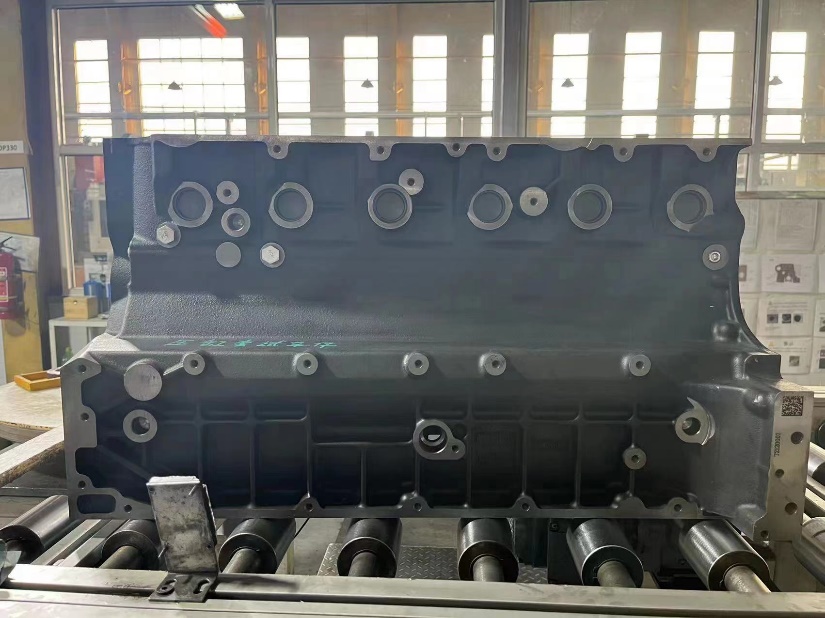
The cylinder block is the largest and most complex casting in the engine. It holds the cylinders, supports the crankshaft, carries cooling water and lubrication passages, and absorbs combustion pressure on every power stroke.
For generator-set engines, the block usually uses gray iron such as HT250 or HT300, where vibration damping and machinability matter more than raw strength. Higher-duty blocks may use ductile iron. The block’s stiffness decides how much the engine flexes under load; flex translates into bore wear, oil consumption and noise.
Common block problems we see in the field include porosity from unstable pouring, hard spots that break tools, and warped mating faces that cause head gasket leaks. A block that is sound at the foundry saves the buyer from compression loss and coolant leaks later.
Flywheel — Smoothing Rotation and Coupling to the Alternator
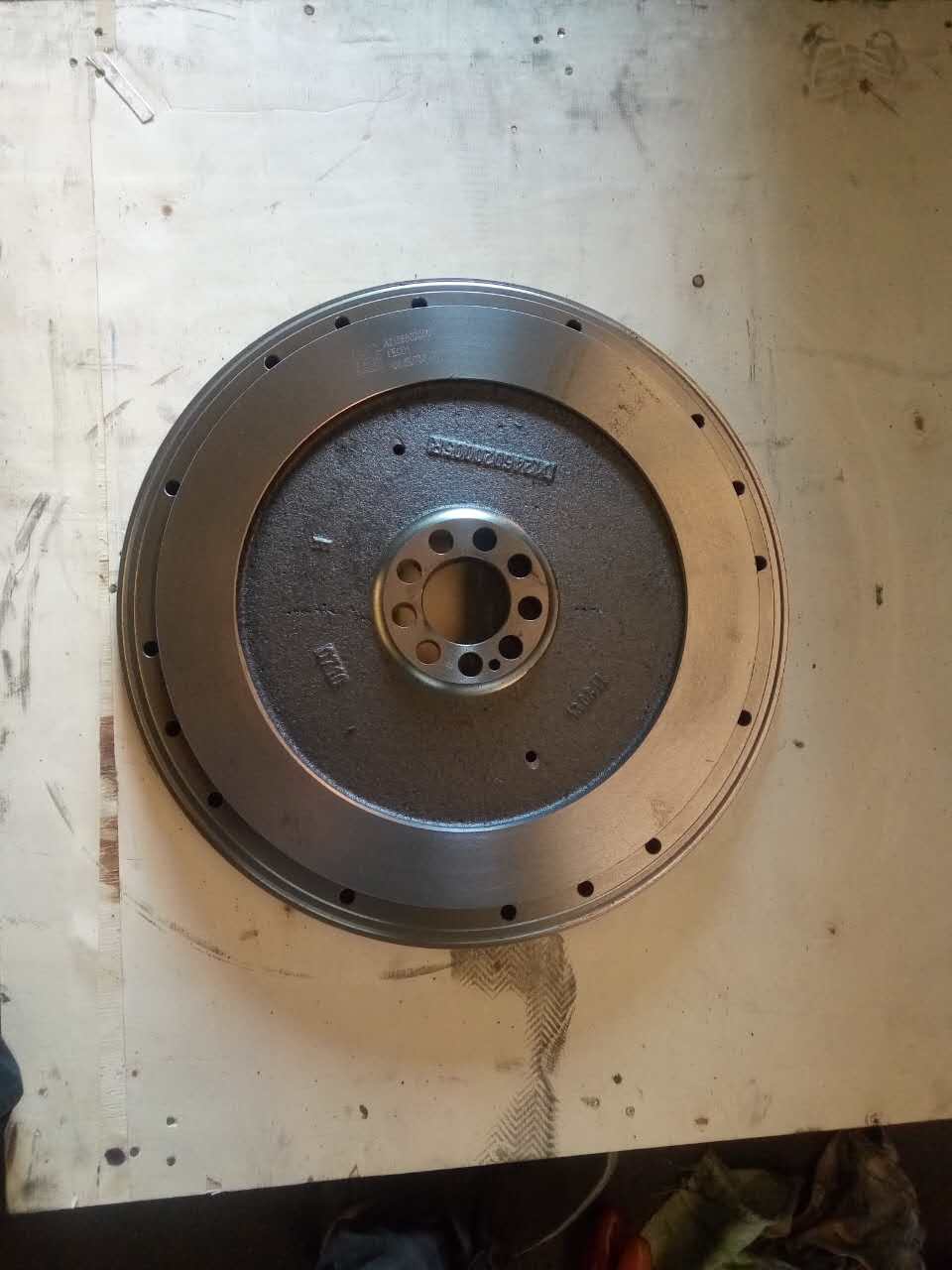
The flywheel bolts to the crankshaft and stores rotational energy between combustion pulses, so the output speed stays even enough to drive the alternator. On a genset it also carries the ring gear for the starter and often the coupling flange to the alternator.
Flywheels are normally ductile iron, grades such as QT450 or QT500, because they need both strength and some damping. The single most important quality factor is dynamic balance. An unbalanced flywheel sends vibration through the crankshaft and alternator, wears bearings and produces unstable electrical output.
A good genset flywheel is cast to a consistent weight, machined to tight runout, and balanced to a defined grade. When sourcing, ask for the balance grade and the SAE or custom flange pattern, because the flywheel must match the alternator coupling.
Timing Gear Housing — Protecting the Timing Train
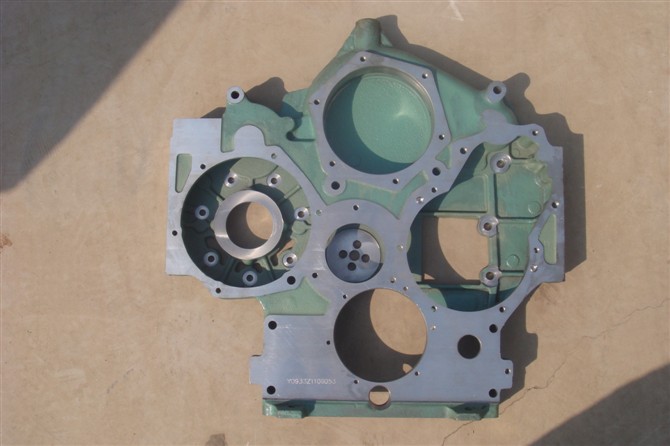
The timing gear housing encloses the gears or chain that keep the crankshaft and camshaft in phase. It also seals the front of the engine, locates sensors, and keeps dust and moisture away from the timing train.
This housing is usually gray iron with relatively thin walls, so dimensional stability is the key property. If the housing warps during cooling or machining, the front cover face goes out of flat, the gears mesh incorrectly, and the result is whine, rapid wear or, in the worst case, timing failure.
Because the housing sets the position of several moving parts, we treat bore position and flatness as critical characteristics and verify them on every batch.
Exhaust Manifold — Heat and Thermal Fatigue
The exhaust manifold collects hot gas from the cylinders and routes it to the turbocharger or exhaust pipe. In a genset it can sit at 600 to 900 degrees Celsius under cyclic load, which is the hardest thermal condition in the whole engine.
Manifolds are normally ductile iron, and for high-temperature duty a silicon-molybdenum (SiMo) grade is common because it resists creep and oxidation. The typical failure is cracking from repeated heating and cooling, especially where wall thickness changes suddenly.
We produce exhaust manifolds to customer drawings and samples. Because the product library does not yet have manifold photos published, we supply them on request with drawings and material certificates rather than a stock catalog image.
Bearing Housing — Supporting the Rotating Shafts
Bearing housings (bearing seats) hold the bearings that support rotating shafts such as the crankshaft and camshaft. Their job is to keep those shafts in exact alignment under load and temperature change.
These are usually gray iron parts with a precisely machined bore and bolt pattern. The failure mode is gradual: bore wear or distortion lets the shaft move, which grows vibration and accelerates every other wear path in the engine. For a generator set that may run for thousands of hours, bore stability directly protects uptime.
Bearing housings are made to drawing, and we supply them alongside blocks, flywheels and gear housings as part of a matched iron-parts package.
Gray Iron vs Ductile Iron: Which for Which Part
| Property | Gray Iron (e.g. HT250) | Ductile Iron (e.g. QT450/500) |
|---|---|---|
| Vibration damping | Excellent | Good |
| Tensile strength | Moderate | High |
| Elongation | Near zero | 10 to 18 percent |
| Machinability | Very good | Good |
| Relative cost | Lower | Higher |
| Typical genset use | Cylinder block, gear housing, bearing seat | Flywheel, exhaust manifold, high-stress brackets |
The choice is not “better or worse.” It is fitness for function. A block wants damping; a flywheel wants strength with some damping; a manifold wants heat resistance. Specifying the right grade is the first step to a reliable genset.
How Casting Quality Affects Genset Service Life
Casting quality shows up in ways a photo cannot capture:
- Porosity and inclusions become crack starters under heat and pressure.
- Inconsistent hardness makes machining unpredictable and leaves residual stress.
- Dimensional drift forces extra machining and weakens walls.
- Poor balance in a rotating part spreads vibration to the whole set.
As an IATF 16949 certified foundry, we run controlled processes with material certification, dimensional reports and batch traceability. For buyers, that means a casting arrives with proof of what it is, not just a promise. Related reading: our note on why IATF 16949 matters for engine parts and our guide to flywheel housing function and failure signs.
Material and Price Reference
The table below is a market-tested reference range, not an official quotation. Final price depends on weight, grade, machining and order volume. All prices are reference only and subject to factory quotation.
| Component | Common material | Reference price (USD/pc) | MOQ |
|---|---|---|---|
| Cylinder block | Gray / ductile iron | 30 to 2,000 (by weight) | 20 |
| Flywheel | Ductile iron QT450/500 | 30 to 260 | 20 |
| Timing gear housing | Gray iron | 18 to 45 | 20 |
| Exhaust manifold | Ductile / SiMo iron | 20 to 690 | 20 |
| Bearing housing | Gray iron | 2.3 to 95 | 20 |
Terms: MOQ 20 pieces, FOB Qingdao. Reference prices, subject to factory quotation.
Selection and Maintenance Tips
- Match the iron grade to the duty. Use gray iron where damping matters, ductile or SiMo where strength or heat resistance matters.
- Ask for material certificates and a dimensional inspection report with the batch, not just a price.
- For flywheels, confirm the dynamic balance grade and the flange pattern before ordering, because it must match the alternator.
- Keep cooling systems healthy. Overheating is the fastest route to a cracked manifold and a warped block face.
- Use the specified bolt torque on block and housing joints; uneven clamping distorts bores and faces.
- For generator-set service, plan bore and balance checks as part of the long-run maintenance schedule.
FAQ
Q: Can you supply complete diesel generator sets?
A: No. We are an iron foundry, not a genset assembler. We supply the core cast components — cylinder blocks, flywheels, timing gear housings, exhaust manifolds and bearing housings — to engine builders and parts distributors.
Q: Which iron is best for a genset flywheel?
A: Ductile iron such as QT450 or QT500 is the usual choice, for strength with some damping, plus verified dynamic balance to match the alternator coupling.
Q: Do you make exhaust manifolds?
A: Yes, to customer drawings or samples, in ductile iron or SiMo grade for high-temperature duty. Manifold photos are shared on request because they are made to order.
Q: What is your minimum order quantity?
A: MOQ is 20 pieces per item, FOB Qingdao, for the iron castings listed above.
Q: Can you match OEM part numbers or our drawings?
A: Yes. We produce both OEM-reference parts and fully custom castings from drawings or samples, including mold development.
Q: What certifications do you hold?
A: We are IATF 16949 certified, with material certification, dimensional reports and batch traceability on request.
Q: How do I get a quote?
A: Send the part name, drawing or sample, required material and quantity to our team. Contact details are below.
Talk to Our Engineering Team
If you build or service diesel generator sets and need reliable iron castings — cylinder blocks, flywheels, timing gear housings, exhaust manifolds or bearing housings — our engineering team can review your drawings and propose a material and process plan.
- Contact: Irene
- Email: [email protected]
- Phone / WeChat / WhatsApp: +86 19953662121
- Factory: Changyi, Weifang, Shandong, China
- Port of shipment: Qingdao (FOB Qingdao)
You can also reach us through our inquiry page or browse our flywheel and flywheel housing product pages for more casting details.