
Flywheel Vibration Diagnosis: Why Start-Up Jerking Is a Clutch Problem, Not a Flywheel Problem
When a vehicle jerks or lurches forward suddenly during start-up — a fault Chinese technicians call “跳头” (jumping head) — many mechanics and owners immediately blame the flywheel. It is one of the most persistent diagnostic errors in clutch and flywheel work, and it leads to flywheels being replaced when the real fault sits next door.
The reality is more precise. Flywheel vibration manifests as mild shaking or tremor. It does not produce the sudden, forceful lurching that characterizes start-up jerking. Knowing which is which saves parts, labor, and downtime.
At Changwei, our engineering team has over 20 years in engine flywheel systems and sees this mistake from customers and technicians constantly. This guide explains the mechanical reason jerking is a clutch problem, what genuine flywheel vibration actually feels like, and a 4-step method to diagnose either one correctly.
Key takeaways:
- Start-up jerking (lurching) is a clutch-engagement problem — the flywheel does not control engagement, so it cannot cause it.
- Genuine flywheel vibration shows up as mild, rhythmic shaking that tracks engine RPM — never a violent forward lurch.
- The flywheel, pressure plate, and clutch disc act as one rotating system; jerking points to the disc and pressure plate, not the flywheel.
- A 4-step method (characterize → isolate → inspect → address) separates the two faults before you pull a single bolt.
Understanding the Clutch–Flywheel–Pressure Plate System
Accurate diagnosis starts with knowing how the three parts interact. They are bolted and splined together, but each has a distinct job.
The Three Components and Their Roles
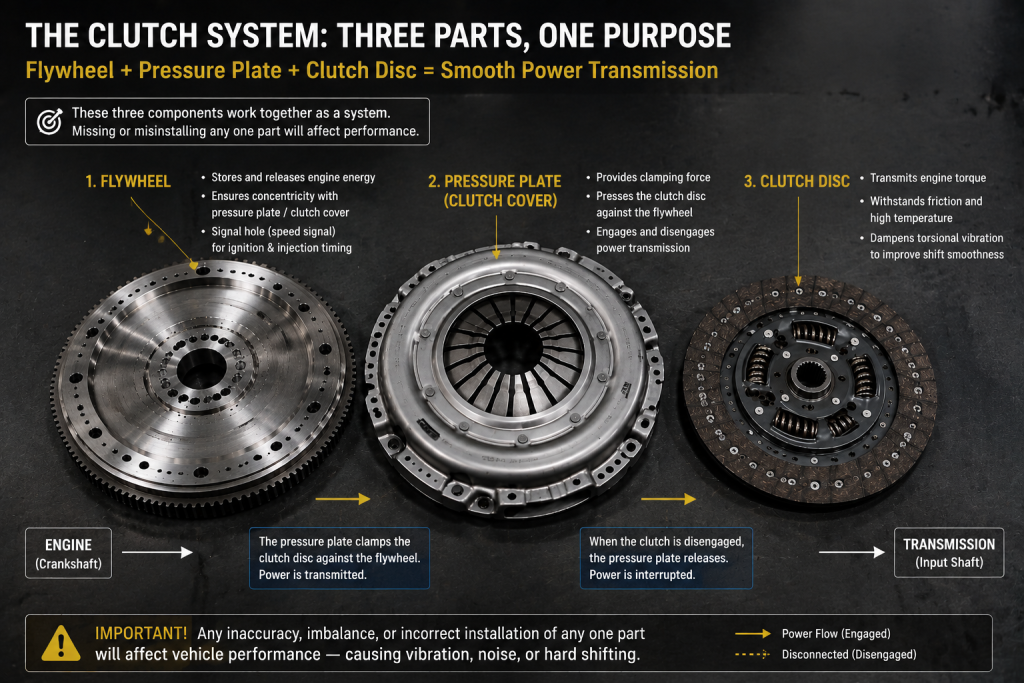
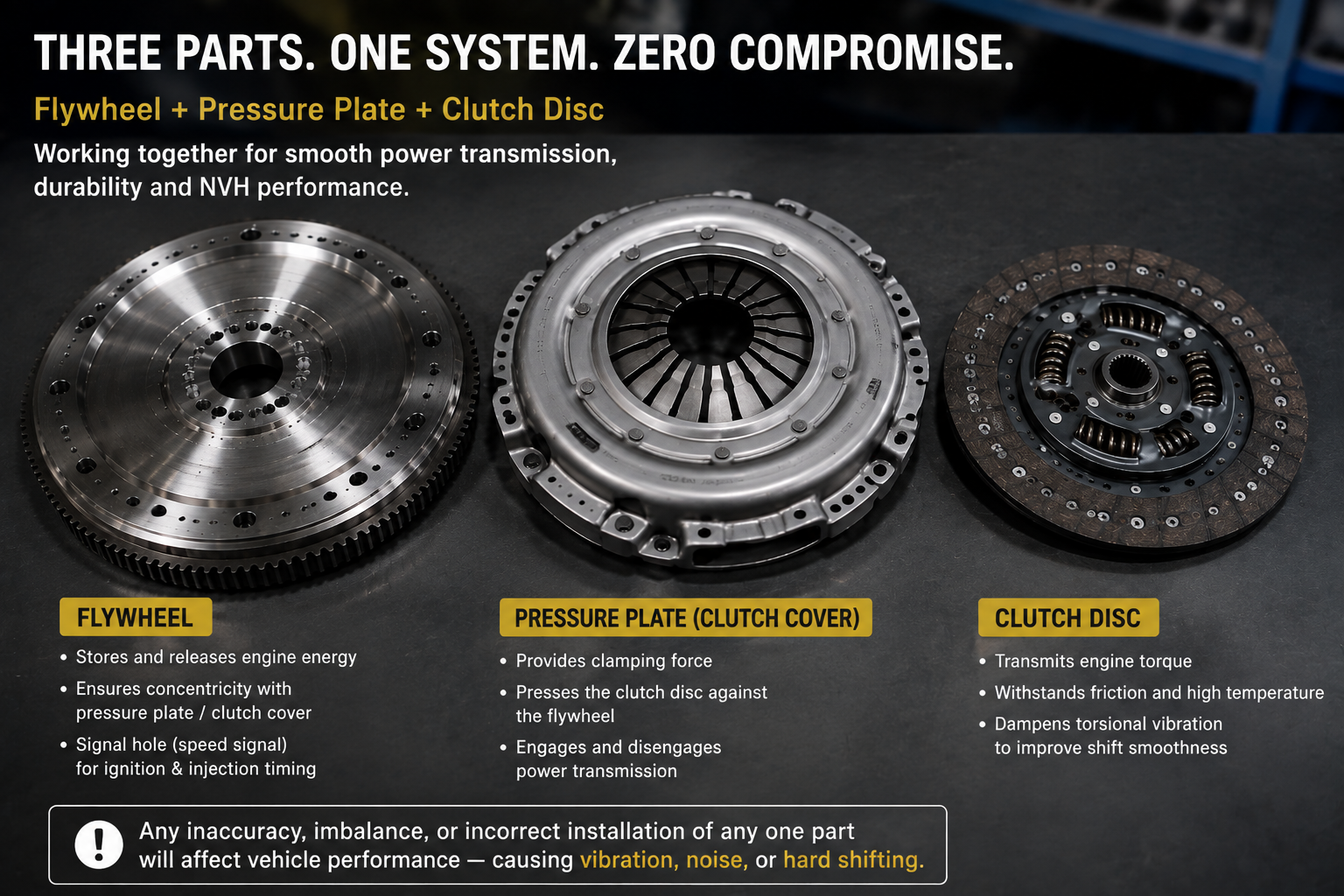
Flywheel — Bolted to the engine crankshaft. It stores rotational energy, provides the friction surface for the clutch disc, smooths out the pulsating power of individual cylinder firings, and carries the starter ring gear. It always turns at engine speed.
Pressure plate (clutch cover) — Bolted to the flywheel. Its diaphragm or coil springs apply clamping force that presses the clutch disc against the flywheel friction surface. It rotates with the flywheel.
Clutch disc (friction disc) — Sandwiched between flywheel and pressure plate. It connects to the transmission input shaft via splines and is the component that transmits or interrupts power.
How the System Operates
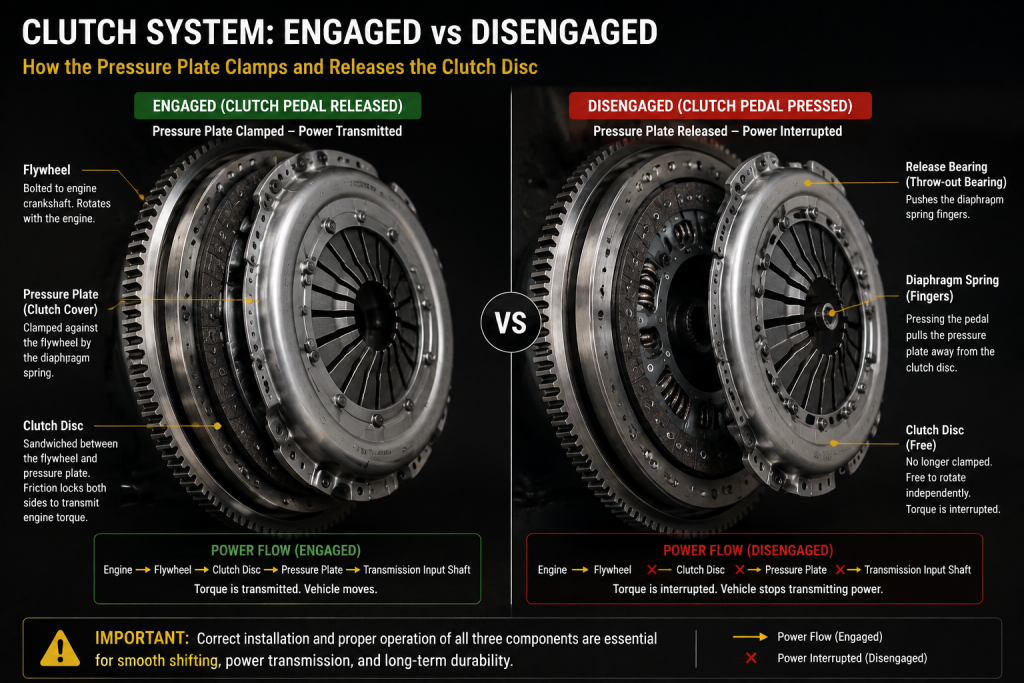
Engaged (pedal up): The pressure plate clamps the clutch disc firmly against the flywheel. All three parts rotate together as a single unit at engine speed, and power flows continuously to the transmission.
Disengaged (pedal down): The release bearing pushes the diaphragm spring fingers, retracting clamp force. The disc is freed and slows or stops with the input shaft, while the flywheel and pressure plate keep spinning at engine speed. That speed difference is what allows clean gear changes.
The crucial point: engagement and disengagement are controlled by the pressure plate and clutch disc. The flywheel only provides a surface.
Why Flywheel Vibration Does Not Cause Jerking
The Flywheel’s Mechanical Role
The flywheel stores energy and provides a machined friction face. It has no mechanism to independently cause a sudden lurch. Its surface quality (flatness, finish, thermal condition) can affect smoothness, but only as mild shaking or chatter — never as violent jerking.
What Flywheel Vibration Actually Feels Like
Genuine flywheel shaking presents as:
- A mild tremor through the floor, seat, or steering wheel
- A consistent, rhythmic shake that correlates with engine RPM
- In severe cases (warped or heat-cracked surface), a chatter during engagement — but it is still a shaking motion, not a lurch
These symptoms usually indicate:
- Friction-surface warping from excess heat
- Glazing or scoring on the friction face
- Loose flywheel-to-crankshaft bolts
- Imbalance from material loss or uneven wear
What Start-Up Jerking Actually Indicates
When a vehicle lurches from a stop, the fault is almost always in the clutch system:
- Clutch disc contamination — oil or grease on the friction material causes grab-and-slip, producing jerky engagement
- Worn or damaged friction material — uneven surfaces transfer power inconsistently
- Pressure plate spring fatigue — weak or broken diaphragm springs cannot hold steady clamp force, causing grabby engagement
- Release mechanism issues — a sticking release bearing, warped fork, or poor adjustment makes the clutch engage abruptly instead of progressively
- Clutch disc damper spring failure — the torsional damper springs absorb shock during engagement; if broken, engagement turns harsh and jerky
Diagnostic principle: jerking is an engagement-control fault. The pressure plate and clutch disc control engagement; the flywheel does not.
Engine Vibration Troubleshooting: A 4-Step Approach
Step 1: Characterize the Symptom
Before opening anything, document:
- Timing — at start-up, during shifts, at idle, or in a specific RPM range?
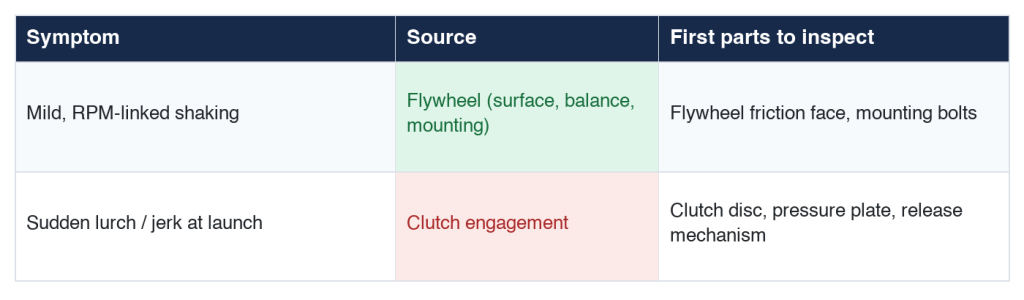
- Character — mild consistent shake (flywheel) or sudden forceful lurch (clutch)?
- Conditions — with pedal pressed, released, or during the transition?
- Severity — all gears, or only specific ones?
Step 2: Isolate the System
- Symptom only during pedal release from a stop → clutch disc, pressure plate, release mechanism
- Consistent vibration at idle or specific RPMs regardless of pedal → flywheel or engine
- Vibration felt mainly through the pedal during engagement → pressure plate irregularities
Step 3: Physical Inspection
- Clutch disc: contamination, uneven wear, damaged damper springs, worn friction material
- Pressure plate: uneven clamp surface, heat marks, cracks, diaphragm finger wear
- Flywheel: warping, heat checking (cracks), glazing, scoring, loose mounting
- Release bearing and fork: smooth operation and proper adjustment
Step 4: Address the Root Cause
Resurface or replace based on findings. Minor surface wear may be restored by professional resurfacing; severe heat cracking, warping beyond limits, or ring gear damage requires replacement.
For a fast triage table that separates idle, acceleration, and launch-shudder vibrations, see our companion guide: Flywheel, Pressure Plate & Clutch Vibration: Quick Diagnosis for 3 Types.
The Cost of Misdiagnosis
Diagnosing start-up jerking as a flywheel fault leads to unnecessary flywheel replacement — and the problem persists, because the real cause is in the clutch. That wastes parts, labor, and downtime.
Conversely, ignoring genuine flywheel vibration (mild shaking) lets a warped or damaged friction surface accelerate clutch disc wear, since it prevents proper engagement and causes uneven friction-material wear over time.
How Changwei Supports Accurate Diagnosis
As an IATF 16949 certified flywheel manufacturer, Changwei’s responsibility is accurate technical information — even when that means telling a customer they do not need to buy a flywheel. Our engineering team, drawing on two decades of engine-component manufacturing, builds flywheels to precise specifications for dynamic balancing, surface finish, and material integrity.
When a flywheel genuinely needs replacement, we supply precision flywheels for Chinese, Japanese, and European engine series — Weichai, Cummins, Hino, Isuzu, Mercedes, Volvo, and Scania among them. When the problem lies elsewhere, we point customers to the correct diagnosis.
FAQ
Why does start-up jerking point to the clutch, not the flywheel?
Because engagement is controlled by the pressure plate and clutch disc. The flywheel only provides a friction surface and rotates with the engine; it has no mechanism to create a sudden lurch. Jerking is an engagement-control fault.
What does real flywheel vibration feel like?
A mild, rhythmic tremor through the floor, seat, or steering wheel that tracks engine RPM. It is shaking, not lurching. Severe cases add chatter during engagement from a warped or heat-damaged surface.
How do I tell flywheel vibration from clutch shudder?
If the shake is present at idle or a fixed RPM regardless of clutch position, suspect the flywheel. If the jerk appears only as you release the pedal from a stop, suspect the clutch disc and pressure plate.
Can Changwei help diagnose a flywheel or clutch issue from a sample?
Yes. Send the part number and, if possible, overhead photographs plus basic measurements. We cross-check against our flywheel database and technical drawings and confirm the exact specification before any production or shipment.
Conclusion
Start-up jerking is a clutch-system problem, not a flywheel problem. Flywheel vibration is mild shaking, not forceful jerking. Understanding the mechanical relationship between flywheel, pressure plate, and clutch disc lets technicians avoid one of the most common diagnostic errors in clutch repair — and deliver accurate, cost-effective fixes.
Need help identifying a flywheel or diagnosing a vibration issue? Contact Changwei’s engineering team — we verify every specification before production so you get it right the first time.
About Changwei: Weifang Changwei Intelligent Equipment Co., Ltd. is an IATF 16949 certified engine flywheel manufacturer based in Weifang, China. With a 40,000 sqm production facility and 20+ years of engineering expertise, Changwei supplies flywheels, gear rings, and housing parts to customers in 20+ countries. Contact us for OEM/ODM flywheel solutions.